Revenue cycle management (RCM) mistakes are one of the biggest reasons healthcare providers experience delayed payments, claim denials, and unnecessary administrative costs.
Common Revenue Cycle Management (RCM) mistakes include inaccurate patient information, medical coding errors, missing modifiers, incomplete documentation, and poor claim denial management.
These issues can lead to revenue loss, delayed reimbursements, and cash flow problems for healthcare organisations.
What Are Common RCM Mistakes? Understanding these errors is essential for medical billing teams because even small administrative or coding issues can disrupt the entire revenue cycle.
Incorrect medical coding, inaccurate patient details, and incomplete documentation can prevent healthcare providers from receiving timely payments and increase the risk of claim rejections.
Revenue cycle management covers every stage of the healthcare payment process, from patient registration and insurance verification to medical coding, claim submission, denial management, and final payment collection.
When one step contains an error, it can affect the entire workflow and create financial challenges for providers.
In this guide, we explore the most common RCM mistakes, why healthcare claims get denied, and practical strategies medical billing teams can use to improve accuracy, reduce claim denials, and strengthen their overall revenue cycle management process.
Table of Contents
What Is Revenue Cycle Management (RCM)?
Revenue cycle management is the end-to-end financial process that tracks a patient’s care journey from appointment booking through to final payment.
It covers registration, coding, billing, and collections, and it exists to make sure providers get paid accurately and on time for the care they deliver.
RCM runs through several connected stages, and a mistake at any one of them ripples through the rest:
- Patient registration and eligibility verification – confirming who the patient is and what their insurance actually covers
- Medical coding – translating clinical documentation into standardised ICD-10, CPT, and HCPCS codes
- Charge capture – recording every billable service performed
- Claim submission – sending accurate, complete claims to the correct payer
- Denial management – identifying, correcting, and resubmitting rejected claims
- Payment posting – reconciling what’s been paid against what was billed
- Patient collections – recovering any balance owed by the patient
Because these stages are sequential, an error early on (say, an eligibility check that misses an expired policy) doesn’t stay contained. It surfaces later as a denial, and by then it costs far more time and money to fix than it would have taken to catch upfront.
What Are the 5 Common Coding Errors in Medical Billing?

The five most common coding errors are incorrect diagnosis coding, upcoding, undercoding, incorrect modifier use, and duplicate or unbundled coding.
Each one either delays payment, triggers a denial, or exposes the practice to a compliance audit, so catching them before submission matters more than fixing them afterwards.
1. Incorrect Diagnosis Coding
This happens when a coder assigns the wrong ICD-10 code, or assigns a diagnosis that isn’t actually supported by the clinical documentation. Payers cross-check diagnosis codes against the procedure billed, so a mismatch is one of the fastest routes to a rejected claim.
The fix isn’t just “code more carefully”. It’s making sure documentation is specific enough to code correctly in the first place. Vague notes force coders to guess, and guessing is where errors creep in.
2. Upcoding Services
Upcoding means billing for a higher-level or more complex service than what was actually delivered, whether intentionally or through carelessness.
Beyond the immediate denial risk, upcoding is a compliance red flag that can trigger a full payer audit and, in serious cases, penalties under fraud regulations.
3. Undercoding
Undercoding is the quieter cousin of upcoding: failing to report all the billable services actually performed, often out of caution about being flagged for upcoding.
It doesn’t trigger denials the way upcoding does, but it steadily erodes revenue that the practice earned and never claimed.
4. Incorrect Use of Modifiers
CPT modifiers tell the payer important context, for example that a procedure was performed on both sides of the body, or that two services on the same day were genuinely distinct.
Missing a required modifier, or using the wrong one, is a common and entirely avoidable cause of claim denials.
5. Duplicate or Unbundled Coding Errors
Duplicate coding means billing the same service more than once, whether from a system glitch or manual re-entry. Unbundling means separating out procedures that payer rules require to be billed together as a single bundled code.
Both are treated as billing errors by payers, and repeated instances can look like a pattern rather than an accident.
What Are Some Common Coding Errors in Medical Billing?
Beyond the five headline errors above, most coding mistakes trace back to a handful of process gaps rather than one-off carelessness. Fixing the process fixes the recurring error.
The most frequent contributing causes include:
- Coding before reviewing the full clinical documentation
- Selecting the wrong CPT, HCPCS, or ICD-10 code from a similar-looking option
- Failing to update to the current year’s code set (ICD-10 and CPT both update annually)
- Working from incomplete medical records
- Attaching incorrect patient demographic or insurance information to a claim
- Missing a payer’s prior authorisation requirement before the service is billed
Each of these is a process failure, not a knowledge failure, which is exactly why they’re so fixable. A coder who knows the rules can still make these mistakes if the workflow around them is broken.
What Are the Top 5 Denials in Medical Billing?

The top five causes of claim denials are eligibility and insurance verification errors, missing prior authorisation, coding errors, claim filing errors, and medical necessity denials.
Most of these are preventable at the front end of the revenue cycle, before the claim is ever submitted.
1. Eligibility and Insurance Verification Errors
Denials in this category stem from outdated insurance details, coverage that expired before the date of service, or claims sent to the wrong payer entirely. Verifying eligibility at every visit, not just at initial registration, closes most of this gap.
2. Lack of Prior Authorisation
Some procedures and medications require payer sign-off before they’re performed. If that approval isn’t secured (or isn’t documented) beforehand, the claim is denied regardless of medical appropriateness. A standing checklist of which services require authorisation, reviewed at scheduling, prevents this.
3. Coding Errors
Diagnosis and procedure codes that don’t align with a specific payer’s requirements, along with incorrect modifiers or thin documentation, remain one of the largest denial categories. Payer-specific coding rules do vary, so a claim that’s technically correct for one insurer can still be denied by another.
4. Claim Filing Errors
These are the administrative slips: missing fields, the wrong claim form, or a claim submitted after the payer’s filing deadline. None of these involve clinical judgement at all, which makes them entirely preventable with a claim-scrubbing step before submission.
5. Medical Necessity Denials
A payer will deny a claim if the clinical documentation doesn’t clearly justify why the service was necessary. This is less about whether the care was appropriate and more about whether the notes prove it was, which is why documentation quality and coding accuracy are so tightly linked.
What Is the Golden Rule in Medical Billing?
The golden rule in medical billing is: “If it wasn’t documented, it wasn’t done.” No matter how necessary or well-performed a service was, if the clinical record doesn’t capture it clearly, it can’t be coded, billed, or defended in an audit.
This rule sits underneath almost every mistake covered above. Undercoding, medical necessity denials, and coding errors all trace back to documentation that’s too thin, too vague, or too late.
Strong documentation doesn’t just support one claim; it protects the practice if that claim is ever reviewed months later.
Following payer guidelines and compliance standards matters here too. A service can be documented perfectly and still get denied if it doesn’t meet a specific payer’s medical necessity criteria, which is why documentation and payer policy need to be checked together, not separately.
How RCM Mistakes Affect Healthcare Providers
RCM mistakes don’t just cost a single claim. They compound across the practice in ways that are easy to underestimate until you add them up:
- Delayed payments as claims cycle through correction and resubmission
- Increased claim denials, each one requiring staff time to identify and appeal
- Higher administrative costs from rework that a clean claim would have avoided entirely
- Compliance risk, particularly from upcoding or documentation gaps that attract audits
- Reduced profitability, as denied and delayed revenue drags down cash flow
The industry benchmark for a healthy clean claim rate sits around 90% or higher. Practices well below that aren’t looking at bad luck; they’re looking at a specific, fixable weak point somewhere in the cycle.
How to Prevent Common RCM Mistakes
Preventing RCM mistakes comes down to four areas: documentation accuracy, ongoing coder training, the right technology, and active denial monitoring.
None of these require a full department overhaul; each one is a targeted fix for a specific failure point covered earlier in this guide.
Improve Documentation Accuracy
Encourage providers to document at the point of care rather than from memory later, when detail is inevitably lost. Regular documentation audits, even a quick monthly sample review, catch gaps before they turn into denials.
Provide Ongoing Coding Training
Code sets change every year, and a coder trained on last year’s rules will make this year’s mistakes. Keep the team current on ICD-10 and CPT updates and on the specific policies of your top payers, since payer rules often diverge from the general coding guidelines.
Use Technology and Automation
A well-configured EHR, a claim-scrubbing tool that flags errors before submission, and automated eligibility verification at scheduling all catch mistakes before they become denials rather than after. The return on these tools shows up directly in a higher first-pass clean claim rate.
Monitor Denial Trends
Every denial is a diagnostic signal, not just a problem to fix and forget. Track denials by reason code, look for the ones that repeat, and build a corrective action plan around the pattern rather than the individual claim.
A practice that fixes the same denial reason five times a month has a process problem, not five separate mistakes.
Best Practices for Effective Revenue Cycle Management
Strong RCM performance rests on a few consistent habits rather than any single fix:
- Verify patient information and coverage before the service is delivered, not after
- Aim to submit a clean claim the first time, since resubmission is always slower and more expensive
- Keep coding practices current and consistent across the team
- Track the metrics that actually reveal where the cycle is breaking down:
- Clean claim rate – the percentage of claims accepted without correction
- Denial rate – the percentage of claims denied on first submission
- Days in accounts receivable – how long it takes, on average, to collect payment
- Collection rate – the percentage of billed revenue actually collected
These four metrics, tracked monthly, tell you more about the health of your revenue cycle than almost any other single report.
FAQs
- What are common RCM mistakes?
The most common RCM mistakes are incorrect diagnosis coding, upcoding, undercoding, modifier errors, duplicate or unbundled billing, and eligibility verification failures. Most stem from process gaps in documentation and pre-claim review rather than a coder’s lack of knowledge.
2. What are the 5 most common coding errors?
The five most common coding errors are incorrect diagnosis coding, upcoding, undercoding, incorrect modifier use, and duplicate or unbundled coding. Each one causes either a claim denial or a compliance risk if left uncorrected.
3. What causes medical billing claim denials?
Claim denials are most commonly caused by eligibility and insurance verification errors, missing prior authorisation, coding errors, claim filing mistakes, and insufficient documentation of medical necessity. The first two are preventable before the claim is even submitted.
4. What is the golden rule of medical billing?
The golden rule is “if it wasn’t documented, it wasn’t done.” Without clear supporting documentation, a service cannot be reliably coded, billed, or defended if the claim is ever audited.
5. How can healthcare providers reduce RCM errors?
Providers reduce RCM errors by improving documentation accuracy at the point of care, keeping coders trained on annual code updates, using claim-scrubbing and eligibility verification technology, and actively monitoring denial trends to fix recurring patterns rather than individual claims.
Conclusion
Most revenue cycle management mistakes are not caused by a single major failure. They usually come from repeated process gaps, such as inaccurate documentation, incorrect coding, missed authorisation requirements, or incomplete claim reviews.
Over time, these small errors can lead to delayed payments, increased denials, compliance risks, and lost revenue.
The key to reducing RCM errors is creating a consistent and proactive approach.
Healthcare providers can improve their revenue cycle by maintaining accurate documentation, providing regular medical coding training, using technology to identify claim issues early, and analysing denial patterns to prevent repeated problems.
A strong RCM process is not only about fixing rejected claims. It is about preventing mistakes before they happen.
By improving accuracy across registration, coding, billing, and collections, healthcare organisations can create a more efficient revenue cycle, improve financial performance, and ensure that every service delivered is properly documented and reimbursed.
Becoming an expert in Revenue Cycle Management (RCM) requires mastering the complete financial and administrative process of patient care, from scheduling and registration to final payment collection.
A skilled RCM professional understands how every stage of the healthcare revenue cycle connects, including patient access, insurance verification, medical coding, claims submission, denial management, accounts receivable follow-up, and payment processing.
How to Become an Expert in RCM ? The journey involves developing a strong understanding of healthcare billing workflows, learning payer requirements, gaining hands-on experience with real claims, improving knowledge of coding and compliance, and tracking key performance indicators (KPIs) that impact revenue performance.
RCM expertise is not built through theory alone. It comes from analysing real-world billing challenges, identifying the causes of claim denials, improving operational processes, and using technology to create a more efficient revenue cycle.
Whether you are starting a career in medical billing, advancing from an RCM specialist role, or managing a healthcare revenue team, building expertise in RCM requires continuous learning and practical experience.
This guide explains the essential skills, tools, certifications, and career steps needed to become an RCM expert and succeed in the evolving healthcare revenue cycle industry.
What Is Revenue Cycle Management, and Why Does It Matter?
Revenue Cycle Management is the financial process healthcare organisations use to track patient care from registration through to final payment.
It covers every step where money changes hands or could be lost: verifying insurance, coding a visit correctly, submitting a clean claim, chasing a denial, and collecting what’s owed.
RCM matters because it’s the difference between a practice that gets paid promptly for the care it delivers and one that haemorrhages revenue through denied claims, coding errors, and unpaid balances.
A hospital can deliver excellent clinical care and still struggle financially if its revenue cycle is poorly managed. Get RCM right, and the organisation has the cash flow to invest in staff, equipment, and patient experience. Get it wrong, and even good clinical outcomes don’t translate into a sustainable business.
The Key Stages of the Healthcare Revenue Cycle
Every RCM expert can walk through these stages without hesitation, because each one is a point where revenue can be won or lost:
- Patient registration and eligibility verification – confirming insurance coverage before the visit happens.
- Medical coding and charge capture – translating clinical documentation into billable codes.
- Claims submission – sending accurate, complete claims to payers.
- Payment posting – recording what payers and patients actually pay.
- Denial management – identifying, correcting, and appealing rejected claims.
- Accounts receivable (AR) follow-up – chasing outstanding balances before they age out.
- Patient billing and collections – handling the portion the patient owes directly.
Miss a step, or handle it poorly, and the whole cycle slows down or leaks revenue.
Why Do You Need to Understand Healthcare Operations First?

You need to understand healthcare operations because RCM doesn’t happen in isolation. It sits on top of clinical workflows, insurance structures, and compliance rules, and you can’t manage the money side well if you don’t understand what’s happening around it.
How Hospitals, Clinics, and Physician Practices Actually Operate
RCM experts learn how care is delivered before they focus on how it’s billed. Understanding how a physician practice schedules patients, how a hospital handles admissions and discharges, or how a specialty clinic bills for procedures gives billing decisions proper context.
This is also where you learn the three-way relationship between providers, payers, and patients, and how each one’s incentives can pull against the others.
Insurance Processes You Can’t Skip
You need working knowledge of the insurance landscape a claim moves through: commercial plans, Medicare, Medicaid, and the specific rules that govern each.
Prior authorisation and referral requirements catch out even experienced billers when they’re treated as a formality rather than a hard gate. An expert knows which services need prior authorisation for which payers, and builds that check into the workflow rather than finding out after a denial.
HIPAA Compliance Isn’t Optional Background Reading
Every stage of RCM touches patient data, so HIPAA compliance has to be built into daily practice, not treated as a training you did once.
Understanding what counts as protected health information, and how it moves securely through registration, coding, billing, and collections systems, protects both the patient and the organisation.
What Skills Actually Separate an RCM Expert From a Beginner?

The skills that separate an expert from a beginner are medical coding fluency, claims management, denial management, and accounts receivable control, applied together rather than in isolation.
A beginner can process a straightforward claim. An expert can spot why a claim is likely to be denied before it’s even submitted.
Medical Coding Knowledge
You don’t need to be a certified coder to be excellent at RCM, but you do need working fluency in ICD-10, CPT, and HCPCS codes.
Coding accuracy is the single biggest lever on reimbursement: a mismatched or outdated code is one of the most common reasons a clean claim turns into a denied one.
Claims Management Skills
Preparing a clean claim on the first attempt is the goal, because every resubmission adds days to payment and cost to processing.
Learn the common rejection reasons for your specialty and payer mix (missing modifiers, mismatched patient information, invalid provider identifiers) and build habits that catch them before submission rather than after.
Denial Management Expertise
Real expertise shows up in how you handle denials, not whether you avoid them entirely. That means spotting denial trends by payer and reason code, doing genuine root-cause analysis instead of just resubmitting, and feeding what you learn back into the front end of the process so the same denial doesn’t keep recurring.
Accounts Receivable (AR) Management
Reading an AR ageing report and knowing exactly which accounts need attention today, not next week, is what keeps cash flow healthy. Experts prioritise by dollar value and age together, not just by which claim happens to be easiest to close.
Which RCM Software and Tools Should You Learn?

You should learn the major categories of RCM technology (EHR systems, practice management software, and claims management platforms) along with the reporting layer that sits on top of them, because modern RCM expertise is inseparable from the systems it runs on.
Core Systems You’ll Work In Daily
Electronic Health Records (EHR) systems hold the clinical documentation your coding depends on. Practice Management Systems (PMS) manage scheduling, registration, and the billing workflow.
Claims management platforms handle submission, scrubbing, and tracking. Knowing how these systems talk to each other, and where handoffs commonly break down, is often more valuable than deep expertise in any single tool.
Data Analytics: Where Good RCM Becomes Great RCM
The professionals who get promoted into RCM leadership are usually the ones who can read a dashboard and act on it, not just produce one. Learn to track KPIs over time, spot a downward trend before it becomes a crisis, and use reporting to make the case for a process change.
Automation and AI Are Changing the Job, Not Replacing It
Claims automation, predictive analytics for denial risk, and workflow optimisation tools are now standard in mid-sized and large organisations.
The expert’s job shifts from manual data entry towards exception handling and process design: setting up the rules the automation follows, and stepping in when it flags something unusual.
Do You Need Certifications to Become an RCM Expert?
You don’t strictly need a certification to work in RCM, but certification is one of the fastest ways to prove your expertise, and most employers treat it as a meaningful signal when hiring or promoting into senior roles.
| Certification | Best for | Focus area |
| Certified Professional Biller (CPB) | Billing specialists and AR staff | End-to-end billing process, claims, payment posting |
| Certified Professional Coder (CPC) | Coders and coding-adjacent roles | ICD-10, CPT, HCPCS coding accuracy |
| Certified Revenue Cycle Executive (CRCE) | RCM managers and directors | Full revenue cycle strategy and leadership |
Certification does three things for your career: it validates knowledge you may already have informally, it forces structured learning of areas you’ve never had to touch, and it signals credibility to employers who can’t otherwise assess your depth of experience from a CV alone.
How Do You Gain Real Hands-On RCM Experience?
You gain hands-on RCM experience by starting in an entry-level operational role (medical billing specialist, claims analyst, AR specialist, or payment posting specialist) where you handle real claims and real denials every day, because RCM expertise is built through repetition on live cases far more than through study alone.
Start Where the Work Is Concrete
Entry-level roles put you directly in the workflow: reviewing claims for accuracy, working denial queues, following up with insurance companies on outstanding balances, and posting payments correctly against the right accounts.
These roles feel repetitive at first, but they’re where pattern recognition develops. After a few hundred denials, you start seeing the same five root causes behind most of them.
Learn From People Who’ve Already Made the Mistakes
Mentorship shortens the learning curve considerably. A more experienced colleague can tell you in five minutes why a claim is likely to bounce, saving you the two weeks it would take to learn that lesson the hard way.
Industry communities and professional networks (many built around the certifying bodies above) are also worth joining early, not after you’re already senior.
Which KPIs Do RCM Experts Actually Track?
RCM experts track clean claim rate, claim denial rate, days in accounts receivable (AR), collection rate, and net revenue collection percentage, because these five numbers together tell you exactly where revenue is being lost and how fast it’s coming in.
- Clean claim rate – the percentage of claims accepted on first submission, without correction.
- Claim denial rate – the percentage of claims rejected by payers, broken down by reason.
- Days in AR – how long, on average, it takes to collect payment after a claim is submitted.
- Collection rate – the percentage of billed charges actually collected.
- Net revenue collection percentage – how much of the revenue the organisation is actually entitled to collect, it does.
Experts don’t just report these numbers, they use them diagnostically. A rising denial rate for one payer points to a contract or documentation issue. A lengthening AR cycle points to a follow-up process that’s falling behind. The metric is the symptom; the expert’s job is finding the cause.
What Does Advanced RCM Expertise Look Like?
Advanced RCM expertise looks like moving from managing individual claims to managing the system that produces them: reducing revenue leakage across the whole cycle, negotiating with payers directly, and staying ahead of regulatory and coding changes before they cause problems.
Revenue Optimisation, Not Just Revenue Collection
At an advanced level, the focus shifts from “did we get paid for this claim” to “are we capturing the full value of every service we deliver”.
That means auditing for under-coding, tightening documentation practices that support higher (accurate) reimbursement, and closing the small gaps that add up to significant leakage across thousands of claims a year.
Understanding Payer Contracts and Negotiation
Reading and understanding payer contracts, including reimbursement rates, timely filing limits, and appeal rights, lets an RCM expert catch underpayments that would otherwise slip through unnoticed. This is usually where the transition from specialist to strategic contributor happens.
Staying Ahead of Regulatory and Coding Change
Coding updates, payer policy changes, and healthcare regulation shift constantly. Experts build a habit of tracking these changes proactively (through payer bulletins, coding body updates, and industry associations) rather than discovering them only after a wave of denials shows something changed.
What Does a Realistic RCM Career Path Look Like?
A realistic RCM career path moves from a specialist role, into an analyst or team lead position, and then into management and director-level responsibility, typically over five to ten years depending on how deliberately you build the skills above.
- RCM Specialist – hands-on claims, coding, or AR work.
- RCM Analyst – KPI tracking, reporting, and process improvement.
- Team Lead – supervising a small group while still doing operational work.
- RCM Manager – owning outcomes for a department or facility.
- Revenue Cycle Director – setting strategy across the entire organisation.
The technical skills matter throughout, but what separates people who plateau as specialists from those who reach director level is a second layer: problem-solving under ambiguity, analytical thinking that goes beyond the standard KPIs, clear communication with clinical and payer stakeholders, and the leadership skills to run a team, not just a queue.
What Mistakes Should You Avoid on the Way to Becoming an Expert?
The mistakes that slow people down most are treating coding accuracy as someone else’s problem, tracking denials without acting on the trend, skipping compliance training because it feels irrelevant to their role, falling behind on healthcare and payer changes, and focusing narrowly on billing instead of the whole revenue cycle.
Each of these is a shortcut that feels harmless in the moment and compounds badly over time. A biller who doesn’t understand coding will keep submitting claims with the same errors.
A team that logs denials without analysing them will keep hitting the same wall every month.
And someone who only ever learns billing, without understanding registration, coding, and collections as connected parts of one system, will always be a specialist, never the expert who can fix the system itself.
Frequently Asked Questions
What does a Revenue Cycle Management specialist do?
An RCM specialist manages one or more stages of the billing cycle, such as claims submission, payment posting, or accounts receivable follow-up, to make sure a healthcare organisation is paid accurately and on time for the care it provides.
How long does it take to become an RCM expert?
Most professionals reach genuine expert-level skill in three to five years, combining hands-on experience with certification. Reaching a senior leadership role like RCM director typically takes five to ten years in total.
What skills are required for RCM professionals?
Core skills include medical coding knowledge, claims management, denial management, accounts receivable follow-up, and increasingly, comfort with RCM software and data analytics.
How does Revenue Cycle Management (RCM) work?
RCM manages the financial process of healthcare services from patient registration and insurance verification through billing, claims processing, payment collection, and account follow-up.
Which certifications are best for Revenue Cycle Management?
The Certified Professional Biller (CPB) and Certified Professional Coder (CPC) are the strongest starting points for billing and coding roles, while the Certified Revenue Cycle Executive (CRCE) suits professionals moving into management.
How can I improve my RCM knowledge and skills?
Combine structured certification study with hands-on experience in an entry-level role, track KPIs consistently so you learn to diagnose problems rather than just process transactions, and stay current with coding and payer policy changes through industry associations and mentorship.
Conclusion
The pre-registration process plays an essential role in creating an efficient and reliable Revenue Cycle Management system.
By verifying patient information, confirming insurance details, and identifying financial responsibilities before appointments, healthcare organisations can prevent avoidable errors and improve the accuracy of their billing workflows.
A strong pre-registration strategy helps reduce claim denials, accelerate reimbursements, improve front-office efficiency, and provide patients with greater clarity about their healthcare costs.
When combined with automation, digital registration tools, and effective RCM practices, pre-registration becomes more than an administrative task—it becomes a key driver of revenue optimisation.
For healthcare providers looking to improve financial outcomes and deliver a better patient experience, investing in an accurate and streamlined pre-registration process is one of the most effective ways to strengthen the entire revenue cycle.
The pre-registration process in Revenue Cycle Management (RCM) involves collecting and verifying patient and insurance information before an appointment, helping prevent billing errors, reduce claim denials, and speed up the payment process.
It is an essential step that ensures healthcare organisations have accurate demographic details, confirmed insurance eligibility, required documentation, and a clear understanding of patient financial responsibility before care begins.
What are the Benefits of the Pre-registration Process in rcm ? A well-managed pre-registration workflow helps healthcare providers create a stronger revenue cycle by improving data accuracy, increasing first-pass claim acceptance, enhancing patient experience, and supporting faster reimbursement.
Since every stage after patient access, including coding, claims submission, and collections, depends on accurate information captured at the beginning, effective pre-registration helps prevent costly issues before they occur.
Without a proper pre-registration process, healthcare organisations may face incorrect patient records, insurance verification problems, claim rejections, delayed payments, and increased administrative workload.
By addressing these challenges before the appointment, providers can improve operational efficiency and create a smoother experience for both staff and patients.
This guide explains the key benefits of the pre-registration process in RCM, including how it reduces claim denials, improves revenue collection, strengthens compliance, and helps healthcare organisations build a more efficient and predictable revenue cycle.
Table of Contents
What Is the Pre-registration Process in RCM?
Pre-registration is the step in healthcare revenue cycle management where a provider collects and verifies a patient’s demographic, insurance, and financial information before their appointment takes place.
It happens ahead of the visit rather than at check-in, which is what makes it effective: any problems it uncovers can be resolved before care is delivered, not after a claim has already been submitted.
A thorough pre-registration process typically includes:
- Collecting patient demographic information – name, date of birth, address, and contact details.
- Verifying insurance eligibility and benefits – confirming active coverage, plan type, and what’s included.
- Confirming medical history and appointment details – making sure the visit type and provider match what’s scheduled.
- Gathering required documents and consent forms – identification, referrals, and signed authorisations.
- Estimating patient financial responsibility – copays, deductibles, and any out-of-pocket costs.
Why Is Pre-registration Important in Healthcare Revenue Cycle Management?
Pre-registration is important because it establishes accurate patient records and confirmed coverage before service delivery, which prevents the billing issues and claim delays that happen when this information is only checked after the fact.
A claim built on unverified information is a claim built to be denied. Beyond preventing errors, pre-registration creates better communication between providers, patients, and payers from the outset.
Patients know what to expect financially, providers know what they’re likely to be paid and by whom, and payers receive cleaner claims that don’t need back-and-forth correction. That alignment is what supports a more predictable, stable revenue cycle rather than one that swings unpredictably month to month.
6 Key Benefits of the Pre-registration Process in RCM

The key benefits of pre-registration are fewer claim denials, a smoother patient experience, stronger revenue collection, better operational efficiency, more accurate data, and tighter regulatory compliance. Each benefit compounds on the others, because they all trace back to the same root cause: information that’s correct and confirmed before care happens.
1. Reduces Claim Denials
Pre-registration reduces claim denials by catching eligibility and coverage problems before the claim is ever submitted, rather than after a payer rejects it.
Verifying insurance details upfront prevents the errors related to eligibility, coverage, and patient information that account for a large share of denied claims. The direct result is a higher first-pass claim acceptance rate, meaning fewer claims need correction and resubmission.
2. Improves Patient Experience
Pre-registration improves patient experience by handling paperwork and verification before the visit, so patients spend less time filling in forms and waiting at check-in. It also lets providers give patients upfront cost information, so there are no unwelcome surprises when the bill arrives.
A patient who knows what they’ll owe before their appointment is a far less frustrated patient than one who finds out weeks later.
3. Enhances Revenue Collection
Pre-registration enhances revenue collection by identifying a patient’s financial responsibility early enough to collect or arrange payment before or at the time of service.
This improves upfront collections and makes payment planning possible for patients who need it, which in turn reduces the unexpected billing disputes that arise when costs are only communicated after care has already been delivered.
4. Increases Operational Efficiency
Pre-registration increases operational efficiency by moving data collection and verification out of the check-in window and into a dedicated pre-visit process.
This streamlines front-office workflows, reduces the administrative workload on staff during appointment days, and frees healthcare teams to focus on patient care rather than paperwork under time pressure.
5. Improves Data Accuracy
Pre-registration improves data accuracy by creating complete, verified patient records before any clinical or billing activity begins.
This reduces duplicate entries and the documentation mistakes that happen when information is captured hurriedly at check-in, and it gives coding and billing teams a reliable foundation to work from further down the revenue cycle.
6. Strengthens Compliance
Pre-registration strengthens compliance by ensuring the right documentation and authorisation processes are completed and confirmed before service delivery.
This helps healthcare organisations meet payer requirements consistently and reduces the risks associated with incorrect billing practices, which can otherwise expose an organisation to audits, penalties, or repayment demands.
What Are the Best Practices for an Efficient Pre-registration Process?

Without an effective pre-registration process, organisations typically see incorrect patient information reaching billing systems, unresolved insurance verification issues, and a measurable rise in claim rejection and denial rates.
These problems don’t stay contained. They cause delayed reimbursements that strain cash flow, and they show up in poor patient satisfaction when billing surprises or repeated paperwork requests frustrate patients who expected a smoother experience.
What Are the Best Practices for an Efficient Pre-registration Process?
The best practices for efficient pre-registration are using automated RCM and patient management solutions, verifying insurance before every appointment, training staff thoroughly on accurate data collection, offering digital registration options, and auditing workflows regularly.
Together, these practices turn pre-registration from an inconsistent manual task into a reliable, repeatable process.
- Use automated RCM and patient management solutions to reduce manual data entry and human error.
- Verify insurance information before appointments, not on the day, so problems can be resolved in advance.
- Train staff on accurate data collection, since even the best software depends on correct input.
- Offer digital registration options so patients can complete forms and verification ahead of time, at their own pace.
- Regularly audit and update workflows to catch process gaps before they become recurring denial patterns.
How Does Technology Improve Pre-registration in RCM?
Technology improves pre-registration in RCM by automating the manual, error-prone parts of the process, primarily insurance verification and data entry, and by giving staff real-time information instead of information that’s hours or days out of date.
Automation and AI-powered RCM solutions can flag eligibility issues or missing information immediately, rather than leaving them for staff to discover at check-in.
Digital patient portals and online forms let patients complete registration details before they arrive, reducing front-desk bottlenecks. Real-time insurance eligibility verification checks coverage the moment it’s needed, rather than relying on data that may have changed since the last visit.
And improved data integration between healthcare systems means the information collected at pre-registration flows cleanly into scheduling, clinical, and billing systems without being re-entered or lost in the handoff.
Frequently Asked Questions
What is the pre-registration process in RCM?
Pre-registration is the step where healthcare providers collect and verify a patient’s demographic information, insurance eligibility, and financial responsibility before their appointment takes place, rather than at check-in.
Why is pre-registration important in revenue cycle management?
It’s important because it catches errors and coverage issues before a claim is submitted, which prevents denials, speeds up reimbursement, and creates a more predictable revenue cycle overall.
How does pre-registration reduce claim denials?
It reduces claim denials by verifying insurance eligibility and patient information upfront, so the errors that commonly cause payer rejections are caught and corrected before the claim is ever submitted.
Does pre-registration improve the patient experience?
Yes. Pre-registration reduces paperwork and waiting times at check-in and gives patients upfront cost information, which leads to fewer billing surprises and higher patient satisfaction.
What technology supports effective pre-registration?
Automated RCM and patient management solutions, digital patient portals, real-time insurance eligibility verification tools, and integrated healthcare data systems all support a more accurate and efficient pre-registration process.
What Are the Four Basic Revenue Cycle Activities?
The four basic RCM activities are patient registration, charge capture, claim submission, and payment collection, covering the key stages of the healthcare revenue process.
Conclusion
The pre-registration process is one of the most important steps in building an efficient and reliable Revenue Cycle Management system.
By verifying patient demographics, insurance eligibility, documentation, and financial responsibility before an appointment, healthcare organisations can identify and resolve issues before they lead to claim denials, payment delays, or patient dissatisfaction.
The benefits of pre-registration in RCM extend beyond administrative efficiency. A strong process improves first-pass claim acceptance, enhances revenue collection, reduces front-office workload, strengthens data accuracy, and supports better compliance.
When healthcare providers combine effective workflows with automation, digital registration tools, and regular process audits, pre-registration becomes a strategic advantage rather than just a routine administrative task.
For healthcare organisations aiming to create a smoother patient experience and a more predictable revenue cycle, optimising the pre-registration process is essential.
Getting patient and insurance information right at the beginning helps prevent downstream issues and supports better financial outcomes across the entire RCM workflow.
Every sale creates a chain of activities that must work correctly before revenue becomes usable cash. From receiving a customer’s order to delivering the product, issuing an invoice and collecting payment, each stage plays an important role in keeping the business financially healthy.
The Four Basic Revenue Cycle Activities explain how a business moves from receiving an order to collecting and recording payment. The four basic activities in a company’s revenue cycle are sales order entry, shipping, billing, and cash collections.
Together, these activities form the order-to-cash process and help ensure that sales are processed accurately, customers receive the correct goods, invoices are issued properly and payments are collected on time.
Understanding how these activities work together is important because an error at one stage can create problems later in the cycle, including incorrect shipments, billing disputes, delayed payments and inaccurate financial records.
In this guide, we explain each of the four revenue cycle activities, how they connect, the documents involved, common problems and the internal controls businesses can use to protect revenue and cash flow.
What Are the Four Basic Revenue Cycle Activities?

The four basic revenue cycle activities are sales order entry, shipping, billing, and cash collections.
Together they form the “order-to-cash” process: a customer orders something, the business fulfils and invoices that order, and the business collects and records the payment.
Each stage produces a document that feeds the next, which is why accuracy at each step matters more than it might seem.
1. Sales Order Entry
Sales order entry is the first activity in the revenue cycle. It’s where the business captures what the customer wants, confirms it can actually deliver, and creates the record everything else in the cycle is built on.
This stage typically involves:
- Receiving and recording the customer’s order
- Checking the customer’s credit before the order is approved
- Confirming that stock is available to fulfil it
- Answering customer questions about pricing, availability, or delivery
- Creating the sales order document that shipping and billing will both rely on
Accuracy here matters more than any other step, because every downstream document (the packing slip, the invoice, the payment record) inherits whatever was entered at this stage.
A wrong product code or quantity at order entry doesn’t just cause a shipping mix-up, it usually resurfaces as a billing dispute weeks later, once the customer has already received the wrong thing and been invoiced for it.
2. Shipping
Shipping is where the order becomes a physical (or digital) delivery. The warehouse pulls the stock, packs it, and gets it to the customer, while generating the paperwork that proves what was actually sent.
Core tasks at this stage include:
- Picking the ordered goods from inventory
- Packing the order correctly
- Shipping the goods to the customer
- Preparing a packing slip that lists exactly what’s in the shipment
- Preparing a bill of lading for the carrier
Shipping documentation isn’t just admin, it’s the evidence trail. If a customer disputes an invoice later, the packing slip and bill of lading are what confirm whether the right items, in the right quantities, actually went out the door.
3. Billing
Billing converts a completed shipment into money owed. This is where the business formally charges the customer for what was delivered.
Billing typically covers:
- Preparing the customer invoice
- Recording the sale in the accounting system
- Updating accounts receivable to reflect the new amount owed
- Checking that invoiced prices and quantities match what was actually ordered and shipped
- Identifying and correcting billing errors before they reach the customer
Billing errors are among the most common causes of late payment. A customer who receives an invoice that doesn’t match their order won’t just pay it and query it later, in most cases they’ll hold payment until it’s fixed, which stalls the entire cash collection stage.
4. Cash Collections
Cash collection is the final activity: receiving the customer’s payment and recording it correctly against their account.
This stage includes:
- Receiving customer payments (bank transfer, cheque, card, or other method)
- Depositing cash or cheques
- Applying the payment to the correct customer account
- Updating accounts receivable to clear the balance
- Updating the general ledger so the company’s books reflect the payment
Cash collection is where the revenue cycle either closes cleanly or leaves a loose end. A payment applied to the wrong account, or not matched to the right invoice, creates a discrepancy that someone in accounting will eventually have to chase down.
How Do the Four Revenue Cycle Activities Work Together?
The four activities work together as a single chain, where each stage depends on accurate information from the one before it.
The flow runs: customer order → sales order entry → shipping → billing → cash collection, with each step generating a document the next step relies on.
From Customer Order to Final Payment
Information moves in one direction through the cycle. The sales order created at entry tells the warehouse what to ship. The packing slip and bill of lading from shipping confirm what to bill.
The invoice from billing tells accounts receivable what payment to expect. And the payment received closes out the receivable and updates the general ledger.
Why Each Activity Depends on the Previous Stage
Because the cycle is sequential, an error rarely stays contained to the stage where it happened:
- Incorrect order information causes picking and shipping problems, since the warehouse only knows what was recorded at entry.
- Shipping errors create incorrect invoices, because billing is based on what was actually sent, not what was intended.
- Billing errors delay payment, since customers withhold payment on invoices they don’t trust.
- Payment errors distort the accounting records, leaving accounts receivable and the general ledger out of step with reality.
This is why revenue cycle problems are best diagnosed by working backwards: a late payment is often really an order entry problem that took four steps to surface.
What Documents Are Used in the Revenue Cycle?

The revenue cycle runs on five core documents, each one created by a specific activity and used as input by the next.
- Sales order. Records exactly what the customer requested and confirms the business has accepted the order.
- Packing slip. Lists the items actually included in a shipment, used to confirm the order was fulfilled correctly.
- Bill of lading. The shipping document that acts as a contract and receipt between the business and the carrier transporting the goods.
- Sales invoice. The formal bill sent to the customer, based on what was ordered and shipped.
- Remittance advice or payment record. Matches the payment received back to the specific invoice and customer account it settles.
Together, these documents create a paper trail that lets a business trace any transaction from the original order through to final payment, which is essential for both day-to-day dispute resolution and year-end audits.
What Are the Main Objectives of the Revenue Cycle?
The main objective of the revenue cycle is to convert customer orders into collected cash as accurately and efficiently as possible, while keeping the accounting records reliable throughout.
In practice, that breaks down into:
- Processing customer orders accurately
- Delivering products efficiently
- Invoicing customers correctly
- Collecting payments promptly
- Maintaining accurate accounting records
- Protecting cash and other business assets from error or fraud
What Are the Common Problems in the Revenue Cycle?
Most revenue cycle problems trace back to one of the four core activities, and they tend to compound as they move through the cycle.
- Incorrect customer or order information. Wrong product codes, quantities, or customer details entered at the start, which then affect every later stage.
- Inventory and shipping errors. Picking the wrong item, shipping short, or sending duplicate orders because stock records don’t match reality.
- Incorrect or duplicate invoices. Billing for the wrong amount, the wrong customer, or issuing the same invoice twice.
- Late customer payments. Often a symptom of a billing dispute rather than a genuine cash flow issue on the customer’s side.
- Incorrect cash posting. Payments applied to the wrong invoice or account, which leaves accounts receivable inaccurate even after the money has actually been received.
What Internal Controls Protect Revenue Cycle Activities?
Internal controls exist to catch errors and prevent fraud at each stage of the revenue cycle, before they can affect cash flow or the accuracy of the accounts.
- Credit approval controls. Checking a customer’s creditworthiness before an order is accepted, to avoid extending credit to customers unlikely to pay.
- Inventory and shipping controls. Verifying stock counts and matching shipments against sales orders before goods leave the warehouse.
- Billing verification. Cross-checking invoices against sales orders and shipping documents before they’re sent to the customer.
- Cash collection and bank reconciliation. Regularly matching recorded payments against actual bank deposits to catch missing or misapplied funds early.
These controls matter because the revenue cycle touches cash directly, making it one of the areas most exposed to both honest error and deliberate fraud.
A business that reconciles its bank account monthly, rather than quarterly, will typically catch a misapplied payment within weeks instead of months.
Four Basic Revenue Cycle Activities: A Worked Example
Here’s how the four activities play out in a single, ordinary transaction: a customer places an order, the business approves and records it, the warehouse ships the product, accounting sends an invoice, and the customer pays.
- Sales order entry. The customer orders 50 units of a product. The business checks the customer’s credit limit and confirms 50 units are in stock, then records the sales order.
- Shipping. The warehouse picks and packs the 50 units, prepares a packing slip listing the exact quantity, and arranges a carrier, generating a bill of lading.
- Billing. Accounting compares the packing slip to the original sales order, confirms they match, and issues an invoice for 50 units at the agreed price.
- Cash collection. The customer pays the invoice by bank transfer. The payment is matched to the invoice, accounts receivable is cleared, and the general ledger is updated.
Notice that each stage checks its work against the one before it. That cross-checking is what keeps small errors from turning into disputes.
What Are the 7 Steps of the Revenue Cycle?
A seven-step model breaks the four broad activities into more specific operational steps, typically:
- Customer order
- Credit approval
- Inventory checking
- Order fulfilment
- Shipping
- Billing
- Payment collection
The exact number of steps and the terminology used varies between organisations and accounting textbooks. What matters isn’t which model a business uses, but that every step from order to cash is documented and controlled.
Why Is the Revenue Cycle Important for a Business?
The revenue cycle is important because it’s the process that turns sales into usable cash, and it’s the single biggest driver of a business’s short-term financial health.
- Cash flow. A well-run revenue cycle gets cash into the business faster and more predictably.
- Accurate financial reporting. Clean revenue cycle data means accounts receivable and revenue figures can be trusted.
- Customer satisfaction. Accurate orders, shipments, and invoices mean fewer disputes and a smoother customer experience.
- Accounts receivable management. A tight cycle keeps outstanding balances low and easier to track.
- Operational efficiency. Fewer errors at each stage means less time spent correcting problems after the fact.
- Fraud and error prevention. Strong controls at each activity protect cash, the business’s most liquid and most vulnerable asset.
Frequently Asked Questions
What activities are involved in the revenue cycle?
The revenue cycle involves four core activities: sales order entry, shipping, billing, and cash collections. Each activity produces a document that the next activity relies on, forming a continuous chain from customer order through to received payment.
What are the four main functional areas of the revenue cycle?
The four main functional areas are the same four activities: sales order entry, shipping, billing, and cash collections. Some businesses assign each area to a different department, such as sales, warehouse, accounting, and finance.
How does Revenue Cycle Management reduce claim denials?
RCM reduces denials by identifying problems with patient information, insurance eligibility, prior authorisation, medical coding, documentation, and claim data before or soon after submission.
What is the difference between billing and cash collection?
Billing creates and records the amount a customer owes by issuing an invoice, while cash collection is the separate step of actually receiving that payment and applying it to the customer’s account. Billing happens before the money arrives; cash collection happens once it does.
How many steps are there in the revenue cycle?
The number of revenue cycle steps varies depending on how the process is divided. Some models use seven broad stages, while more detailed models use 13 steps. Both generally cover the same core process of scheduling, verifying, treating, coding, billing, and collecting payment.
Why are internal controls important in the revenue cycle?
Internal controls are important because they catch errors and prevent fraud at each stage before they affect cash flow or the accuracy of financial records. Controls such as credit checks, shipping verification, and bank reconciliation protect a business’s cash, which is its most exposed asset.
Conclusion
The revenue cycle is more than a sequence of accounting tasks. It is the complete process that turns a customer order into collected and recorded cash.
The four basic revenue cycle activities, sales order entry, shipping, billing, and cash collections, each play a distinct role in making that process accurate and efficient.
Because every stage depends on information created earlier in the cycle, errors rarely remain isolated. Incorrect order details can lead to shipping problems, shipping mistakes can create inaccurate invoices, and billing errors can delay payment.
Strong internal controls, accurate documentation and regular reconciliation therefore help businesses identify problems early and keep the entire cycle working smoothly.
Ultimately, an effective revenue cycle helps a business improve cash flow, maintain reliable financial records, reduce disputes and protect its assets.
When payment problems occur, looking at the entire order-to-cash process rather than only the final collection stage can make it much easier to identify and correct the real cause.
Healthcare organisations need more than excellent patient care to remain financially sustainable. They also need an efficient system for managing every financial interaction connected to that care.
Revenue Cycle Management (RCM) encompasses the financial processes involved in managing a patient’s account, from appointment scheduling through to final payment.
Understanding How Revenue Cycle Management Works is important because the process connects patient registration, insurance verification, charge capture, medical coding, claim submission, reimbursement, denial management and patient collections.
A small error at any stage can lead to delayed payments, rejected claims, additional administrative work and lost revenue.
Effective RCM helps healthcare providers improve cash flow, reduce billing errors and ensure they receive accurate and timely payment for the services they deliver.
In this guide, we explain the revenue cycle process step by step, including the seven main stages of RCM, common mistakes, important performance indicators and the role of technology in improving revenue cycle performance.
How Revenue Cycle Management Works in Medical Billing
Revenue cycle management is the administrative and financial process that connects patient care to payment.
It covers every step between a patient booking an appointment and the provider receiving full reimbursement, whether that payment comes from an insurer, a government payer or the patient directly.
RCM exists because healthcare billing is rarely a single transaction. A patient’s visit generates clinical documentation, which becomes medical codes, which becomes a claim, which an insurer reviews, partially pays, sometimes denies, and eventually reconciles against a remaining patient balance.
RCM is the discipline that manages that whole chain so nothing falls through the cracks.
What Is the Revenue Cycle in Healthcare?
The revenue cycle is the complete financial journey of a single patient account, from the moment care is scheduled to the moment the account is fully settled.
It typically begins with pre-registration or scheduling and ends only when both the payer and the patient have paid what they owe, or the balance is formally written off.
Because it spans clinical, administrative and financial teams, the revenue cycle only works when information flows accurately between departments.
A mistake made at registration, such as a misspelt name or an outdated insurance ID, can resurface weeks later as a denied claim.
What Is RCM in Medical Billing?
Medical billing and revenue cycle management are related but not the same thing.
Medical billing is the specific task of generating and submitting claims for services already provided, while RCM is the broader framework that manages the entire financial relationship with a patient, before, during and after that service.
Think of medical billing as one important stage within RCM, sitting alongside registration, eligibility verification, coding, denial management and patient collections.
A practice can have excellent billers and still lose revenue if the earlier stages, like insurance verification, are weak.
How Does Revenue Cycle Management Work?
Revenue cycle management works by moving a patient account through a defined sequence of stages, with each stage handing off clean, accurate information to the next.
The typical flow runs: patient registration → insurance verification → charge capture → medical coding → claim submission → payment processing → patient collections.
Information passes between several groups along the way:
- Patients, who provide demographic and insurance details and, later, settle any remaining balance.
- Front-desk and scheduling staff, who capture and verify that information at the point of booking.
- Clinicians, who document the care delivered.
- Medical coders, who translate that documentation into standardised billing codes.
- Billing teams, who build and submit claims and chase unpaid balances.
- Insurance companies, who adjudicate claims and issue reimbursement.
A breakdown at any handoff point, not just at billing, is what typically causes a claim to be delayed or denied. That’s why RCM is best understood as one continuous system rather than a series of disconnected departments.
What Are the 7 Steps of the Revenue Cycle?

The healthcare revenue cycle runs through seven core steps, from registering the patient to closing out their account once every payer and patient balance is settled.
Each step feeds the next, so an error early on tends to surface as a denial or delay much later down the line.
1. Patient Registration and Pre-Registration
Registration is where the revenue cycle begins. Staff collect the patient’s demographic details, contact information, insurance policy numbers and appointment specifics, either in advance (pre-registration) or on arrival.
This step matters more than it looks. A single transposed digit in a policy number or an out-of-date address is enough to bounce a claim weeks later, which is why accuracy here has an outsized effect on everything downstream.
2. Insurance Eligibility and Benefits Verification
Before treatment, the practice checks that the patient’s insurance is active and confirms what it actually covers. This includes deductibles, copayment amounts and whether the planned service needs prior authorisation from the insurer.
Skipping or rushing this step is one of the most common causes of claim rejection. Verifying eligibility upfront also lets staff give the patient a realistic cost estimate before care is delivered, which reduces disputes later.
3. Patient Care and Charge Capture
Once treatment happens, every service, procedure, test and medicine provided needs to be recorded accurately as it occurs. This is charge capture, and it’s the direct link between clinical work and eventual reimbursement.
Documentation quality here determines what can legally and accurately be billed. Anything performed but not documented is, in billing terms, effectively free care the organisation cannot recover.
4. Medical Coding and Charge Entry
Clinical documentation is then converted into standardised codes using systems like ICD-10 for diagnoses, CPT for procedures and HCPCS for supplies and services. These codes are what insurers actually use to determine reimbursement.
Coding errors, whether a wrong code, a missing code, or codes that don’t match the documentation, are one of the biggest drivers of denied and delayed claims. Regular coding audits catch these patterns before they become a revenue problem.
5. Claim Creation and Submission
The coded charges are compiled into a formal claim and submitted to the payer, usually electronically. Before submission, claims typically go through “scrubbing”, an automated check for errors or missing information against each payer’s specific requirements.
A clean claim, submitted correctly the first time, is paid faster and with far less administrative rework than one that bounces back for correction.
6. Payment Posting and Denial Management
Once the payer processes the claim, it returns an Explanation of Benefits or Electronic Remittance Advice detailing what was paid, adjusted or denied. Billing teams post that payment to the account and immediately flag underpayments or denials for follow-up.
This is where revenue is either recovered or quietly lost. Denied claims that aren’t tracked, appealed within the payer’s deadline, and analysed for root cause tend to simply disappear as write-offs.
7. Patient Billing and Collections
After insurance has paid its share, any remaining balance becomes the patient’s responsibility. The organisation sends a clear statement, offers payment plan options where appropriate, and pursues collections on overdue amounts.
The account only closes once this final balance is resolved, either paid in full or formally written off, which is what marks the true end of the revenue cycle.
Revenue Cycle Management Process at a Glance
The revenue cycle moves from accurate patient registration through insurance verification, billing, claims, payment, denial resolution and final collections to ensure complete and timely reimbursement.
| Revenue Cycle Stage | Main Activity | Main Goal |
| Registration | Collect patient data | Accurate patient record |
| Verification | Check insurance | Confirm coverage |
| Charge Capture | Record services | Capture billable care |
| Coding | Assign medical codes | Accurate reimbursement |
| Claims | Submit claims | Receive payer payment |
| Payment & Denials | Post payments and resolve denials | Maximise reimbursement |
| Collections | Collect patient balance | Complete payment |
What Are the Front-End, Mid-Cycle and Back-End Stages of RCM?

Revenue cycle management is often grouped into three broader phases, front-end, mid-cycle and back-end, based on where each activity sits relative to the delivery of care. This grouping helps organisations assign ownership and spot where a bottleneck is actually occurring.
1. Front-End RCM
Front-end RCM covers everything that happens before or at the point of care: scheduling, registration, insurance verification, prior authorisation and giving patients an upfront cost estimate.
Because this is the newest information in the system, errors here are also the cheapest to fix, if they’re caught immediately.
2. Mid-Cycle RCM
Mid-cycle RCM sits between care delivery and claim submission: clinical documentation, charge capture, medical coding and claim preparation.
This is the technical heart of the process, where clinical detail is translated into the standardised language insurers require.
3. Back-End RCM
Back-end RCM covers everything after the claim is submitted: payment posting, denial management, accounts receivable follow-up and patient collections.
This is where an organisation finds out whether the front-end and mid-cycle work was accurate, because errors made earlier tend to surface here as denials.
Why Is Revenue Cycle Management Important in Healthcare?
Effective revenue cycle management is important because it directly determines whether a healthcare organisation gets paid for the care it provides, on time and in full.
Weak RCM doesn’t just cost money on individual claims, it erodes cash flow across the entire organisation.
Strong RCM delivers several concrete benefits:
- Improved cash flow, because claims are paid faster and with fewer delays.
- Fewer claim denials, since errors are caught before submission rather than after.
- Faster reimbursement, from both payers and patients.
- More accurate patient records, which reduces compliance risk.
- Greater billing transparency, which improves patient trust and payment rates.
- Lower administrative costs, from less rework and fewer appeals.
- Better long-term financial stability, which supports investment in staff and equipment.
8 Common Revenue Cycle Management Mistakes?

Most revenue leakage in healthcare doesn’t come from one dramatic failure. It comes from small, repeated errors at specific points in the cycle, and most of them are preventable with the right checks in place.
1. Incorrect Patient Information
Errors in names, dates of birth, policy numbers or addresses, captured at registration, are among the most common reasons claims get rejected outright before an insurer even reviews the clinical detail.
2. Failing to Verify Insurance
Treating a patient without confirming their coverage is active leaves the organisation exposed. Outdated or inactive insurance information almost always surfaces later as an unpaid claim.
3. Medical Coding Errors
Incorrect codes, missing codes, upcoding (billing for a more expensive service than provided) and undercoding (billing for less than was provided) all distort reimbursement and can trigger compliance scrutiny.
4. Missing Prior Authorisation
Certain treatments require the insurer’s approval before care is delivered. Skipping this step means the claim can be denied even when the care itself was medically appropriate.
5. Late Claim Submission
Every payer sets a timely filing limit, a deadline by which a claim must be submitted. Miss it, and the claim is typically denied outright, regardless of how accurate it is.
6. Poor Denial Management
Denied claims that aren’t reviewed, appealed within deadline, or analysed for recurring patterns quietly become lost revenue. Many organisations underestimate just how much of their denial rate is fixable at the root cause.
7. Inaccurate Charge Capture
Services provided but never properly recorded simply can’t be billed. This is a documentation gap, not a billing one, and it’s one of the harder leaks to spot without regular audits.
8. Poor Patient Communication
Confusing bills, unclear cost estimates and unexplained balances all delay patient payment, even when the patient is willing and able to pay.
How Can Healthcare Organisations Improve Their Revenue Cycle?
Organisations improve their revenue cycle by tightening accuracy at the front end, automating repetitive checks in the middle, and staying disciplined about follow-up at the back end. A few changes tend to produce the biggest impact:
- Verify patient information and insurance eligibility before every appointment, not just at intake.
- Automate insurance eligibility checks to catch coverage issues early.
- Strengthen clinical documentation so charge capture is complete and accurate.
- Run regular coding audits to catch patterns before they scale.
- Use claim scrubbing tools to catch errors before submission.
- Track every denied claim and analyse denials for recurring root causes.
- Monitor accounts receivable ageing closely, not just total balance.
- Train billing and coding staff on payer-specific requirements.
- Give patients clear, upfront cost estimates before treatment.
- Adopt dedicated healthcare RCM software to connect these steps.
What Are the Most Important Revenue Cycle Management KPIs?
The health of a revenue cycle is measured through a small set of key performance indicators, and tracking them consistently is what turns RCM from guesswork into a manageable process.
- Days in Accounts Receivable (AR): the average number of days it takes to collect payment after a claim is submitted. Lower is better.
- Clean Claim Rate: the percentage of claims submitted without errors on the first attempt. A high rate means fewer delays.
- Claim Denial Rate: the percentage of claims denied by payers. This is often the clearest early signal of a process problem.
- First-Pass Resolution Rate: the percentage of claims paid correctly the first time, without appeal or resubmission.
- Net Collection Rate: the percentage of collectible revenue actually collected, a key indicator of overall RCM effectiveness.
- Cost to Collect: the administrative cost of collecting each pound of revenue, useful for spotting inefficiency.
- Patient Collection Rate: how much of the patient-owed balance is actually collected, which reflects billing clarity and collections process.
How Does Technology and Automation Support Revenue Cycle Management?
Modern RCM systems reduce manual error and speed up the entire cycle by automating the repetitive, rules-based parts of the process.
This includes automated insurance eligibility verification, coding support, claim scrubbing, electronic claim submission, payment posting and denial pattern detection.
Many systems also now include patient payment portals, which make it easier for patients to understand and settle their balance, and revenue analytics dashboards that surface the KPIs above in real time.
Artificial intelligence is increasingly used within these tools, particularly for flagging likely coding errors and predicting which claims are at risk of denial, though it works best as a support layer over a well-run process, not a replacement for one.
Revenue Cycle Management vs Medical Billing: What’s the Difference?
| Medical Billing | Revenue Cycle Management |
| Focuses mainly on billing and claims | Covers the complete financial cycle |
| Starts after healthcare services are documented | Can start before the patient appointment |
| Includes claims and payments | Includes registration, verification, coding, claims, denials and collections |
In short, medical billing is a component of revenue cycle management, not a synonym for it. An organisation can have accurate billing and still lose revenue if earlier stages, like eligibility verification, are weak.
Is RCM a Good Career Path?
Revenue cycle management is a growing and stable career path, driven by the ongoing complexity of healthcare billing and the sector’s steady demand for administrative and financial expertise. It also offers a genuine range of specialisms rather than a single job title.
Common roles include:
- Medical billing specialist
- Medical coder
- Revenue cycle analyst
- Denial management specialist
- Accounts receivable specialist
- Revenue cycle manager
What Healthcare Revenue Cycle Certifications Are Available?
Most RCM professionals build credibility through certification in one or more specific areas, including medical billing, medical coding, healthcare revenue cycle management, compliance and healthcare finance. These certifications are typically offered by professional bodies focused on healthcare administration and coding standards, and they’re widely recognised by employers as a baseline of competence.
Revenue Cycle Management Resources and Training Materials
Rather than a single document, useful RCM learning resources tend to fall into a few practical categories:
- Revenue cycle process checklists
- RCM workflow diagrams
- Billing and coding reference guides
- Revenue cycle training materials
- Certification study resources
If you want a structured starting point, download our free Revenue Cycle Management Process checklist, which walks through each of the seven steps covered in this guide in a practical, ready-to-use format.
Frequently Asked Questions
What is RCM in healthcare?
RCM is the process healthcare organisations use to manage a patient’s account from scheduling through to final payment, covering registration, insurance verification, coding, billing and collections.
What is revenue cycle management in medical billing?
In medical billing, RCM refers to the wider framework that billing sits within. Billing handles claims for services already delivered, while RCM manages the entire financial relationship with the patient from before care is given.
How to optimise RCM in Medical Billing for Long-Term Revenue Stability?
To optimise RCM in Medical Billing for long-term revenue stability, healthcare providers should improve every stage of the revenue cycle, from accurate patient registration and coding to clean claims, denial management, payment collection, and regular KPI monitoring.
Automating repetitive processes, reducing claim errors, tracking accounts receivable, and addressing denial trends can improve cash flow and create more predictable revenue over time.
What is the revenue cycle in healthcare?
The revenue cycle is the complete financial journey of a patient account, starting at scheduling or registration and ending only once every payer and patient balance has been resolved.
What are the 7 steps of the revenue cycle?
The seven steps are patient registration, insurance eligibility verification, charge capture, medical coding, claim submission, payment posting and denial management, and patient billing and collections.
What is the main purpose of revenue cycle management?
The main purpose of RCM is to ensure healthcare organisations are reimbursed accurately and promptly for the care they provide, while minimising errors, denials and delays along the way.
Where does the healthcare revenue cycle begin?
The revenue cycle usually begins at scheduling, pre-registration or registration, when the patient’s demographic and insurance information is first captured.
Where does the revenue cycle end?
The revenue cycle ends once all payer and patient balances tied to that account are fully resolved, either through payment or formal write-off.
What are common RCM mistakes?
The most common mistakes include inaccurate registration data, skipped insurance verification, coding errors, missed prior authorisations, late claim submission and poor denial follow-up.
Is RCM a good career path?
Yes. RCM offers stable demand and a range of specialisms, from coding and billing to denial management and revenue cycle analysis, supported by widely recognised professional certifications.
Conclusion
Revenue cycle management connects patient care with the financial processes that allow healthcare organisations to remain operational and sustainable.
From patient registration and insurance verification to charge capture, medical coding, claim submission, denial management and patient collections, every stage contributes to whether a provider receives the correct payment at the right time.
The most effective revenue cycles are built on accurate information, strong clinical documentation, correct coding, clean claims, consistent denial follow-up and clear patient communication.
Monitoring important RCM KPIs and using automation can also help organisations identify problems earlier, reduce administrative work and improve overall revenue performance.
Ultimately, understanding how revenue cycle management works is not only useful for billing teams. It helps healthcare professionals, administrators and RCM specialists see how each part of the patient financial journey connects and where improvements can prevent revenue from being delayed or lost.
A well-managed revenue cycle means fewer preventable errors, faster reimbursement and a stronger financial foundation for delivering quality healthcare.
Understanding the Pillars of Revenue Cycle Management is essential for healthcare organisations aiming to improve financial performance, reduce revenue leakage, and create a more efficient payment process.
Revenue Cycle Management (RCM) is built around three core pillars: people, processes, and technology. Together, they support efficient financial operations, improve revenue performance, reduce errors, and help healthcare organisations manage the revenue cycle from start to finish.
Each pillar plays a unique role in maintaining a successful revenue cycle. People provide the expertise and decision-making needed to handle complex situations, processes create consistent workflows across every stage, and technology enables automation, accuracy, and better financial visibility.
When these three pillars work together, healthcare organisations can improve claim accuracy, prevent denials, and strengthen overall revenue performance.
3 Pillars of Revenue Cycle Management

The three foundational pillars of Revenue Cycle Management are people, process and technology. People provide the expertise and oversight needed to catch what automation misses.
Processes create consistent, repeatable workflows so quality doesn’t depend on who’s on shift. Technology automates routine tasks and surfaces the data needed to spot problems early and improve financial performance.
None of the three works in isolation. A hospital can buy the best claims-scrubbing software on the market, but if staff aren’t trained to use it or there’s no defined process for handling the errors it flags, denials still pile up. The pillars only deliver results when they’re aligned.
Pillar 1: People
People are the pillar most organisations under-invest in, yet they’re the ones who catch what systems and templates can’t. This pillar includes:
- Patient access staff, who collect demographic and insurance information at the first point of contact
- Medical coders, who translate clinical documentation into billable codes
- Billing specialists, who prepare and submit claims and manage payer follow-up
- Clinical documentation teams, who ensure the medical record supports the codes and charges
- Denial management teams, who investigate and appeal rejected claims
- Revenue cycle managers, who oversee performance and hold the process together
- Ongoing training and continuous development, particularly around payer rule changes
- Clear communication between clinical and administrative departments, which is where a surprising number of denials originate
Coding errors and incomplete documentation are two of the most common reasons for denials, and both come down to people: either they weren’t trained on a specific payer’s requirements, or the workflow gave them no way to flag a documentation gap before the claim went out.
Pillar 2: Process
Process is what turns individual expertise into a system that performs consistently, regardless of who’s working that day. Core RCM processes include:
- Standardised workflows for every stage of the cycle, documented rather than left to memory
- Patient registration procedures that capture accurate demographic and insurance data
- Eligibility verification steps completed before, not after, the appointment
- Prior authorisation tracking, so services aren’t delivered without the required approval
- Charge capture procedures that ensure every billable service is recorded
- Medical coding review steps, including a second check before submission
- Claim submission protocols, including scrubbing rules specific to each payer
- Payment posting procedures that reconcile remittances promptly
- Denial management workflows with clear ownership and appeal deadlines
- Patient collections processes that balance revenue recovery with patient experience
Most revenue leakage doesn’t happen because of one big mistake. It happens because a small step gets skipped inconsistently, an eligibility check here, a missed authorisation there, and those small gaps compound across thousands of claims.
Pillar 3: Technology
Technology is the pillar that scales the other two. Without it, people and process are limited by how much manual work a team can physically get through. Key technology components include:
- Electronic Health Records (EHRs), which capture the clinical documentation that everything downstream depends on
- Practice management systems, which coordinate scheduling, registration and billing
- Medical billing software, which generates and tracks claims
- Clearinghouses, which route claims to payers and flag format errors before submission
- Claim-scrubbing technology, which checks claims against payer rules before they go out
- Eligibility verification tools, which confirm coverage in real time
- Workflow automation, which removes repetitive manual tasks from staff workloads
- Revenue cycle analytics, which surface trends in denials, collections and cash flow
- AI-assisted RCM tools, which are increasingly used for predictive denial risk scoring and coding support
Technology should support trained people and defined processes, not replace the judgement they bring. A claim-scrubbing tool can flag an error; it still takes a person to decide how to fix it and a process to make sure that fix happens the same way every time.
Why Are People, Process and Technology Important in RCM?
Each pillar solves a different part of the revenue cycle problem, and none of them can compensate for a serious gap in the others. Strong technology cannot fix weak processes, and well-designed processes cannot succeed with untrained people.
| Pillar | Primary role | What can go wrong without it |
| People | Expertise and decision-making | Coding errors, poor communication, incorrect charge entry |
| Process | Consistent workflows | Missed steps, delayed follow-up, revenue leakage |
| Technology | Automation and visibility | Manual bottlenecks, slower processing, limited performance data |
This is why organisations that fix only one pillar, say, by buying new software, often see limited improvement. The software might process claims faster, but if the underlying process for handling exceptions is undefined, or staff haven’t been trained on the new system, denial rates barely move.
How Do the Three RCM Pillars Work Together?

The three pillars work together by dividing responsibility across a single claim’s lifecycle: people apply judgement, processes create consistency, and technology automates and monitors the workflow. Here’s how that plays out in practice.
1. People Apply Knowledge
Staff verify insurance details, interpret clinical documentation, communicate with patients about their financial responsibility, and resolve the exceptions that automated systems flag but can’t fix themselves.
2. Processes Create Consistency
Defined procedures determine exactly how eligibility checks, coding reviews, claim submissions and denial appeals should be handled, so outcomes don’t depend on which staff member is on duty.
3. Technology Automates and Monitors the Workflow
Systems handle repetitive, high-volume tasks: checking eligibility in real time, scrubbing claims against payer rules, and flagging anomalies for review. They also generate the performance data leadership needs to see where the cycle is breaking down.
Worked example: a patient books an appointment. Technology (the practice management system) triggers an automated eligibility check. A staff member reviews any flags, such as an inactive policy, and follows the defined process for resolving it before the visit.
After the appointment, a coder applies the correct codes based on the clinical documentation, technology scrubs the claim against payer-specific rules, and it’s submitted.
If it’s denied, the process routes it to the denial management team, who use their expertise to correct and resubmit it within the payer’s appeal window. Each pillar does the part the others can’t.
How Do the RCM Pillars Support Front-End, Mid-Cycle and Back-End Operations?
People, process and technology describe the organisational foundations of RCM, while front-end, mid-cycle and back-end operations describe where those foundations are applied. Every stage of the revenue cycle depends on all three pillars working together.
Front-End RCM: Patient Access
Front-end RCM covers everything that happens before care is delivered:
- Scheduling
- Pre-registration
- Collecting demographic information
- Insurance verification
- Eligibility checks
- Prior authorisation
- Communicating patient financial responsibility
Pillar connection: people collect and verify information at first contact, standardised processes ensure eligibility checks happen the same way every time, and technology automates real-time eligibility verification so problems surface before the appointment, not after.
Mid-Cycle RCM: Documentation, Coding and Charge Capture
Mid-cycle RCM covers the clinical and coding work that connects the care delivered to what gets billed:
- Clinical documentation
- Charge capture
- Medical coding
- Coding validation
- Claim preparation
Medical coding is the link between documented care and reimbursement, which makes accuracy here one of the highest-leverage points in the entire cycle. A single missed or incorrect code can trigger a denial that takes weeks to resolve.
Back-End RCM: Claims, Payments and Collections
Back-end RCM covers everything after the claim leaves the building:
- Claim submission
- Claim status tracking
- Payment posting
- Denial management
- Appeals
- Accounts receivable follow-up
- Patient billing
- Final collections
This is where the cost of front-end and mid-cycle errors becomes visible. A denial at this stage usually traces back to a gap in people, process or technology much earlier in the cycle.
What Are the Key Components of Revenue Cycle Management?
The key components of Revenue Cycle Management are the individual functional steps that make up the cycle, from patient scheduling through to final collections. They include:
- Patient scheduling and registration
- Insurance eligibility verification
- Prior authorisation
- Clinical documentation
- Charge capture
- Medical coding
- Claim submission
- Payment posting
- Denial management
- Accounts receivable follow-up
- Patient billing and collections
- Reporting and performance monitoring
It’s worth being precise about the distinction here: these are the components of the revenue cycle, the individual functional steps. People, process and technology are the pillars, the foundations that determine how well each of those components actually performs.
A component can exist on paper (like “denial management”) while still failing in practice if the people running it aren’t trained, the process isn’t defined, or the technology doesn’t support it.
What Are the 7 Steps of the Revenue Cycle?

The revenue cycle typically runs through seven core stages, from patient registration to final collections.
1. Patient Registration
Capture accurate patient, demographic and insurance information at the first point of contact. Errors here cascade through every later stage.
2. Insurance Verification and Authorisation
Confirm eligibility, coverage details and any required prior approvals before the service is delivered.
3. Documentation and Charge Capture
Record the care and services provided in enough detail to support accurate coding and billing.
4. Medical Coding
Translate documented diagnoses and services into the correct procedural and diagnostic codes.
5. Claim Submission
Prepare, scrub and submit the claim to the payer, checking it against payer-specific rules first.
6. Payment Posting and Denial Management
Record reimbursements as they arrive and investigate any rejected or denied claims promptly.
7. Patient Billing and Final Collections
Resolve any remaining patient balance and close out the account.
People, process and technology support every one of these seven stages. A weakness in any pillar at any stage, an undertrained coder, an undefined authorisation workflow, a claims system with no scrubbing rules, shows up later as a denial, a delay or lost revenue.
How Do the Pillars of RCM Help Reduce Claim Denials?
The three pillars reduce claim denials by addressing the three different root causes behind them: knowledge gaps, workflow inconsistency and errors that go undetected until it’s too late.
1. People Prevent Knowledge-Based Errors
Ongoing training on payer-specific requirements improves accuracy in registration, coding and billing, the three areas responsible for the largest share of preventable denials.
2. Processes Prevent Workflow Errors
Standardised procedures reduce the missed authorisations, incomplete information and delayed follow-up that account for a large share of denials that have nothing to do with clinical accuracy at all.
3. Technology Detects Errors Earlier
Claim scrubbers, real-time eligibility tools and automated rules engines catch problems before submission, when they’re cheap to fix, rather than after, when they require a formal appeal.
How Does Technology Strengthen Revenue Cycle Management?
Technology strengthens RCM by removing manual bottlenecks and giving teams visibility into problems before they become denials. Key applications include:
- Workflow automation for repetitive, high-volume tasks
- Real-time insurance eligibility checks
- Automated claim scrubbing against payer-specific rules
- Coding support tools that flag inconsistencies between documentation and codes
- Denial analytics that identify recurring patterns by payer, code or department
- Accounts receivable dashboards that flag ageing claims before they become uncollectable
- Patient payment tools that make it easier for patients to understand and pay their balance
- AI applications, increasingly used for predictive denial risk scoring and coding assistance
Technology should support trained professionals and defined processes rather than replace them. The most common failure mode isn’t choosing the wrong software, it’s implementing new technology without updating the process around it or training the people who’ll use it.
How Can Healthcare Organisations Strengthen the Three RCM Pillars?
Improve RCM performance through ongoing staff training, standardised workflows, task automation, and regular performance tracking.
Improve Staff Training
Build ongoing training programmes covering coding updates, billing requirements and payer-specific rules, which change frequently enough that a one-off induction isn’t sufficient.
Standardise Revenue Cycle Workflows
Document responsibilities, escalation procedures and quality checks for every stage of the cycle, so performance doesn’t depend on individual staff knowledge.
Automate Repetitive Tasks
Apply automation where it removes manual work without sacrificing the oversight that catches exceptions and edge cases.
Track Revenue Cycle Performance
Monitor the indicators that reveal where the pillars are underperforming:
- Clean claim rate
- Denial rate
- Days in accounts receivable
- Net collection rate
- Cost to collect
A falling clean claim rate, for example, usually points to a specific pillar: a training gap (people), a missed step (process), or a scrubbing rule that needs updating (technology). Tracking these metrics is how organisations know which pillar to invest in next, rather than guessing.
What Is McKinsey’s Role in Revenue Cycle Management?
McKinsey is a global management consultancy, not a revenue cycle management software platform. Its healthcare practice publishes research and advises organisations on operational and financial performance, including in RCM.
McKinsey’s healthcare work has covered topics such as operational productivity, digital transformation, automation adoption and financial performance improvement across health systems.
Consulting frameworks like this can influence how large organisations approach RCM transformation, particularly around prioritising which pillar to invest in first and how to sequence change across a large workforce.
It’s worth distinguishing strategic consulting from day-to-day revenue cycle operations. McKinsey advises on strategy and transformation planning; it isn’t a claims platform, EHR or billing system.
For claims specific to McKinsey’s published findings, refer directly to McKinsey’s own healthcare publications rather than second-hand summaries.
What Does an Effective RCM Framework Look Like?
An effective RCM framework connects the three pillars to two additional stages: measurement and continuous improvement. A simple way to represent it:
People → Process → Technology → Measurement → Continuous Improvement
- People perform and oversee the work.
- Process determines how the work gets done, consistently.
- Technology improves speed, accuracy and visibility.
- Measurement shows exactly where performance is weak.
- Continuous improvement feeds findings back into the first three pillars, closing the loop.
This framework treats RCM as a cycle in the truest sense: not a one-off fix, but a system that’s continually measured and refined.
Organisations that skip the measurement and improvement stages tend to see initial gains from a new hire or a new tool plateau within a year, because nothing is feeding performance data back into the pillars that need it.
Frequently Asked Questions
What are the three pillars of Revenue Cycle Management?
The three pillars of Revenue Cycle Management are people, process and technology. People bring expertise and judgement, process creates consistent workflows, and technology automates tasks and provides performance data. All three must work together across the full revenue cycle.
How does automation improve the efficiency of RCM workflows?
Automation improves RCM workflows by reducing manual tasks, speeding up processes, increasing accuracy, and allowing staff to focus on complex revenue issues.
What are the 7 steps of the revenue cycle?
The seven steps are patient registration, insurance verification and authorisation, documentation and charge capture, medical coding, claim submission, payment posting and denial management, and patient billing and final collections.
Why is technology important in Revenue Cycle Management?
Technology automates repetitive tasks, verifies eligibility in real time, scrubs claims against payer rules before submission, and provides the analytics teams need to spot and fix recurring problems. It should support trained staff and defined processes, not replace them.
What role do people play in RCM?
People provide the expertise, judgement and communication that technology and process alone can’t replicate, including interpreting documentation, resolving exceptions, coding accurately and managing denial appeals.
What is the difference between front-end, mid-cycle and back-end RCM?
Front-end RCM covers patient access activities like scheduling and eligibility verification. Mid-cycle RCM covers documentation, charge capture and coding. Back-end RCM covers claim submission, payment posting, denial management and collections.
How do the pillars of RCM reduce claim denials?
People reduce knowledge-based errors through training, process reduces workflow inconsistency through standardisation, and technology catches errors before submission through claim scrubbing and eligibility checks.
What is McKinsey’s role in Revenue Cycle Management?
McKinsey is a management consultancy whose healthcare practice publishes research and advises health systems on operational and financial performance, including RCM transformation strategy. It is not an RCM software platform.
Conclusion
The success of Revenue Cycle Management depends on the effective alignment of people, processes, and technology.
Each pillar contributes essential support to the financial journey of healthcare organisations, from patient registration and documentation to claims processing, payment collection, and performance improvement.
Skilled people ensure accurate decisions and problem-solving, well-defined processes create consistency, and advanced technology improves efficiency through automation and data insights.
Strengthening all three pillars together allows healthcare organisations to reduce errors, minimise claim denials, improve cash flow, and build a more effective revenue cycle system.
Next step: review your organisation’s clean claim rate and denial rate by cause. If most denials trace back to missed authorisations or coding errors, start with process and training before investing further in new technology.
Understanding the difference between Medical Billing vs Revenue Cycle Management is essential for healthcare organisations that want to improve financial performance, reduce claim issues, and maintain a smooth payment process.
Although these terms are often used interchangeably, they represent different parts of the healthcare revenue process. Medical billing focuses on coding, submitting, and tracking insurance claims, while Revenue Cycle Management (RCM) covers the entire financial journey of a patient account, from scheduling through final payment collection.
Medical billing plays a vital role in ensuring healthcare providers receive accurate reimbursement for services delivered. However, it only represents one stage of the wider revenue cycle.
RCM takes a broader approach by managing every financial touchpoint, including patient registration, insurance verification, prior authorisation, claims processing, denial management, collections, and performance analytics.
Understanding how these two functions work together helps healthcare organisations identify inefficiencies, prevent revenue loss, and improve overall financial health.
What Is Medical Billing?
Medical billing is the process of translating a documented healthcare service into a claim, submitting that claim to a payer, and collecting the resulting payment from the insurer and the patient.
It sits downstream of the clinical visit — the appointment has already happened, and the job now is to get paid accurately and quickly for it.
Think of medical billing as the transactional engine of a healthcare practice. A biller doesn’t decide whether a patient is eligible for a service or whether prior authorization was obtained — that happens earlier in the cycle.
Instead, a biller works with what’s already documented: the diagnosis, the procedure, and the payer rules that determine reimbursement.
What Does the Medical Billing Process Include?
The medical billing process includes coding, claim submission, claim tracking, payment posting, and patient billing — the steps needed to convert a completed visit into collected revenue.
Each step depends on accuracy in the one before it, so an error in coding ripples all the way through to a denied claim weeks later.
- Medical coding using ICD-10 and CPT. Diagnoses are translated into ICD-10 codes and procedures into CPT (or HCPCS) codes, forming the backbone of every claim.
- Claim creation and submission. The biller compiles coded data, patient demographics, and payer information into a clean claim and submits it — usually electronically through a clearinghouse.
- Claim tracking and follow-up. Claims are monitored for acceptance, rejection, or denial, with billers following up on anything stuck in the payer’s system.
- Payment posting. Payments and adjustments from insurers (and patients) are recorded against the correct account and claim line.
- Patient billing. Once insurance has paid its portion, the remaining balance is billed directly to the patient.
- Handling unpaid balances. Overdue patient balances move into statements, reminders, and — eventually — collections.
What Is Revenue Cycle Management in Medical Billing?
Revenue cycle management is the complete administrative and financial process that tracks a patient’s account from the first scheduled appointment through final payment — covering everything that happens before, during, and after the clinical visit. Where billing starts once a service is documented, RCM starts the moment a patient calls to book.
That earlier starting point matters. A large share of denied claims trace back to problems that occur before a claim is ever created — an unverified eligibility status, a missing prior authorization, or an incorrect patient ID captured at check-in.
RCM exists to catch those issues upstream, which is why it’s best understood as the framework billing operates inside of, not a separate competing process.
What Does the Revenue Cycle Management Process Include?
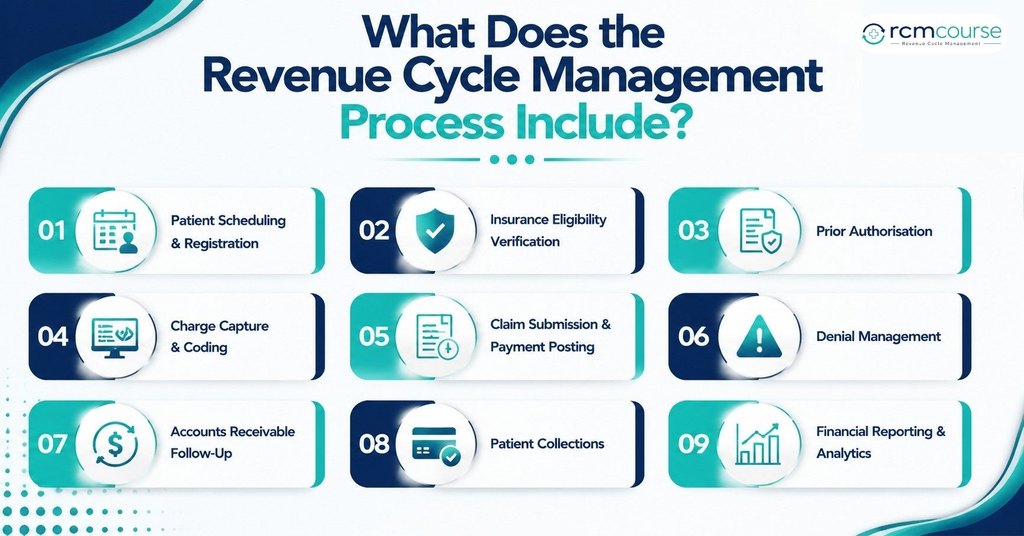
The RCM process includes every administrative and financial touchpoint tied to a patient account, from scheduling through final collections and reporting. It spans front-office, mid-cycle, and back-office functions that billing alone doesn’t cover.
- Patient scheduling and registration — capturing accurate demographic and insurance information at the first point of contact.
- Insurance eligibility verification — confirming active coverage and benefits before the visit occurs.
- Prior authorization — securing payer approval for services that require it, ahead of time.
- Charge capture and coding — documenting and coding the services actually rendered.
- Claim submission — the same core function found in medical billing, but managed as one stage among many.
- Payment posting — recording insurer and patient payments against the account.
- Denial management — identifying, correcting, and appealing denied claims, and tracking why they happened.
- Accounts receivable (AR) follow-up — actively working aged, unpaid claims until they’re resolved.
- Patient collections — managing patient-owed balances, payment plans, and financial communication.
- Financial reporting and analytics — measuring KPIs like clean claim rate, days in AR, and denial rate to improve performance over time.
Medical Billing vs Revenue Cycle Management: What Are the Key Differences?
The clearest way to see the difference is side by side. Billing is a subset of activities focused on claims and payment; RCM is the operating system those activities run inside of.
| Comparison | Medical Billing | Revenue Cycle Management |
| Scope | Specific billing activities | Entire financial lifecycle |
| Starting Point | Usually after services are documented | Before the patient visit |
| Main Focus | Claims and payments | Financial performance |
| Insurance Verification | Limited/not core | Core function |
| Claim Submission | Yes | Yes |
| Denial Management | Mainly resolving individual denials | Resolving and preventing denials |
| Analytics | Limited | Extensive KPI and financial analysis |
| Patient Collections | Yes | Managed across the full cycle |
What Are the Main Responsibilities of Medical Billing?

Medical billing involves accurate coding and charge entry, timely claims submission and tracking, and precise payment posting and patient billing to keep the revenue cycle moving efficiently.
1. Medical Coding and Charge Entry
Billers (often working alongside dedicated coders) are responsible for translating clinical documentation into accurate ICD-10 and CPT codes and entering the corresponding charges.
Getting this step right the first time is the single biggest lever for reducing downstream denials, since a mismatched or unsupported code is one of the most common rejection reasons payers cite.
2. Claims Submission and Tracking
Once coded, claims are prepared, formatted to payer specifications, and submitted — typically through a clearinghouse that scrubs the claim for errors before it reaches the payer.
Billers then monitor claim status, flagging anything that stalls or bounces back so it can be corrected and resubmitted quickly.
3. Payment Posting and Patient Billing
After a payer adjudicates a claim, billers post the payment, apply any contractual adjustments, and calculate what’s left for the patient to pay.
That remaining balance moves to patient statements, and any amount that goes unpaid past a defined window is escalated toward collections.
What Are the Main Responsibilities of Revenue Cycle Management?

Revenue Cycle Management covers patient registration, financial clearance, claims and AR management, and denial prevention to optimise the healthcare organisation’s revenue flow.
1. Patient Registration and Insurance Eligibility
RCM begins with getting patient demographic and insurance details right at the very first touchpoint, then verifying eligibility and benefits before the appointment happens.
A single incorrect digit in a policy number at registration can cause a denial weeks later — which is exactly the kind of failure RCM is built to prevent.
2. Prior Authorization and Financial Clearance
Certain procedures require payer sign-off before they’re performed, and RCM teams are responsible for securing that approval ahead of time.
This stage also covers financial clearance — making sure the patient understands their expected out-of-pocket responsibility before care is delivered, which reduces billing surprises and bad debt later.
3. Claims, Payments and Accounts Receivable
RCM owns the same claims and payment posting functions found in billing, but places them inside a continuous AR management process.
Instead of treating each claim as a one-off transaction, RCM teams actively monitor aging accounts receivable and work unpaid claims until they’re resolved — not just submitted.
4. Denial Management and Prevention
RCM treats denials as a data problem, not just a paperwork problem. Beyond correcting and resubmitting individual denied claims, RCM teams analyze denial patterns by payer, code, and root cause, then feed those insights back into front-end processes to prevent the same denial from happening again.
Revenue Cycle Analytics
RCM relies on a defined set of KPIs to measure financial health and catch problems early, including:
- Clean claim rate — the percentage of claims accepted on first submission without correction.
- Days in AR — the average number of days it takes to collect payment after a claim is submitted.
- Denial rate — the percentage of claims denied by payers.
- Collection performance — how much of billed, allowable revenue is actually collected.
How Do Medical Billing and Revenue Cycle Management Work Together?
Medical billing is the engine inside the larger RCM machine — RCM sets up the conditions for a clean claim, and billing executes the claims-and-payment step at the center of that process.
Neither functions well in isolation: RCM without strong billing execution still leaves money on the table, and billing without RCM’s upstream checks means chasing preventable denials indefinitely.
The relationship typically flows like this:
Patient Scheduling → Eligibility → Treatment → Coding → Medical Billing → Payment → Denial/AR Follow-up → Analytics
Framed this way, billing isn’t a standalone department bolted onto the practice — it’s one stage in a connected loop where each stage’s output becomes the next stage’s input, and the analytics stage feeds insights back to the very first step.
Why Is Revenue Cycle Management Broader Than Medical Billing?
RCM is broader because it manages both revenue generation and revenue collection, while medical billing focuses almost entirely on the collection half.
RCM’s front-end functions — scheduling, eligibility, prior authorization, financial clearance — exist to generate revenue cleanly in the first place, by preventing errors before they can turn into denied or delayed claims.
That upstream focus is what separates the two in practice. Medical billing mainly processes what’s already been documented and tries to collect on it.
RCM asks a different question at every stage: how do we prevent a financial problem before it occurs? It also uses performance data — clean claim rate, denial trends, days in AR — to continuously improve the organization’s overall financial health, not just resolve individual claims.
Medical Billing vs RCM: Which Does a Healthcare Organization Need?
Medical billing and RCM aren’t competing alternatives — a healthcare organization needs both, because one is a necessary function nested inside the other.
Medical billing is essential for the mechanical work of processing claims and getting paid; effective RCM incorporates that billing function alongside the front-end, back-end, and analytical processes that keep the whole financial lifecycle healthy.
In practice, most growing practices don’t choose between “better billing” and “better RCM” — they start by tightening billing accuracy, then expand into full RCM as they realize how many denials and delays originate before a claim is ever created.
Frequently Asked Questions
Is RCM the Same as Medical Billing?
No. RCM is the entire financial lifecycle of a patient account, from scheduling through final payment, while medical billing is one function within that lifecycle — specifically, converting documented services into claims and collecting on them.
Is Billing Part of the Revenue Cycle?
Yes. Medical billing is a core stage within revenue cycle management, sitting between charge capture/coding and payment posting. It couldn’t exist without the earlier RCM stages (registration, eligibility, authorization) feeding it accurate information.
What Is the Difference Between Revenue and Billing?
Revenue refers to the total money a healthcare organization earns for services rendered, while billing is the operational process used to claim and collect that revenue. Revenue is the outcome; billing is one of the mechanisms used to achieve it.
What Is AR in Medical Billing?
AR, or accounts receivable, refers to the money owed to a healthcare organization for services already rendered but not yet paid. In billing and RCM, “days in AR” is a key metric tracking how long it takes on average to collect that outstanding balance.
What Is Denial Management in Medical Billing?
Denial management is the process of identifying why a claim was denied, correcting the underlying issue, and resubmitting or appealing it with the payer. Within full RCM, denial management also includes tracking denial trends to prevent the same errors from recurring.
How does RCM support healthcare billing teams?
RCM supports healthcare billing teams by providing structured processes for managing claims, payments, denials, and financial reporting.
Conclusion
Medical billing and Revenue Cycle Management are closely connected but serve different purposes within the healthcare financial process.
Medical billing focuses on the accurate preparation, submission, and collection of claims, while RCM manages the complete journey of healthcare revenue from the first patient interaction to final payment.
A successful healthcare organisation requires both effective billing practices and strong RCM strategies. While accurate billing ensures claims are processed correctly, comprehensive RCM helps prevent problems before they occur through better registration, eligibility checks, denial prevention, and financial analysis.
By combining both approaches, healthcare providers can improve cash flow, reduce delays, and create a more efficient revenue cycle.
Revenue cycle management is the process healthcare organisations use to turn patient care into paid revenue, covering everything from the moment a patient books an appointment to the moment their balance is settled in full.
It sits at the intersection of clinical, administrative and financial work, which is exactly why it is so easy for something to go wrong.
Revenue Cycle Management Healthcare Challenges are becoming increasingly difficult for organisations to manage as pressure builds from several directions at once: rising claim denial rates, tighter prior authorisation requirements, front-end data errors, staffing shortages in billing and coding, constantly shifting payer rules, and patients carrying a larger share of their own healthcare costs than ever before.
Left unaddressed, these problems compound. A registration error becomes a denied claim, a denied claim becomes an unpaid balance, and an unpaid balance becomes a cash flow problem for the whole organisation.
Overcoming these challenges is not optional. It is what keeps a healthcare organisation financially healthy enough to keep delivering care. This guide walks through the major RCM challenges healthcare organisations face today, why they happen, and the practical steps that reduce them.
What Is Revenue Cycle Management in Healthcare?
Healthcare revenue cycle management is the end-to-end financial process that tracks a patient’s account from initial registration through to final payment, spanning insurance verification, clinical documentation, coding, claims submission, payment posting and collections.
It is the administrative backbone that turns clinical work into revenue.
The cycle starts well before treatment, at scheduling and registration, and continues through insurance verification, the clinical encounter itself, coding and documentation, claim submission to the payer, payment posting, and finally any outstanding patient collections.
Each stage depends on the accuracy of the one before it. A single incorrect field at registration can travel all the way through the cycle and surface weeks later as a denied claim, which is why RCM has to be managed as one connected process rather than a set of separate departments working in isolation.
Why Is Revenue Cycle Management Important?
Effective revenue cycle management protects a healthcare organisation from preventable revenue loss, speeds up reimbursement, and reduces the billing and administrative errors that quietly drain margin over time.
It also supports regulatory and coding compliance, improves the patient’s financial experience, and gives leadership real visibility into financial performance.
Organisations that manage RCM well are not just collecting more money faster. They are also lowering the operational risk that comes from non-compliant coding, reducing the staff burnout caused by chasing denials, and giving patients a clearer, less stressful billing experience.
All of this feeds back into financial stability, which ultimately supports the organisation’s ability to keep delivering care.
4 Major Revenue Cycle Management Healthcare Challenges

Revenue Cycle Management (RCM) involves multiple interconnected processes, from patient registration and insurance verification to claims processing, payment collection and accounts receivable management.
However, healthcare organisations face several challenges that can slow revenue collection, increase administrative workload, create compliance risks and reduce financial performance.
Understanding these challenges is essential for improving RCM efficiency and building a more accurate, reliable and financially sustainable healthcare revenue cycle.
1. Front-End Revenue Cycle Management Challenges
These front-end RCM challenges can create downstream billing issues, increasing claim denials, payment delays and administrative workload.
Front-End Patient Data Errors
Front-end data errors occur when incorrect demographics, missing information or outdated insurance details are captured during patient registration. These mistakes are among the most common causes of claim denials because errors made at the beginning of the patient journey can affect every later stage of the revenue cycle.
A misspelt patient name, incorrect policy number or outdated insurance information can result in rejected claims and delayed payments. Preventing these issues requires organisations to treat registration accuracy as a revenue-critical process rather than a simple administrative task.
Insurance Eligibility Verification Problems
Insurance eligibility verification problems occur when healthcare organisations fail to confirm active coverage, benefit details or patient financial responsibility before services are provided. Manual verification processes can make it difficult to maintain accuracy, especially when patient insurance information changes frequently.
Incorrect eligibility information can lead to denied claims, unexpected patient bills and delayed reimbursement. Automated eligibility verification and real-time insurance checks can help reduce these risks.
Prior Authorisation Challenges
Prior authorisation challenges arise when healthcare providers must manage increasing payer requirements, approval delays and complex authorisation processes. Different insurers may have different requirements depending on the service, procedure or patient plan.
When prior authorisation is missing or delayed, healthcare organisations may experience claim denials, payment delays and additional administrative workload for clinical and billing teams.
2. Claims and Payer-Related RCM Challenges
These back-end RCM challenges can directly affect reimbursement, revenue integrity, compliance and the overall financial performance of healthcare organisations.
Rising Claim Denial Rates
Claim denials are one of the biggest challenges affecting healthcare revenue cycles. They often occur because of coding mistakes, missing documentation, incorrect patient information, eligibility issues, lack of prior authorisation or missed payer deadlines.
Although many denials are preventable, correcting them after submission requires additional staff time and resources. Effective denial prevention strategies help organisations improve first-pass claim acceptance and protect revenue.
Complex and Changing Payer Rules
Managing changing payer rules is challenging because insurance companies frequently update their requirements for coding, documentation and claim submission. Billing teams must continuously monitor these changes to avoid errors and compliance issues.
Failure to follow updated payer guidelines can result in underpayments, delayed reimbursements and avoidable claim denials.
Medical Coding and Documentation Errors
Medical coding and documentation errors occur when submitted codes do not accurately represent the services provided or when clinical documentation does not support the codes billed.
These errors can reduce reimbursement, delay payments and increase compliance risks. Regular coding audits, staff training and improved documentation practices help maintain accuracy and reduce revenue loss.
Coding Compliance and Revenue Cycle Management
Coding compliance plays a critical role in successful RCM because healthcare organisations are reimbursed based on the accuracy of submitted codes. Incorrect ICD-10-CM, CPT or HCPCS coding can result in denied claims, delayed payments and potential regulatory issues.
Undercoding may cause organisations to lose legitimate revenue by billing below the level of services provided, while overcoding can create compliance risks by billing for services that are not supported by documentation.
Maintaining accurate coding requires strong documentation practices, regular compliance audits and continuous education for coding professionals. Effective coding compliance helps healthcare organisations reduce denials while protecting against regulatory concerns.
3. Technology and Data Challenges in Revenue Cycle Management
Together, these system, data and security issues can disrupt revenue cycle workflows, weaken decision-making and expose healthcare organisations to unnecessary financial and compliance risks.
Disconnected EHR and Billing Systems
Disconnected electronic health record (EHR) and billing systems create communication gaps between clinical and financial processes. When systems cannot exchange information effectively, staff may need to enter the same data multiple times, increasing workload and the risk of errors.
Poor system integration can delay claims processing and make it harder for organisations to maintain accurate financial records.
Limited Revenue Cycle Data Visibility
Limited access to real-time RCM data makes it difficult for healthcare organisations to identify trends, monitor performance and respond quickly to problems.
Without effective analytics and reporting tools, organisations may struggle to understand denial patterns, accounts receivable issues and areas requiring improvement.
Data Security and Compliance Risks
RCM systems manage sensitive patient, insurance and financial information, making data security a major concern. Weak security controls can increase the risk of data breaches, compliance violations and reputational damage.
Healthcare organisations must implement strong cybersecurity practices, access controls and compliance measures to protect valuable information.
4. Financial and Operational Revenue Cycle Challenges
These workforce, patient payment and collection challenges can place additional pressure on RCM operations, affecting staff productivity, cash flow and overall financial performance.
Healthcare Staffing Shortages
Staffing shortages make it difficult for healthcare organisations to recruit and retain experienced billing and coding professionals. Reduced staffing levels can increase workloads, create processing delays and raise the risk of billing errors.
Experienced RCM professionals require specialised knowledge of coding rules, payer requirements and healthcare regulations, making workforce shortages particularly challenging.
Administrative Staff Burnout
Administrative burnout often results from repetitive billing tasks, high denial volumes and constant follow-up with payers. Over time, excessive workloads can reduce productivity and increase staff turnover.
Reducing manual processes through automation and improving workflow efficiency can help staff focus on more complex and valuable activities.
Increasing Patient Financial Responsibility
As patients take on greater healthcare costs through higher deductibles and out-of-pocket expenses, collecting patient payments has become more challenging.
Healthcare organisations must provide clear cost estimates, transparent billing information and convenient payment options to improve patient understanding and payment experience.
Slow Accounts Receivable Collections
Slow accounts receivable (AR) collections occur when insurance balances remain unresolved, payer responses are delayed or follow-up processes are ineffective.
High AR days can negatively affect healthcare cash flow. Consistent account monitoring, timely follow-up and improved collection strategies are essential for maintaining financial stability.
Revenue Cycle Management: The Art and the Science

The science of RCM focuses on data, systems and measurable performance, while the art of RCM relies on human judgement, communication and relationship management.
The Science of Revenue Cycle Management
The scientific side of RCM is built on data analytics, defined KPIs, automation, coding standards, denial tracking and financial forecasting. This is the measurable, repeatable, process-driven half of the discipline, the part that can be standardised, automated and audited.
The Art of Revenue Cycle Management
The art of RCM is everything that resists full standardisation: communicating with patients, negotiating and building relationships with payers, training staff effectively, coordinating clinical and administrative teams, and managing the complex exceptions that automation cannot fully resolve on its own.
A revenue cycle run purely on process, with no judgement or relationship management behind it, will always underperform one that combines both.
A Physician’s Guide to Effective Revenue Cycle Management
Physicians play a bigger role in RCM outcomes than most realise, because clinical documentation is the foundation everything else in the cycle is built on.
Complete documentation promptly after each encounter, rather than leaving it to catch up later, since delayed documentation is far more likely to be incomplete or inaccurate.
Document diagnoses and procedures with enough specificity that coders can work from them directly, without having to guess or query back.
Understanding how documentation choices affect coding and reimbursement helps physicians see documentation as part of patient care administration, not a separate paperwork burden.
Supporting prior authorisation requirements by providing the clinical detail payers ask for, and responding quickly to documentation queries from coding and billing staff, both directly shorten the time it takes to get a claim paid.
Close collaboration between physicians and the coding/billing team, along with basic awareness of the denial reasons most often tied to documentation gaps, closes the loop that keeps the whole cycle moving.
6 Proven Strategies for Overcoming Healthcare RCM Challenges

Healthcare organisations can overcome RCM challenges by improving processes, adopting automation, strengthening accuracy and using technology to create a more efficient revenue cycle.
1. Improve Front-End Registration Processes
Standardise patient intake with consistent procedures and required fields. Validate demographic information during registration and confirm insurance details before treatment to prevent avoidable claim issues.
2. Automate Eligibility and Prior Authorisation
Use automated eligibility checks to confirm insurance coverage in real time. Track prior authorisation requirements before services are provided to reduce delays and administrative workload.
3. Strengthen Claim Scrubbing
Review every claim against payer-specific requirements before submission. Identify missing or incorrect information early to improve clean claim rates and reduce preventable denials.
4. Build a Strong Denial Management Process
Analyse denials by reason code to identify recurring problems. Assign responsibility for corrective actions, manage appeals effectively and track recovered revenue.
5. Improve Coding and Documentation Training
Provide continuous coding education, conduct regular internal audits and keep staff updated on coding standards and payer requirements to improve accuracy and compliance.
6. Integrate Healthcare Technology
Connect EHR, practice management and billing systems to enable smooth data flow. Reduce duplicate data entry, improve communication and create a more efficient revenue cycle workflow.
Use RCM Analytics and KPIs
Track metrics consistently rather than only reviewing them when a problem has already surfaced. The most useful RCM metrics include:
- Initial denial rate – the percentage of claims denied before any appeal
- Clean claim rate – the percentage of claims accepted on first submission
- Days in accounts receivable – the average time between service and payment
- First-pass resolution rate – claims paid in full without any rework
- Net collection rate – actual revenue collected against the total collectable
- Claim submission turnaround time – time from service delivery to claim submission
Revenue Cycle Management Challenges Checklist
Use this checklist to spot-check where your own revenue cycle may be exposed:[ ] Patient registration accuracy
[ ] Insurance verification
[ ] Prior authorisation
[ ] Coding accuracy
[ ] Documentation quality
[ ] Claim submission
[ ] Denial management
[ ] AR follow-up
[ ] Patient collections
[ ] System integration
[ ] Compliance
[ ] Performance monitoring
How Automation and AI Can Improve Revenue Cycle Management
Automation and AI improve RCM by taking over repetitive, rules-based work across the cycle, including automated insurance verification, claim scrubbing, coding assistance, predictive denial identification, automated payment posting, workflow prioritisation and patient billing communication.
Used well, these tools do not replace RCM staff. They absorb the high-volume repetitive work so staff have more time for the exceptions, appeals and patient conversations that genuinely need human judgement.
Predictive denial identification is a good example of where this shift is heading: rather than reacting to a denial after it happens, AI models can flag a claim as high-risk before submission, giving staff the chance to correct it while it still costs almost nothing to fix.
Benefits of Improving Revenue Cycle Management
Improving RCM delivers faster reimbursement, fewer claim denials, reduced administrative costs and better overall cash flow. It also improves coding compliance, raises staff productivity by removing repetitive manual work, and gives patients a clearer, less stressful financial experience.
Taken together, these improvements build genuine financial stability for the organisation, which is the ultimate point of the entire exercise.
Frequently Asked Questions
What are the biggest challenges in healthcare revenue cycle management?
The biggest challenges are front-end data errors, insurance eligibility problems, prior authorisation delays, rising claim denial rates, complex and changing payer rules, coding and documentation errors, staffing shortages, and growing patient financial responsibility.
Why are claim denials a major RCM challenge?
Claim denials are a major challenge because they delay payment, require costly rework to resubmit, and often trace back to preventable causes such as coding errors, missing documentation or absent prior authorisation.
How does prior authorisation affect revenue cycle management?
Prior authorisation affects RCM by creating administrative workload and payment risk whenever a required approval is delayed or missing, since services performed without authorisation can be denied outright regardless of medical necessity.
How do coding errors affect healthcare revenue?
Coding errors reduce healthcare revenue directly through denied or delayed claims, and can also create compliance risk if patterns of overcoding or undercoding are identified during a payer or regulatory audit.
Why is revenue cycle management important in healthcare?
Revenue cycle management is important because it protects an organisation from preventable revenue loss, speeds up reimbursement, supports regulatory compliance, and gives leadership visibility into financial performance.
What is the relationship between coding compliance and revenue cycle management?
Coding compliance and revenue cycle management are directly linked because payers reimburse based on the codes submitted, so inaccurate coding leads to denials, underpayment or regulatory scrutiny, while accurate, well-documented coding protects both revenue and compliance standing.
How can healthcare organisations improve revenue cycle management?
Organisations can improve RCM by standardising front-end registration, automating eligibility and prior authorisation checks, strengthening claim scrubbing, building a structured denial management process, investing in coding training, integrating their technology systems, and tracking RCM KPIs consistently.
What are the key components of the Pillars of Revenue Cycle Management?
The Pillars of Revenue Cycle Management are people, processes, and technology, which work together to improve billing accuracy, efficiency, and financial outcomes.
What are the most important healthcare RCM KPIs?
The most important RCM KPIs are the initial denial rate, clean claim rate, days in accounts receivable, first-pass resolution rate, net collection rate and claim submission turnaround time.
How does revenue cycle management affect patient experience?
Revenue cycle management affects patient experience through the clarity of cost estimates, the accuracy of bills, and how easy the organisation makes it for patients to understand and pay what they owe.
Conclusion
The major challenges covered here, front-end data errors, eligibility and prior authorisation problems, rising denials, complex payer rules, coding and documentation gaps, disconnected technology, staffing pressure and growing patient financial responsibility, rarely exist in isolation. They compound each other, which is exactly why a piecemeal fix rarely holds.
Successful revenue cycle management requires accurate front-end processes, strong coding compliance, effective denial management, integrated technology, well-trained staff and continuous performance monitoring, working together rather than as separate initiatives.
Organisations that treat RCM as one connected system, rather than a collection of departmental tasks, are the ones that see the clearest improvement in both financial performance and the overall patient care experience.
Revenue Cycle Management (RCM) technology and automation are transforming how healthcare organisations manage the financial journey of patients, from registration and insurance verification to claims processing, payment collection and final reimbursement.
By replacing slow manual steps with smart digital workflows, these solutions help speed up claims, prevent billing mistakes and improve cash flow from patient check-in to final payment.
The role of technology and automation in RCM is to create a faster, more accurate and connected revenue cycle. Technology provides the digital infrastructure that links essential healthcare systems, including electronic health records (EHRs), billing platforms, claims systems and payment solutions.
Automation uses this infrastructure to complete repetitive tasks such as eligibility verification, claim scrubbing, payment posting and denial management with greater speed and consistency.
Traditional manual RCM processes often create delays, increase administrative workload and raise the risk of errors that can lead to claim denials and lost revenue.
Modern RCM automation helps healthcare organisations identify problems earlier, improve billing accuracy and give staff access to real-time data for better decision-making.
This guide explores the roles of technology and automation in RCM, including the tools driving digital transformation, how automation improves front-end and back-end revenue cycle processes, the benefits and challenges of implementation, and why human oversight remains essential for successful RCM operations.
What Is the Roles of Technology and Automation in RCM ?

Technology provides the connected infrastructure that links every stage of the revenue cycle, from patient registration to payment collection.
RCM automation uses this infrastructure to streamline repetitive tasks such as eligibility verification, claim processing, payment posting and denial management.
Together, technology and automation improve accuracy, reduce administrative workload, accelerate payments and strengthen overall RCM performance.
What Is the Role of Technology in RCM?
Technology is the digital infrastructure that connects every stage of the revenue cycle, from patient registration through to final payment. It includes electronic health records, practice management systems, claims clearinghouses, patient billing portals and analytics tools.
Its role is to capture accurate data once and make it available consistently across every downstream step.
Without that connective layer, RCM becomes a series of disconnected manual handoffs. A registration error at check-in, for instance, has nowhere to be caught before it turns into a denied claim weeks later.
With the right technology in place, the same data flows cleanly from the front desk to the billing office, and every system involved is working from a single, accurate source of truth.
The core technology components of a modern revenue cycle include:
- Electronic patient registration and scheduling systems, which capture demographic and insurance details at the first point of contact
- Insurance and eligibility verification tools, which confirm coverage before the appointment happens
- Electronic health records (EHR) and billing systems, which link clinical documentation to the codes and charges that follow
- Claims management platforms, which format, scrub and transmit claims to payers
- Payment and patient billing technologies, including online portals and payment plans
- Data analytics and reporting tools, which surface trends in denials, days in accounts receivable (AR) and collection rates
- Integration layers, typically APIs, that keep clinical and financial data in sync
How Does Technology Connect the RCM Process End to End?
Technology links the revenue cycle by passing accurate data automatically from one stage to the next: scheduling feeds registration, registration feeds documentation and coding, coding feeds claims submission, and claims feed payment posting and patient collections.
Each handoff is a potential failure point if it is done manually, which is exactly why connected systems matter.
In a well-integrated setup, a patient’s insurance details entered at scheduling flow straight through to eligibility checks, then into the clinical encounter, then into coding and billing, without anyone re-entering the same information.
That single thread of accurate data is what makes downstream automation possible in the first place. Automation cannot fix bad data; it can only act on what technology hands it.
What Is the Role of Automation in RCM?
RCM automation uses software, rules engines and increasingly AI to carry out repetitive revenue cycle tasks without manual input, such as verifying eligibility, scrubbing claims, posting payments and flagging denials.
It reduces data entry errors, speeds up claim submission, catches problems before they reach the payer, and helps staff prioritise the accounts that need attention most.
Where technology provides the connected infrastructure, automation is what actually executes work inside it.
A rules-based automation engine, for example, can check every outgoing claim against thousands of payer-specific requirements in seconds, something that would take a human coder considerably longer to do by hand for each claim individually.
How Does Front-End RCM Automation Work?
Front-end automation covers everything that happens before a claim is created, from scheduling through to prior authorisation. Getting this stage right matters disproportionately, because a large share of denials originate from errors made at registration and eligibility checking, long before a claim is ever submitted.
Automated Eligibility Verification
Automated eligibility verification connects directly to payer systems to confirm a patient’s coverage, benefits and cost-sharing responsibility in real time, usually before or at the point of scheduling.
This removes the need for staff to call payers or log into separate portals for each patient, and it flags coverage gaps early enough to resolve them before the appointment.
Automated Patient Registration
Automated registration tools capture and validate demographic and insurance information at intake, cross-checking it against payer databases and existing records to catch typos, duplicate entries and mismatched details immediately.
Because this is the first data point in the entire revenue cycle, catching errors here prevents them from cascading into denials further down the line.
Automated Cost Estimates
Automated cost estimation tools combine a patient’s benefits, the expected procedure codes and the provider’s contracted rates to generate an accurate out-of-pocket estimate before the visit. This supports price transparency requirements and gives patients a realistic figure to plan around, which in turn improves the likelihood of timely payment.
Automated Prior Authorisation
Automated prior authorisation tools check payer rules to determine whether a service requires approval, then submit and track the request electronically instead of relying on fax or phone.
Given that prior authorisation delays are one of the most common causes of care delays and denied claims, automating this step has a direct, measurable effect on both patient experience and revenue timing.
How Does Back-End RCM Automation Improve Medical Billing?

Back-end automation takes over once a clinical encounter is complete, handling everything from coding support through to final payment reconciliation. This is where the volume of repetitive, rules-based work is highest, and where automation tends to deliver the fastest, most measurable return.
Automated Claim Scrubbing
Automated claim scrubbing checks every outgoing claim against payer-specific rules, coding logic and formatting requirements before submission, flagging anything likely to trigger a rejection or denial. Because scrubbing happens before the claim ever reaches the payer, it catches errors while they are still cheap and fast to fix.
AI-Assisted Medical Coding
AI-assisted coding tools analyse clinical documentation and suggest appropriate procedure and diagnosis codes, which a certified coder then reviews and confirms.
This speeds up the coding process considerably while keeping a qualified human in the loop for anything ambiguous or high-risk, which matters given how directly coding accuracy affects both reimbursement and compliance.
Automated Claim Submission
Automated submission tools format and transmit claims to clearinghouses and payers electronically, batching and scheduling them without manual intervention. This shortens the time between service delivery and claim submission, which is one of the biggest levers on days in AR.
Automated Payment Posting
Automated payment posting matches incoming remittance advice against outstanding claims and posts payments to the correct accounts automatically, flagging any mismatches for review. Manual payment posting is one of the most time-consuming back-office tasks in RCM, so automating it frees a meaningful amount of staff capacity for higher-value work.
Automated Denial Management
Automated denial management tools categorise incoming denials by reason code, route them to the right team, and in some cases auto-generate the appeal documentation based on payer requirements.
Given that a large proportion of denials are ultimately recoverable if appealed correctly and on time, automation that speeds up and standardises this process protects revenue that would otherwise be written off.
6 Technologies Driving RCM Automation

Several underlying technologies work together to make RCM automation possible, each suited to a different type of task within the revenue cycle.
1. Robotic Process Automation (RPA)
RPA uses software “bots” to mimic repetitive, rules-based human actions, such as logging into a payer portal, checking a claim status, and updating the record accordingly. It is best suited to high-volume, well-defined tasks that follow the same steps every time.
2. Artificial Intelligence (AI)
AI goes beyond fixed rules, using models trained on historical data to make judgement-based decisions, such as predicting which claims are likely to be denied before submission. This makes it particularly useful for prioritisation and risk-scoring work that RPA alone cannot handle.
3. Machine Learning (ML)
ML is the subset of AI that improves its predictions over time as it processes more data, for example refining its denial-probability model as it sees more outcomes from a given payer. The longer an ML model runs against an organisation’s own claims data, the more accurate its predictions typically become.
4. Intelligent Document Processing (IDP)
IDP extracts structured data from unstructured documents such as scanned referrals, faxed authorisations or handwritten forms, converting them into usable data for downstream systems. This matters because a significant share of healthcare documentation still arrives in non-digital formats, and IDP is what allows automation to reach that data at all.
5. APIs Connecting EHR, Billing and Payer Systems
APIs allow separate systems, such as an EHR, a billing platform and a payer’s eligibility database, to exchange data automatically in real time. Without this connective layer, automation within any single system stays siloed and cannot act on information held elsewhere.
6. RCM Analytics Platforms
Analytics platforms aggregate data across the revenue cycle to surface trends in denials, AR ageing and collection performance, giving leadership the visibility needed to target automation where it will have the greatest effect. These platforms are typically what organisations use to measure whether their automation investment is actually working.
How Do AI and Automation Reduce Claim Denials?
AI and automation reduce denials by catching errors at the earliest possible point, scoring each claim’s denial risk before submission, and tracking payer-specific patterns to adjust future claims accordingly.
The sequence typically runs from pre-service eligibility verification, through automated error detection at coding and scrubbing, to denial-probability scoring, payer-pattern tracking, and finally prioritised appeals for anything that is still denied.
This layered approach matters because denials rarely have a single cause. Some originate from eligibility issues, others from coding mismatches, and others from payer-specific formatting rules that change over time. Automation that only addresses one point in that chain will always leave a share of preventable denials behind.
6 Benefits of Technology & Automation in RCM

RCM automation improves efficiency by reducing manual work, minimising errors and speeding up key revenue cycle processes.
Compared with traditional manual RCM, automated systems provide faster processing, real-time insights and more consistent revenue collection.
1. Faster Revenue Collection
Automated eligibility checks, scrubbing and submission shorten the time between service delivery and payment, directly reducing days in AR.
2. Fewer Billing Errors
Rules-based validation catches coding and formatting errors before a claim ever reaches a payer, cutting the volume of preventable denials.
3. Lower Administrative Costs
Automating repetitive tasks such as payment posting and eligibility verification reduces the staff hours required per claim, lowering the overall cost to collect.
4. Higher Staff Productivity
Freeing staff from repetitive data entry allows them to focus on exceptions, appeals and patient communication, where human judgement adds the most value.
5. Improved Cash Flow
Faster, cleaner claims combined with fewer denials produce steadier, more predictable cash flow for the organisation.
6. Better Patient Financial Experience
Accurate upfront cost estimates and self-service payment tools give patients clarity and control over their bills, which supports timelier payment.
RCM Automation vs Traditional Manual RCM
RCM automation uses technology to streamline repetitive tasks, reduce errors and speed up claims, billing and payment processes.
Traditional manual RCM relies heavily on staff to manage these tasks, which can increase processing time, administrative costs and the risk of human error.
Here is a comparison table:
| Process Stage | Manual RCM | Automated RCM |
| Eligibility verification | Staff call or log into payer portals individually | Verified in real time via automated system checks |
| Claim scrubbing | Reviewed manually, error-prone at high volume | Checked automatically against payer rules before submission |
| Coding | Fully manual coder review | AI-assisted suggestions reviewed and confirmed by a coder |
| Payment posting | Manually matched line by line | Automatically matched and posted, exceptions flagged |
| Denial management | Denials sorted and researched manually | Categorised, routed and partly drafted automatically |
| Reporting | Static, periodic reports | Real-time dashboards and predictive analytics |
What RCM Tasks Should Be Automated First?
RCM automation works best for high-volume, error-prone, time-sensitive and data-heavy tasks where it can improve accuracy, efficiency and revenue performance.
High-Volume Repetitive Tasks
Tasks performed hundreds or thousands of times a month, such as eligibility checks and payment posting, deliver the fastest and clearest return once automated.
Error-Prone Processes
Any step with a known high rate of manual error, such as coding or claim formatting, should be prioritised because automation reduces the downstream cost of denials.
Time-Sensitive Activities
Prior authorisation and claim submission both have strict payer deadlines, and automation reduces the risk of missing them.
Data-Heavy Processes
Tasks that involve cross-referencing large volumes of data, such as denial-pattern analysis, are well suited to automation because software can process far more data points than a person can manually.
What Are the Challenges of Automating RCM?
Automating a revenue cycle is not without friction. The most common challenges include:
- Integration difficulty between legacy systems and newer automation tools, particularly in organisations running older EHR or billing platforms
- Data quality issues, since automation amplifies existing errors rather than fixing them on its own
- Cybersecurity risk, as automated systems handling protected health information (PHI) become a bigger attack surface if not properly secured
- Training costs, both financial and in staff time, to bring teams up to speed on new workflows
- Faulty rule configuration, where poorly set-up automation rules generate as many problems as they solve
- AI overreliance, where organisations remove human review from decisions that still require judgement, particularly around complex denials and appeals
Why Is Human Oversight Still Important in Automated RCM?
Human oversight remains essential because automation is built to handle volume and repetition, not judgement. Staff are still needed for complex coding decisions, unusual or high-value denials, payer relationship management, and compliance decisions that carry legal or financial risk if handled incorrectly.
The organisations that get the most value from RCM automation are the ones that treat it as a support layer for their teams, not a replacement for them. Automation should absorb the repetitive volume so that experienced staff can spend their time on the accounts and decisions that genuinely need a person.
6 Steps to Implement RCM Automation in Healthcare Organisations

Implementing RCM automation requires a structured approach, from identifying bottlenecks and selecting high-impact processes to integrating systems and training staff.
Ongoing performance measurement and human oversight help ensure automation improves efficiency, accuracy and revenue cycle outcomes.
Here are six key steps for implementing RCM automation effectively:
Step 1: Identify RCM Bottlenecks
Start by reviewing where claims stall or denials cluster, using existing reporting to find the stages costing the most time and revenue.
Step 2: Choose High-Impact Processes
Prioritise automating the tasks identified earlier as high-volume, error-prone, time-sensitive or data-heavy, rather than trying to automate everything at once.
Step 3: Integrate RCM Systems
Confirm that the EHR, billing platform and any automation tools can exchange data properly before rolling automation out, since disconnected systems undermine the whole effort.
Step 4: Establish Human Review Points
Build in checkpoints where staff review automated outputs, particularly for coding suggestions, denial-probability scores and appeal drafts.
Step 5: Train RCM Teams
Give staff time and structured training to understand how the new tools work and where their own judgement still fits into the process.
Step 6: Measure Performance
Track the key metrics below before and after rollout to confirm the automation is actually delivering the expected improvement.
How Do You Measure the Success of RCM Automation?
The clearest signal that RCM automation is working comes from tracking a consistent set of metrics before and after implementation, rather than relying on anecdotal feedback from staff.
- Clean claim rate – the percentage of claims accepted on first submission
- Initial denial rate – the percentage of claims denied before any appeal
- Days in AR – the average time between service and payment
- First-pass resolution rate – claims paid in full without any rework
- Cost to collect – total collection cost as a percentage of revenue collected
- Claim processing time – time from submission to payer response
- Denial recovery rate – the percentage of denied claims successfully appealed
- Patient collection rate – the percentage of patient-owed balances actually collected
- Staff productivity – claims or accounts processed per staff member
What Is the Future of Technology and Automation in RCM?
The next phase of RCM automation is moving from reactive processing towards prediction and prevention. Predictive AI is increasingly used to flag denial risk before a claim is even created, while generative AI is starting to support administrative tasks such as drafting appeal letters and summarising payer correspondence.
Automated prior authorisation, real-time analytics and deeper payer-provider interoperability are all maturing quickly.
The direction of travel across the industry is towards human-in-the-loop AI: systems that handle the bulk of repetitive decisions automatically but route anything ambiguous, high-value or compliance-sensitive to a human for final sign-off.
Frequently Asked Questions
What processes can be automated in revenue cycle management?
Eligibility verification, patient registration, prior authorisation, claim scrubbing, coding support, claim submission, payment posting and denial categorisation can all be automated, typically with a human reviewing exceptions and complex cases.
How does automation reduce RCM denials?
Automation reduces denials by catching eligibility and coding errors before submission, scoring claims for denial risk, and tracking payer-specific patterns so future claims are formatted correctly the first time.
How to Optimise RCM in Medical Billing for Long-Term Revenue Stability?
Healthcare providers can optimise RCM in medical billing by improving workflows, using automation, reducing claim errors, monitoring performance data, and training staff.
What is RPA in revenue cycle management?
RPA, or robotic process automation, uses software bots to carry out repetitive, rules-based tasks such as checking claim status or updating records, mimicking the exact steps a person would otherwise perform manually.
Can medical coding be fully automated?
No. AI can suggest codes based on clinical documentation, but a certified coder still needs to review and confirm them, particularly for complex or ambiguous cases where compliance risk is higher.
What are the risks of using AI in RCM?
The main risks are poor data quality feeding inaccurate predictions, cybersecurity exposure given the sensitivity of the data involved, and overreliance on automated outputs without adequate human review of complex or high-value decisions.
Will automation replace RCM professionals?
No. Automation is designed to absorb repetitive, high-volume work, not the judgement-based decisions around complex coding, unusual denials, payer negotiation and compliance that still require an experienced person.
Conclusion
Technology and automation are reshaping Revenue Cycle Management by creating faster, more connected and more efficient financial workflows across healthcare organisations.
Technology provides the digital foundation that connects patient registration, clinical documentation, coding, billing, claims and payments, while automation handles many of the repetitive processes that traditionally require significant staff time.
When implemented effectively, automated eligibility checks, claim scrubbing, payment posting, denial management, AI-assisted coding and analytics can help reduce errors, prevent avoidable denials, shorten days in accounts receivable and improve overall cash flow.
However, successful RCM automation depends on accurate data, strong system integration, appropriate cybersecurity measures and clearly defined points of human review.
The future of RCM is therefore not simply about replacing manual work with technology. It is about combining intelligent automation with skilled RCM professionals.
By allowing technology to manage high-volume and repetitive tasks while people focus on complex decisions, exceptions, compliance and patient communication, healthcare organisations can build a revenue cycle that is more accurate, responsive and financially sustainable.
Revenue Cycle Management (RCM) improves medical billing by reducing errors, preventing avoidable claim denials, accelerating reimbursements and helping healthcare providers collect more of the revenue they have earned. Instead of treating billing as a single back-office task, RCM connects every financial stage of the patient journey, from scheduling and insurance verification to coding, claim submission, payment posting and final collection.
This broader approach makes medical billing more accurate, proactive and efficient. By checking patient information early, confirming eligibility, managing prior authorisation, improving coding accuracy and reviewing claims before submission, RCM helps prevent many problems before they reach the payer. It also gives billing teams better visibility into denied claims, outstanding balances, underpayments and delays in accounts receivable.
In practice, this means fewer rejected claims, a higher clean claim rate, lower A/R days, improved cash flow and less administrative work for staff. RCM can also improve the patient financial experience by providing clearer cost estimates, simpler bills and more convenient digital payment options.
Understanding how Revenue Cycle Management (RCM) improves medical billing is therefore essential for healthcare providers that want to strengthen financial performance without creating additional administrative burden. The following sections explain the main ways RCM improves billing accuracy, claim performance, payment speed, denial management and revenue collection.
Table of Contents
What Is Revenue Cycle Management in Medical Billing?

Revenue cycle management is the end-to-end process of tracking a patient’s account from registration and insurance verification through to final payment. It covers everything that touches money: scheduling, eligibility checks, coding, claim submission, payment posting, denial management, and patient collections.
Short Definition
RCM is the administrative and financial process healthcare providers use to manage claims, payments, and revenue from the first patient contact to the last payment received. It brings clinical and financial data together so a practice can see, in real time, where money is moving and where it’s getting stuck.
How RCM Differs from Basic Medical Billing
Medical billing is one piece of RCM, not the whole thing. Billing typically starts after a visit has already happened: a coder assigns codes, a biller submits the claim, and the practice waits to see what comes back. RCM starts much earlier, at scheduling and eligibility verification, and continues well after the claim is submitted, through denial follow-up and patient payment collection.
Think of billing as a single stage in a longer race. RCM is the entire race, coached from start to finish, with checkpoints designed to stop problems before they cost the practice money.
6 Ways RCM Improves Medical Billing

1. Reduces Billing Errors
Most claim denials trace back to a small handful of preventable mistakes made before the claim is ever submitted. RCM builds error-catching checkpoints directly into the front end of the process, so mistakes get fixed while they’re cheap to fix, not after a payer has already rejected the claim.
Accurate patient data: RCM systems verify and standardise demographic and insurance details at registration, which is where a huge share of billing errors originate: a misspelt name, an outdated address, or a transposed policy number.
Eligibility verification: Confirming active coverage, plan type, and benefits before the appointment stops practices from billing for services a patient’s plan won’t cover.
Prior authorisation: RCM tracks which procedures need pre-approval and flags them early, so claims aren’t submitted, and then denied, for a service that needed sign-off first.
2. Improves Clean Claim Rates
A “clean claim” is one that’s accepted and paid the first time it’s submitted, with no errors, missing information, or coding issues. The clean claim rate is one of the clearest signs of a healthy revenue cycle, and RCM is built specifically to push that number up.
Claim scrubbing: Automated scrubbing tools check every claim against payer-specific rules before submission, catching mismatched codes, missing modifiers, and formatting errors that would otherwise bounce back.
Accurate medical coding: RCM pairs coding with real-time payer rule updates, so codes reflect current requirements rather than outdated fee schedules or deprecated codes.
Fewer rejected claims: By combining scrubbing and coding accuracy, RCM shrinks the pool of claims that get kicked back for correction, which means fewer resubmissions and less staff time spent chasing fixes.
3. Reduces Claim Denials
Denials are expensive in two ways: the direct cost of reworking and resubmitting a claim, and the delay to cash flow while the practice waits for payment. RCM tackles denials on both ends, prevention and recovery.
Detects common denial causes: RCM tracking surfaces the patterns behind denials, whether that’s a specific payer, a specific code, or a specific step in the process, so the practice can fix the root cause instead of firefighting each denial individually.
Improves denial prevention: Once a pattern is identified, RCM workflows adjust upstream steps, such as eligibility checks or coding review, to stop that type of denial from recurring.
Supports faster appeals: When a denial does happen, RCM keeps the documentation and claim history organised, so appeals can be filed quickly and with the right supporting evidence, rather than starting the paperwork trail from scratch.
4. Speeds Up Payments
Cash flow is the practical outcome that everything else in RCM is really working towards. A faster, cleaner cycle means money reaches the practice sooner and with less manual chasing.
Faster claim submission: Automation removes the delay between a service being provided and the claim being submitted, shortening the time payers have before the clock even starts on payment.
Automated payment posting: Payments and remittance advice get matched and posted automatically, so staff aren’t manually reconciling every line item against every claim.
Lower A/R days: With fewer errors, faster submission, and quicker posting, accounts receivable ages more slowly, which directly improves the practice’s working capital.
5. Improves Patient Payments
As patients shoulder more of their own healthcare costs through high-deductible plans, patient payments have become a bigger share of practice revenue, and a harder one to collect. RCM addresses this directly rather than treating it as an afterthought.
Cost estimates: Giving patients an accurate estimate before or at the point of care sets expectations early and reduces disputes and surprise bills later.
Clear bills: RCM platforms typically generate itemised, plain-language statements, which cuts down on confused calls to the billing office and speeds up payment.
Digital payment options: Online portals, text-to-pay, and card-on-file options make it easier for patients to pay promptly, which meaningfully raises patient collection rates compared with mailed paper statements alone.
6. Reduces Revenue Leakage
Revenue leakage is money the practice earned but never actually collected, and it’s often invisible until someone goes looking for it. RCM makes leakage visible and gives the practice a structured way to close the gap.
Identifies missed charges: RCM systems cross-check documentation against what was actually billed, catching services that were performed but never invoiced.
Tracks underpayments: By comparing what payers actually pay against contracted rates, RCM flags underpayments that would otherwise go unnoticed and unrecovered.
Recovers denied revenue: Structured denial workflows make sure denied claims are actually followed up and appealed, rather than written off simply because nobody had time to chase them.
How to Improve Revenue Cycle Management
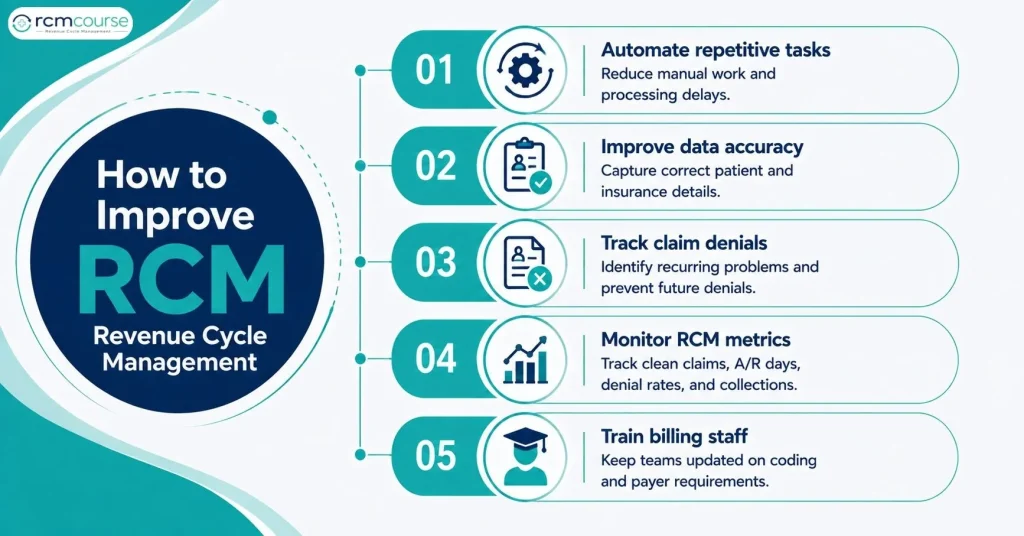
A few consistent habits tend to separate practices with a smooth revenue cycle from those constantly fighting fires:
- Automate repetitive tasks. Eligibility checks, claim scrubbing, and payment posting are all well suited to automation, freeing staff to focus on exceptions rather than routine processing.
- Improve front-end data accuracy. Since most downstream errors start at registration, investing in accurate data capture at the very first patient touchpoint pays off throughout the entire cycle.
- Track denials. Reviewing denial trends regularly, not just handling them one by one, is what turns denial management into denial prevention.
- Monitor key RCM metrics. Keep a close eye on clean claim rate, days in A/R, denial rate, and net collection rate, since these numbers tell you where the cycle is actually breaking down.
- Train billing staff. Payer rules and coding requirements change constantly, so ongoing training keeps the team’s day-to-day work aligned with current requirements rather than last year’s.
FAQs
How does RCM improve medical billing?
RCM improves medical billing by adding verification and error-checking steps throughout the entire billing process, not just at claim submission, which raises clean claim rates, reduces denials, and speeds up payment collection.
What is the difference between RCM and medical billing?
Medical billing is the process of coding and submitting claims after a visit; RCM is the broader end-to-end process that starts at scheduling and eligibility verification and continues through payment posting and denial recovery.
How does RCM reduce claim denials?
RCM reduces claim denials by identifying the root causes behind them, such as eligibility issues or coding errors, and adjusting upstream processes so those errors are caught before a claim is ever submitted.
What is the difference between Medical Billing vs Revenue Cycle Management?
Medical Billing focuses mainly on preparing claims and collecting payments, while Revenue Cycle Management covers the complete financial process from patient registration to final payment collection.
What are the main steps in healthcare RCM?
The main steps are patient registration and eligibility verification, prior authorisation, charge capture and coding, claim submission and scrubbing, payment posting, denial management, and patient billing and collections.
Conclusion
Revenue Cycle Management (RCM) improves medical billing by turning separate billing activities into one connected, end-to-end financial process. From accurate patient registration and insurance verification to clean claim submission, denial management and patient payment collection, every stage works together to reduce errors and improve revenue performance.
Effective RCM helps healthcare providers achieve higher clean claim rates, fewer denials, faster reimbursements, lower A/R days and better control over revenue leakage. It also reduces repetitive administrative work by using automation for tasks such as eligibility checks, claim scrubbing, payment posting and claim tracking.
The biggest improvement often starts before a claim is submitted. Accurate patient data, timely eligibility verification, correct coding and proper prior authorisation can prevent many downstream billing problems before they occur. When these front-end processes are combined with strong denial analysis, payment monitoring and patient-friendly billing, the entire revenue cycle becomes more efficient.
For healthcare organisations, improving RCM is not simply about getting claims paid faster. It is about creating a more reliable medical billing system that supports consistent cash flow, stronger financial control and a better experience for both staff and patients.

