Revenue Cycle Management (RCM) technology and automation are transforming how healthcare organisations manage the financial journey of patients, from registration and insurance verification to claims processing, payment collection and final reimbursement.
By replacing slow manual steps with smart digital workflows, these solutions help speed up claims, prevent billing mistakes and improve cash flow from patient check-in to final payment.
The role of technology and automation in RCM is to create a faster, more accurate and connected revenue cycle. Technology provides the digital infrastructure that links essential healthcare systems, including electronic health records (EHRs), billing platforms, claims systems and payment solutions.
Automation uses this infrastructure to complete repetitive tasks such as eligibility verification, claim scrubbing, payment posting and denial management with greater speed and consistency.
Traditional manual RCM processes often create delays, increase administrative workload and raise the risk of errors that can lead to claim denials and lost revenue.
Modern RCM automation helps healthcare organisations identify problems earlier, improve billing accuracy and give staff access to real-time data for better decision-making.
This guide explores the roles of technology and automation in RCM, including the tools driving digital transformation, how automation improves front-end and back-end revenue cycle processes, the benefits and challenges of implementation, and why human oversight remains essential for successful RCM operations.
What Is the Roles of Technology and Automation in RCM ?

Technology provides the connected infrastructure that links every stage of the revenue cycle, from patient registration to payment collection.
RCM automation uses this infrastructure to streamline repetitive tasks such as eligibility verification, claim processing, payment posting and denial management.
Together, technology and automation improve accuracy, reduce administrative workload, accelerate payments and strengthen overall RCM performance.
What Is the Role of Technology in RCM?
Technology is the digital infrastructure that connects every stage of the revenue cycle, from patient registration through to final payment. It includes electronic health records, practice management systems, claims clearinghouses, patient billing portals and analytics tools.
Its role is to capture accurate data once and make it available consistently across every downstream step.
Without that connective layer, RCM becomes a series of disconnected manual handoffs. A registration error at check-in, for instance, has nowhere to be caught before it turns into a denied claim weeks later.
With the right technology in place, the same data flows cleanly from the front desk to the billing office, and every system involved is working from a single, accurate source of truth.
The core technology components of a modern revenue cycle include:
- Electronic patient registration and scheduling systems, which capture demographic and insurance details at the first point of contact
- Insurance and eligibility verification tools, which confirm coverage before the appointment happens
- Electronic health records (EHR) and billing systems, which link clinical documentation to the codes and charges that follow
- Claims management platforms, which format, scrub and transmit claims to payers
- Payment and patient billing technologies, including online portals and payment plans
- Data analytics and reporting tools, which surface trends in denials, days in accounts receivable (AR) and collection rates
- Integration layers, typically APIs, that keep clinical and financial data in sync
How Does Technology Connect the RCM Process End to End?
Technology links the revenue cycle by passing accurate data automatically from one stage to the next: scheduling feeds registration, registration feeds documentation and coding, coding feeds claims submission, and claims feed payment posting and patient collections.
Each handoff is a potential failure point if it is done manually, which is exactly why connected systems matter.
In a well-integrated setup, a patient’s insurance details entered at scheduling flow straight through to eligibility checks, then into the clinical encounter, then into coding and billing, without anyone re-entering the same information.
That single thread of accurate data is what makes downstream automation possible in the first place. Automation cannot fix bad data; it can only act on what technology hands it.
What Is the Role of Automation in RCM?
RCM automation uses software, rules engines and increasingly AI to carry out repetitive revenue cycle tasks without manual input, such as verifying eligibility, scrubbing claims, posting payments and flagging denials.
It reduces data entry errors, speeds up claim submission, catches problems before they reach the payer, and helps staff prioritise the accounts that need attention most.
Where technology provides the connected infrastructure, automation is what actually executes work inside it.
A rules-based automation engine, for example, can check every outgoing claim against thousands of payer-specific requirements in seconds, something that would take a human coder considerably longer to do by hand for each claim individually.
How Does Front-End RCM Automation Work?
Front-end automation covers everything that happens before a claim is created, from scheduling through to prior authorisation. Getting this stage right matters disproportionately, because a large share of denials originate from errors made at registration and eligibility checking, long before a claim is ever submitted.
Automated Eligibility Verification
Automated eligibility verification connects directly to payer systems to confirm a patient’s coverage, benefits and cost-sharing responsibility in real time, usually before or at the point of scheduling.
This removes the need for staff to call payers or log into separate portals for each patient, and it flags coverage gaps early enough to resolve them before the appointment.
Automated Patient Registration
Automated registration tools capture and validate demographic and insurance information at intake, cross-checking it against payer databases and existing records to catch typos, duplicate entries and mismatched details immediately.
Because this is the first data point in the entire revenue cycle, catching errors here prevents them from cascading into denials further down the line.
Automated Cost Estimates
Automated cost estimation tools combine a patient’s benefits, the expected procedure codes and the provider’s contracted rates to generate an accurate out-of-pocket estimate before the visit. This supports price transparency requirements and gives patients a realistic figure to plan around, which in turn improves the likelihood of timely payment.
Automated Prior Authorisation
Automated prior authorisation tools check payer rules to determine whether a service requires approval, then submit and track the request electronically instead of relying on fax or phone.
Given that prior authorisation delays are one of the most common causes of care delays and denied claims, automating this step has a direct, measurable effect on both patient experience and revenue timing.
How Does Back-End RCM Automation Improve Medical Billing?

Back-end automation takes over once a clinical encounter is complete, handling everything from coding support through to final payment reconciliation. This is where the volume of repetitive, rules-based work is highest, and where automation tends to deliver the fastest, most measurable return.
Automated Claim Scrubbing
Automated claim scrubbing checks every outgoing claim against payer-specific rules, coding logic and formatting requirements before submission, flagging anything likely to trigger a rejection or denial. Because scrubbing happens before the claim ever reaches the payer, it catches errors while they are still cheap and fast to fix.
AI-Assisted Medical Coding
AI-assisted coding tools analyse clinical documentation and suggest appropriate procedure and diagnosis codes, which a certified coder then reviews and confirms.
This speeds up the coding process considerably while keeping a qualified human in the loop for anything ambiguous or high-risk, which matters given how directly coding accuracy affects both reimbursement and compliance.
Automated Claim Submission
Automated submission tools format and transmit claims to clearinghouses and payers electronically, batching and scheduling them without manual intervention. This shortens the time between service delivery and claim submission, which is one of the biggest levers on days in AR.
Automated Payment Posting
Automated payment posting matches incoming remittance advice against outstanding claims and posts payments to the correct accounts automatically, flagging any mismatches for review. Manual payment posting is one of the most time-consuming back-office tasks in RCM, so automating it frees a meaningful amount of staff capacity for higher-value work.
Automated Denial Management
Automated denial management tools categorise incoming denials by reason code, route them to the right team, and in some cases auto-generate the appeal documentation based on payer requirements.
Given that a large proportion of denials are ultimately recoverable if appealed correctly and on time, automation that speeds up and standardises this process protects revenue that would otherwise be written off.
6 Technologies Driving RCM Automation

Several underlying technologies work together to make RCM automation possible, each suited to a different type of task within the revenue cycle.
1. Robotic Process Automation (RPA)
RPA uses software “bots” to mimic repetitive, rules-based human actions, such as logging into a payer portal, checking a claim status, and updating the record accordingly. It is best suited to high-volume, well-defined tasks that follow the same steps every time.
2. Artificial Intelligence (AI)
AI goes beyond fixed rules, using models trained on historical data to make judgement-based decisions, such as predicting which claims are likely to be denied before submission. This makes it particularly useful for prioritisation and risk-scoring work that RPA alone cannot handle.
3. Machine Learning (ML)
ML is the subset of AI that improves its predictions over time as it processes more data, for example refining its denial-probability model as it sees more outcomes from a given payer. The longer an ML model runs against an organisation’s own claims data, the more accurate its predictions typically become.
4. Intelligent Document Processing (IDP)
IDP extracts structured data from unstructured documents such as scanned referrals, faxed authorisations or handwritten forms, converting them into usable data for downstream systems. This matters because a significant share of healthcare documentation still arrives in non-digital formats, and IDP is what allows automation to reach that data at all.
5. APIs Connecting EHR, Billing and Payer Systems
APIs allow separate systems, such as an EHR, a billing platform and a payer’s eligibility database, to exchange data automatically in real time. Without this connective layer, automation within any single system stays siloed and cannot act on information held elsewhere.
6. RCM Analytics Platforms
Analytics platforms aggregate data across the revenue cycle to surface trends in denials, AR ageing and collection performance, giving leadership the visibility needed to target automation where it will have the greatest effect. These platforms are typically what organisations use to measure whether their automation investment is actually working.
How Do AI and Automation Reduce Claim Denials?
AI and automation reduce denials by catching errors at the earliest possible point, scoring each claim’s denial risk before submission, and tracking payer-specific patterns to adjust future claims accordingly.
The sequence typically runs from pre-service eligibility verification, through automated error detection at coding and scrubbing, to denial-probability scoring, payer-pattern tracking, and finally prioritised appeals for anything that is still denied.
This layered approach matters because denials rarely have a single cause. Some originate from eligibility issues, others from coding mismatches, and others from payer-specific formatting rules that change over time. Automation that only addresses one point in that chain will always leave a share of preventable denials behind.
6 Benefits of Technology & Automation in RCM

RCM automation improves efficiency by reducing manual work, minimising errors and speeding up key revenue cycle processes.
Compared with traditional manual RCM, automated systems provide faster processing, real-time insights and more consistent revenue collection.
1. Faster Revenue Collection
Automated eligibility checks, scrubbing and submission shorten the time between service delivery and payment, directly reducing days in AR.
2. Fewer Billing Errors
Rules-based validation catches coding and formatting errors before a claim ever reaches a payer, cutting the volume of preventable denials.
3. Lower Administrative Costs
Automating repetitive tasks such as payment posting and eligibility verification reduces the staff hours required per claim, lowering the overall cost to collect.
4. Higher Staff Productivity
Freeing staff from repetitive data entry allows them to focus on exceptions, appeals and patient communication, where human judgement adds the most value.
5. Improved Cash Flow
Faster, cleaner claims combined with fewer denials produce steadier, more predictable cash flow for the organisation.
6. Better Patient Financial Experience
Accurate upfront cost estimates and self-service payment tools give patients clarity and control over their bills, which supports timelier payment.
RCM Automation vs Traditional Manual RCM
RCM automation uses technology to streamline repetitive tasks, reduce errors and speed up claims, billing and payment processes.
Traditional manual RCM relies heavily on staff to manage these tasks, which can increase processing time, administrative costs and the risk of human error.
Here is a comparison table:
| Process Stage | Manual RCM | Automated RCM |
| Eligibility verification | Staff call or log into payer portals individually | Verified in real time via automated system checks |
| Claim scrubbing | Reviewed manually, error-prone at high volume | Checked automatically against payer rules before submission |
| Coding | Fully manual coder review | AI-assisted suggestions reviewed and confirmed by a coder |
| Payment posting | Manually matched line by line | Automatically matched and posted, exceptions flagged |
| Denial management | Denials sorted and researched manually | Categorised, routed and partly drafted automatically |
| Reporting | Static, periodic reports | Real-time dashboards and predictive analytics |
What RCM Tasks Should Be Automated First?
RCM automation works best for high-volume, error-prone, time-sensitive and data-heavy tasks where it can improve accuracy, efficiency and revenue performance.
High-Volume Repetitive Tasks
Tasks performed hundreds or thousands of times a month, such as eligibility checks and payment posting, deliver the fastest and clearest return once automated.
Error-Prone Processes
Any step with a known high rate of manual error, such as coding or claim formatting, should be prioritised because automation reduces the downstream cost of denials.
Time-Sensitive Activities
Prior authorisation and claim submission both have strict payer deadlines, and automation reduces the risk of missing them.
Data-Heavy Processes
Tasks that involve cross-referencing large volumes of data, such as denial-pattern analysis, are well suited to automation because software can process far more data points than a person can manually.
What Are the Challenges of Automating RCM?
Automating a revenue cycle is not without friction. The most common challenges include:
- Integration difficulty between legacy systems and newer automation tools, particularly in organisations running older EHR or billing platforms
- Data quality issues, since automation amplifies existing errors rather than fixing them on its own
- Cybersecurity risk, as automated systems handling protected health information (PHI) become a bigger attack surface if not properly secured
- Training costs, both financial and in staff time, to bring teams up to speed on new workflows
- Faulty rule configuration, where poorly set-up automation rules generate as many problems as they solve
- AI overreliance, where organisations remove human review from decisions that still require judgement, particularly around complex denials and appeals
Why Is Human Oversight Still Important in Automated RCM?
Human oversight remains essential because automation is built to handle volume and repetition, not judgement. Staff are still needed for complex coding decisions, unusual or high-value denials, payer relationship management, and compliance decisions that carry legal or financial risk if handled incorrectly.
The organisations that get the most value from RCM automation are the ones that treat it as a support layer for their teams, not a replacement for them. Automation should absorb the repetitive volume so that experienced staff can spend their time on the accounts and decisions that genuinely need a person.
6 Steps to Implement RCM Automation in Healthcare Organisations

Implementing RCM automation requires a structured approach, from identifying bottlenecks and selecting high-impact processes to integrating systems and training staff.
Ongoing performance measurement and human oversight help ensure automation improves efficiency, accuracy and revenue cycle outcomes.
Here are six key steps for implementing RCM automation effectively:
Step 1: Identify RCM Bottlenecks
Start by reviewing where claims stall or denials cluster, using existing reporting to find the stages costing the most time and revenue.
Step 2: Choose High-Impact Processes
Prioritise automating the tasks identified earlier as high-volume, error-prone, time-sensitive or data-heavy, rather than trying to automate everything at once.
Step 3: Integrate RCM Systems
Confirm that the EHR, billing platform and any automation tools can exchange data properly before rolling automation out, since disconnected systems undermine the whole effort.
Step 4: Establish Human Review Points
Build in checkpoints where staff review automated outputs, particularly for coding suggestions, denial-probability scores and appeal drafts.
Step 5: Train RCM Teams
Give staff time and structured training to understand how the new tools work and where their own judgement still fits into the process.
Step 6: Measure Performance
Track the key metrics below before and after rollout to confirm the automation is actually delivering the expected improvement.
How Do You Measure the Success of RCM Automation?
The clearest signal that RCM automation is working comes from tracking a consistent set of metrics before and after implementation, rather than relying on anecdotal feedback from staff.
- Clean claim rate – the percentage of claims accepted on first submission
- Initial denial rate – the percentage of claims denied before any appeal
- Days in AR – the average time between service and payment
- First-pass resolution rate – claims paid in full without any rework
- Cost to collect – total collection cost as a percentage of revenue collected
- Claim processing time – time from submission to payer response
- Denial recovery rate – the percentage of denied claims successfully appealed
- Patient collection rate – the percentage of patient-owed balances actually collected
- Staff productivity – claims or accounts processed per staff member
What Is the Future of Technology and Automation in RCM?
The next phase of RCM automation is moving from reactive processing towards prediction and prevention. Predictive AI is increasingly used to flag denial risk before a claim is even created, while generative AI is starting to support administrative tasks such as drafting appeal letters and summarising payer correspondence.
Automated prior authorisation, real-time analytics and deeper payer-provider interoperability are all maturing quickly.
The direction of travel across the industry is towards human-in-the-loop AI: systems that handle the bulk of repetitive decisions automatically but route anything ambiguous, high-value or compliance-sensitive to a human for final sign-off.
Frequently Asked Questions
What processes can be automated in revenue cycle management?
Eligibility verification, patient registration, prior authorisation, claim scrubbing, coding support, claim submission, payment posting and denial categorisation can all be automated, typically with a human reviewing exceptions and complex cases.
How does automation reduce RCM denials?
Automation reduces denials by catching eligibility and coding errors before submission, scoring claims for denial risk, and tracking payer-specific patterns so future claims are formatted correctly the first time.
How to Optimise RCM in Medical Billing for Long-Term Revenue Stability?
Healthcare providers can optimise RCM in medical billing by improving workflows, using automation, reducing claim errors, monitoring performance data, and training staff.
What is RPA in revenue cycle management?
RPA, or robotic process automation, uses software bots to carry out repetitive, rules-based tasks such as checking claim status or updating records, mimicking the exact steps a person would otherwise perform manually.
Can medical coding be fully automated?
No. AI can suggest codes based on clinical documentation, but a certified coder still needs to review and confirm them, particularly for complex or ambiguous cases where compliance risk is higher.
What are the risks of using AI in RCM?
The main risks are poor data quality feeding inaccurate predictions, cybersecurity exposure given the sensitivity of the data involved, and overreliance on automated outputs without adequate human review of complex or high-value decisions.
Will automation replace RCM professionals?
No. Automation is designed to absorb repetitive, high-volume work, not the judgement-based decisions around complex coding, unusual denials, payer negotiation and compliance that still require an experienced person.
Conclusion
Technology and automation are reshaping Revenue Cycle Management by creating faster, more connected and more efficient financial workflows across healthcare organisations.
Technology provides the digital foundation that connects patient registration, clinical documentation, coding, billing, claims and payments, while automation handles many of the repetitive processes that traditionally require significant staff time.
When implemented effectively, automated eligibility checks, claim scrubbing, payment posting, denial management, AI-assisted coding and analytics can help reduce errors, prevent avoidable denials, shorten days in accounts receivable and improve overall cash flow.
However, successful RCM automation depends on accurate data, strong system integration, appropriate cybersecurity measures and clearly defined points of human review.
The future of RCM is therefore not simply about replacing manual work with technology. It is about combining intelligent automation with skilled RCM professionals.
By allowing technology to manage high-volume and repetitive tasks while people focus on complex decisions, exceptions, compliance and patient communication, healthcare organisations can build a revenue cycle that is more accurate, responsive and financially sustainable.
Revenue Cycle Management (RCM) improves medical billing by reducing errors, preventing avoidable claim denials, accelerating reimbursements and helping healthcare providers collect more of the revenue they have earned. Instead of treating billing as a single back-office task, RCM connects every financial stage of the patient journey, from scheduling and insurance verification to coding, claim submission, payment posting and final collection.
This broader approach makes medical billing more accurate, proactive and efficient. By checking patient information early, confirming eligibility, managing prior authorisation, improving coding accuracy and reviewing claims before submission, RCM helps prevent many problems before they reach the payer. It also gives billing teams better visibility into denied claims, outstanding balances, underpayments and delays in accounts receivable.
In practice, this means fewer rejected claims, a higher clean claim rate, lower A/R days, improved cash flow and less administrative work for staff. RCM can also improve the patient financial experience by providing clearer cost estimates, simpler bills and more convenient digital payment options.
Understanding how Revenue Cycle Management (RCM) improves medical billing is therefore essential for healthcare providers that want to strengthen financial performance without creating additional administrative burden. The following sections explain the main ways RCM improves billing accuracy, claim performance, payment speed, denial management and revenue collection.
Table of Contents
What Is Revenue Cycle Management in Medical Billing?

Revenue cycle management is the end-to-end process of tracking a patient’s account from registration and insurance verification through to final payment. It covers everything that touches money: scheduling, eligibility checks, coding, claim submission, payment posting, denial management, and patient collections.
Short Definition
RCM is the administrative and financial process healthcare providers use to manage claims, payments, and revenue from the first patient contact to the last payment received. It brings clinical and financial data together so a practice can see, in real time, where money is moving and where it’s getting stuck.
How RCM Differs from Basic Medical Billing
Medical billing is one piece of RCM, not the whole thing. Billing typically starts after a visit has already happened: a coder assigns codes, a biller submits the claim, and the practice waits to see what comes back. RCM starts much earlier, at scheduling and eligibility verification, and continues well after the claim is submitted, through denial follow-up and patient payment collection.
Think of billing as a single stage in a longer race. RCM is the entire race, coached from start to finish, with checkpoints designed to stop problems before they cost the practice money.
6 Ways RCM Improves Medical Billing

1. Reduces Billing Errors
Most claim denials trace back to a small handful of preventable mistakes made before the claim is ever submitted. RCM builds error-catching checkpoints directly into the front end of the process, so mistakes get fixed while they’re cheap to fix, not after a payer has already rejected the claim.
Accurate patient data: RCM systems verify and standardise demographic and insurance details at registration, which is where a huge share of billing errors originate: a misspelt name, an outdated address, or a transposed policy number.
Eligibility verification: Confirming active coverage, plan type, and benefits before the appointment stops practices from billing for services a patient’s plan won’t cover.
Prior authorisation: RCM tracks which procedures need pre-approval and flags them early, so claims aren’t submitted, and then denied, for a service that needed sign-off first.
2. Improves Clean Claim Rates
A “clean claim” is one that’s accepted and paid the first time it’s submitted, with no errors, missing information, or coding issues. The clean claim rate is one of the clearest signs of a healthy revenue cycle, and RCM is built specifically to push that number up.
Claim scrubbing: Automated scrubbing tools check every claim against payer-specific rules before submission, catching mismatched codes, missing modifiers, and formatting errors that would otherwise bounce back.
Accurate medical coding: RCM pairs coding with real-time payer rule updates, so codes reflect current requirements rather than outdated fee schedules or deprecated codes.
Fewer rejected claims: By combining scrubbing and coding accuracy, RCM shrinks the pool of claims that get kicked back for correction, which means fewer resubmissions and less staff time spent chasing fixes.
3. Reduces Claim Denials
Denials are expensive in two ways: the direct cost of reworking and resubmitting a claim, and the delay to cash flow while the practice waits for payment. RCM tackles denials on both ends, prevention and recovery.
Detects common denial causes: RCM tracking surfaces the patterns behind denials, whether that’s a specific payer, a specific code, or a specific step in the process, so the practice can fix the root cause instead of firefighting each denial individually.
Improves denial prevention: Once a pattern is identified, RCM workflows adjust upstream steps, such as eligibility checks or coding review, to stop that type of denial from recurring.
Supports faster appeals: When a denial does happen, RCM keeps the documentation and claim history organised, so appeals can be filed quickly and with the right supporting evidence, rather than starting the paperwork trail from scratch.
4. Speeds Up Payments
Cash flow is the practical outcome that everything else in RCM is really working towards. A faster, cleaner cycle means money reaches the practice sooner and with less manual chasing.
Faster claim submission: Automation removes the delay between a service being provided and the claim being submitted, shortening the time payers have before the clock even starts on payment.
Automated payment posting: Payments and remittance advice get matched and posted automatically, so staff aren’t manually reconciling every line item against every claim.
Lower A/R days: With fewer errors, faster submission, and quicker posting, accounts receivable ages more slowly, which directly improves the practice’s working capital.
5. Improves Patient Payments
As patients shoulder more of their own healthcare costs through high-deductible plans, patient payments have become a bigger share of practice revenue, and a harder one to collect. RCM addresses this directly rather than treating it as an afterthought.
Cost estimates: Giving patients an accurate estimate before or at the point of care sets expectations early and reduces disputes and surprise bills later.
Clear bills: RCM platforms typically generate itemised, plain-language statements, which cuts down on confused calls to the billing office and speeds up payment.
Digital payment options: Online portals, text-to-pay, and card-on-file options make it easier for patients to pay promptly, which meaningfully raises patient collection rates compared with mailed paper statements alone.
6. Reduces Revenue Leakage
Revenue leakage is money the practice earned but never actually collected, and it’s often invisible until someone goes looking for it. RCM makes leakage visible and gives the practice a structured way to close the gap.
Identifies missed charges: RCM systems cross-check documentation against what was actually billed, catching services that were performed but never invoiced.
Tracks underpayments: By comparing what payers actually pay against contracted rates, RCM flags underpayments that would otherwise go unnoticed and unrecovered.
Recovers denied revenue: Structured denial workflows make sure denied claims are actually followed up and appealed, rather than written off simply because nobody had time to chase them.
How to Improve Revenue Cycle Management
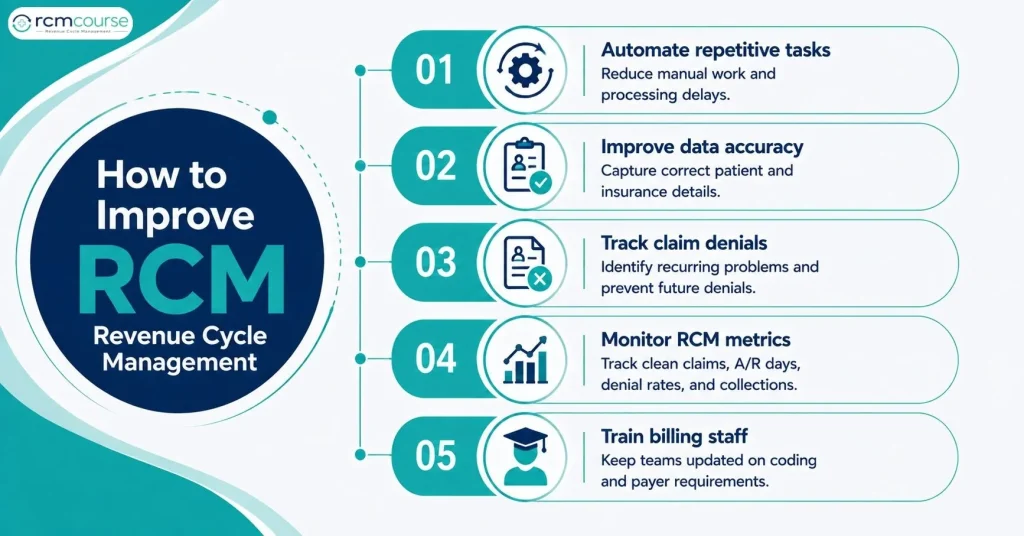
A few consistent habits tend to separate practices with a smooth revenue cycle from those constantly fighting fires:
- Automate repetitive tasks. Eligibility checks, claim scrubbing, and payment posting are all well suited to automation, freeing staff to focus on exceptions rather than routine processing.
- Improve front-end data accuracy. Since most downstream errors start at registration, investing in accurate data capture at the very first patient touchpoint pays off throughout the entire cycle.
- Track denials. Reviewing denial trends regularly, not just handling them one by one, is what turns denial management into denial prevention.
- Monitor key RCM metrics. Keep a close eye on clean claim rate, days in A/R, denial rate, and net collection rate, since these numbers tell you where the cycle is actually breaking down.
- Train billing staff. Payer rules and coding requirements change constantly, so ongoing training keeps the team’s day-to-day work aligned with current requirements rather than last year’s.
FAQs
How does RCM improve medical billing?
RCM improves medical billing by adding verification and error-checking steps throughout the entire billing process, not just at claim submission, which raises clean claim rates, reduces denials, and speeds up payment collection.
What is the difference between RCM and medical billing?
Medical billing is the process of coding and submitting claims after a visit; RCM is the broader end-to-end process that starts at scheduling and eligibility verification and continues through payment posting and denial recovery.
How does RCM reduce claim denials?
RCM reduces claim denials by identifying the root causes behind them, such as eligibility issues or coding errors, and adjusting upstream processes so those errors are caught before a claim is ever submitted.
What is the difference between Medical Billing vs Revenue Cycle Management?
Medical Billing focuses mainly on preparing claims and collecting payments, while Revenue Cycle Management covers the complete financial process from patient registration to final payment collection.
What are the main steps in healthcare RCM?
The main steps are patient registration and eligibility verification, prior authorisation, charge capture and coding, claim submission and scrubbing, payment posting, denial management, and patient billing and collections.
Conclusion
Revenue Cycle Management (RCM) improves medical billing by turning separate billing activities into one connected, end-to-end financial process. From accurate patient registration and insurance verification to clean claim submission, denial management and patient payment collection, every stage works together to reduce errors and improve revenue performance.
Effective RCM helps healthcare providers achieve higher clean claim rates, fewer denials, faster reimbursements, lower A/R days and better control over revenue leakage. It also reduces repetitive administrative work by using automation for tasks such as eligibility checks, claim scrubbing, payment posting and claim tracking.
The biggest improvement often starts before a claim is submitted. Accurate patient data, timely eligibility verification, correct coding and proper prior authorisation can prevent many downstream billing problems before they occur. When these front-end processes are combined with strong denial analysis, payment monitoring and patient-friendly billing, the entire revenue cycle becomes more efficient.
For healthcare organisations, improving RCM is not simply about getting claims paid faster. It is about creating a more reliable medical billing system that supports consistent cash flow, stronger financial control and a better experience for both staff and patients.
Revenue Cycle Management, commonly known as RCM, plays a central role in keeping healthcare billing accurate, efficient and financially sustainable. It connects the administrative and financial activities involved in patient care, from registration and insurance verification to claim submission, payment posting, denial management and final collection.
In medical billing, RCM is the complete financial process used to manage revenue throughout a patient’s journey. Medical billing is only one part of this wider cycle. RCM also focuses on preventing errors before claims are submitted, improving clean claim rates, reducing denials and accelerating reimbursement.
A strong RCM process can help healthcare providers reduce revenue leakage, improve cash flow, minimise administrative rework and create a clearer billing experience for patients.
This guide explains what RCM is in medical billing, how it works, how it differs from traditional medical billing, and why it is important for healthcare organisations.
What Is RCM in Medical Billing?
RCM is the complete financial lifecycle of a patient encounter, covering everything from the moment an appointment is booked to the moment the account is fully paid and closed.
It typically includes:
- Patient registration and scheduling
- Insurance eligibility verification
- Medical coding
- Charge capture
- Claims submission
- Payment posting
- Denial management
- Patient billing and collections
Medical billing sits inside this cycle rather than replacing it. Billing handles the claim itself: coding the service, submitting it to the payer, and processing the payment that comes back. RCM manages everything around that claim too, checking the patient was eligible before treatment even started, and following up on the account long after the claim has been submitted.
Is Medical Billing Part of RCM?
Yes. Medical billing is one component of Revenue Cycle Management. RCM includes billing but also manages the activities that happen before a claim is created and after it is submitted, such as eligibility checks, denial follow-up and patient collections.
6 Ways RCM Improves the Billing Process

RCM improves billing by catching problems at each stage of the cycle rather than waiting for a rejected claim to reveal them. Here is how that plays out in practice.
1. Prevents Errors Before They Happen
Most claim rejections trace back to something that went wrong before treatment was even provided, incorrect patient details, an inactive policy, or a service that needed prior authorisation. RCM verifies insurance and eligibility upfront, so these issues are caught at check-in rather than weeks later when a claim is denied.
2. Boosts Clean Claim Rates
A clean claim is one that gets accepted and paid the first time, with no corrections needed. RCM software scrubs claims automatically before submission, checking for missing information, incorrect codes and payer-specific rule violations. Practices with strong claim scrubbing routinely submit far fewer claims that bounce back.
3. Fixes Denied Claims Faster
When a claim is denied, RCM does not just resubmit it and hope for a different result. It analyses why the claim was rejected, corrects the underlying data, and resubmits with the fix applied. Over time, this also surfaces patterns, if the same payer keeps rejecting the same code, that is a signal to fix the process, not just the individual claim.
4. Speeds Up Payment
Days in accounts receivable (AR) is one of the clearest signs of a healthy revenue cycle. RCM shortens this by following up on unpaid claims persistently instead of letting them sit in a queue. The faster a claim moves from submission to payment, the healthier the practice’s cash flow.
5. Reduces Revenue Leakage
Missed charges, undercoding and claims that simply never get followed up all quietly drain revenue. RCM uses data and reporting to spot these gaps, work that is nearly impossible to do with billing alone, since billing typically only tracks claims that have already been submitted.
6. Improves Patient Trust
Confusing bills and limited payment options frustrate patients and slow down collections. RCM supports clear, itemised statements and easy online payment, which improves the patient’s experience and gets balances paid sooner.
How Is RCM Different From Traditional Medical Billing?
The clearest way to see the difference is side by side.
| Traditional Billing | Revenue Cycle Management |
| Focuses on submitting claims and waiting for payment | Manages the full financial lifecycle, before, during and after treatment |
| Starts after the patient has been treated | Starts at scheduling, with eligibility checks before treatment |
| Reacts to denials as they arrive | Analyses denial patterns to prevent repeat errors |
| Tracks individual transactions | Tracks the overall financial workflow and performance |
| Limited reporting | Uses data analytics to find systemic bottlenecks |
Traditional billing is transactional. It asks: was this claim paid? RCM is operational. It asks: why do claims like this get denied, and what needs to change so it stops happening?
Why Is RCM Important in the Healthcare Industry?
Healthcare organisations run on reimbursement for services already delivered, which makes an efficient revenue cycle a matter of financial survival, not just administrative tidiness.
- Protects revenue. Providers only get paid for care they have already given, so every denied or delayed claim is money already spent that has not come back yet.
- Supports financial stability. Predictable cash flow allows practices to pay staff, maintain equipment and invest in patient care without relying on reserves.
- Reduces administrative waste. Automated eligibility checks and claim scrubbing cut down on the repetitive manual correction work that eats up staff time.
- Supports compliance. Consistent coding and documentation standards reduce the risk of compliance issues with payers and regulators.
- Improves patient experience. Clear communication about costs and easy payment options build trust and reduce disputes.
The RCM Process, Step by Step
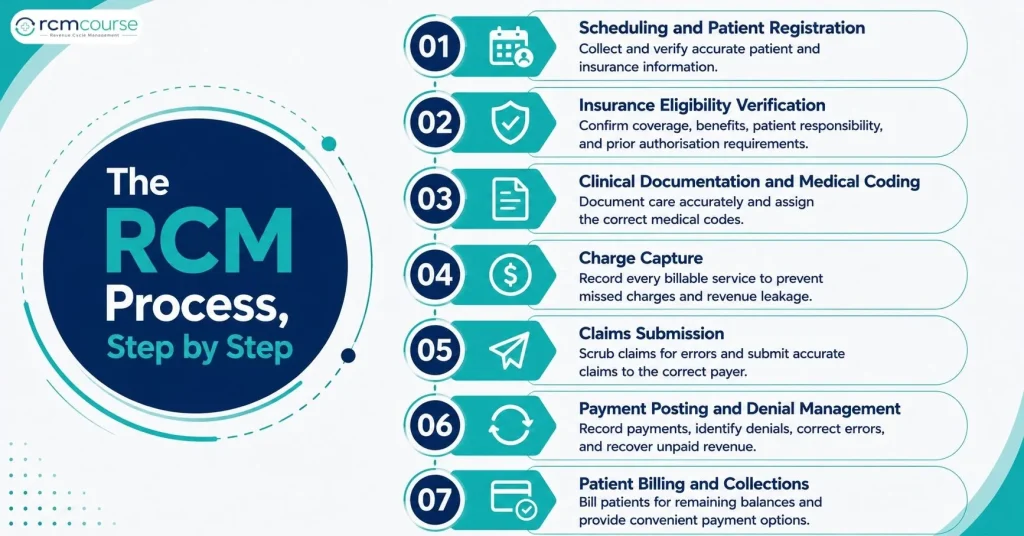
A typical Revenue Cycle Management (RCM) process moves through seven connected stages. Each stage plays an important role in ensuring healthcare providers capture charges accurately, submit clean claims, receive timely reimbursement, and collect any remaining patient balances.
1. Scheduling and Patient Registration
The revenue cycle begins when a patient schedules an appointment and provides their personal and insurance information. Accurate registration is essential because incorrect information can create problems later in the billing process.
During registration, the healthcare provider typically collects and verifies details such as:
- Patient name, date of birth, address, and contact information
- Insurance provider and policy details
- Member and group numbers
- Referring provider information, where required
- Appointment and service details
- Relevant demographic information
Accurate registration reduces the risk of claim rejections caused by incorrect or incomplete patient information. It also creates the foundation for eligibility verification, billing, and claims processing.
2. Insurance Eligibility Verification
Before treatment is provided, the practice verifies whether the patient’s insurance is active and whether the planned service is covered under the patient’s health plan.
Eligibility verification may confirm:
- Whether the insurance policy is active
- Coverage and benefit details
- Copayments and deductibles
- Coinsurance requirements
- Out-of-pocket limits
- Service-specific coverage
- Prior authorisation requirements
Performing these checks before treatment helps prevent unexpected billing problems. For example, if a service requires prior authorisation, the practice can obtain approval before providing the service rather than discovering the issue after the claim has been denied.
3. Clinical Documentation and Medical Coding
After the patient receives care, the healthcare provider documents the services, diagnoses, procedures, and treatments provided. This clinical information is then translated into appropriate medical codes.
Depending on the service and healthcare setting, coding may involve systems such as ICD-10-CM, CPT, and HCPCS Level II.
Accurate coding is essential because these codes communicate to the payer what condition was treated and what services were provided. Incorrect, incomplete, or unsupported coding can result in claim rejections, denials, payment delays, or compliance issues.
4. Charge Capture
Charge capture ensures that every billable service provided to the patient is recorded and included in the billing process.
The practice reviews clinical documentation and other relevant records to identify services that should be billed. These may include consultations, procedures, diagnostic tests, treatments, supplies, or other billable services.
Effective charge capture helps prevent revenue leakage, which occurs when services are provided but the associated charges are missed or incorrectly recorded.
A missed charge may appear small on an individual claim, but repeated missed charges across hundreds or thousands of encounters can create a significant financial impact on a healthcare organisation.
5. Claims Submission
Once patient information, insurance details, documentation, codes, and charges have been reviewed, the claim is prepared for submission to the appropriate payer.
Before submission, many RCM processes use claim scrubbing to identify potential problems, such as:
- Missing patient or insurance information
- Invalid or outdated codes
- Incorrect modifiers
- Coding inconsistencies
- Missing required information
- Payer-specific billing rule violations
Claims that pass these checks are submitted electronically to the payer for processing. Accurate and timely submission helps reduce avoidable rejections and speeds up the reimbursement process.
6. Payment Posting and Denial Management
After the payer processes a claim, the healthcare organisation receives payment and an explanation of how the claim was adjudicated. The payment is posted to the appropriate patient account and matched against the original claim.
If the payer pays less than expected or denies the claim, the billing team investigates the reason.
Denial management may involve:
- Reviewing the denial reason
- Identifying the underlying error
- Correcting patient, coding, or claim information
- Obtaining additional documentation
- Resubmitting the claim
- Filing an appeal when appropriate
- Following up with the payer
Effective denial management helps providers recover revenue that might otherwise remain unpaid or eventually be written off.
7. Patient Billing and Collections
After insurance has processed the claim, any remaining balance that is the patient’s responsibility is transferred to patient billing.
The patient’s balance may include deductibles, copayments, coinsurance, or other amounts not covered by insurance. The provider sends a statement explaining the amount owed and provides available payment methods.
Modern RCM processes may support:
- Online payment portals
- Electronic statements
- Text-to-pay options
- Automated payment reminders
- Payment plans
- Digital receipts
The cycle continues until the outstanding balance is paid, adjusted appropriately, or otherwise resolved according to the provider’s billing and collection policies.
How the Seven Stages Work Together
These seven stages are not independent tasks. They form a connected revenue cycle, meaning an error at one stage can create problems several stages later.
For example, an incorrect insurance policy number during registration can cause an eligibility verification failure. If that issue is not identified before treatment, the resulting claim may later be rejected or denied. The billing team then has to investigate the problem, correct the information, resubmit the claim, and wait for the payer to process it.
This is why effective Revenue Cycle Management in Healthcare focuses on the entire process rather than treating registration, coding, billing, payment posting, and collections as separate functions. The goal is to identify problems as early as possible, maintain accurate information throughout the cycle, and ensure the healthcare provider receives appropriate reimbursement for the services it delivers.
Frequently Asked Questions
What is RCM in medical billing?
RCM, or Revenue Cycle Management, is the process healthcare organisations use to manage the entire financial journey of a patient encounter, from scheduling and eligibility checks through to claims submission and final payment. Medical billing is one part of this broader process.
What is the role of revenue cycle management in medical billing?
RCM’s role is to coordinate everything that affects whether a claim gets paid correctly and on time. This includes verifying eligibility before treatment, scrubbing claims for errors, managing denials, and following up on outstanding balances until the account is resolved.
How do the Steps in Revenue Cycle Management improve healthcare payments?
The Steps in Revenue Cycle Management help maintain accurate billing information, prevent errors, improve claim approval rates, and ensure healthcare providers receive payments efficiently.
How is RCM different from medical billing?
Medical billing focuses narrowly on submitting a claim and processing the payment that comes back. RCM covers the full financial lifecycle, including everything that happens before the claim is created and after it is submitted, using data to spot and fix recurring problems.
Why is revenue cycle management important in the healthcare industry?
RCM protects revenue that has already been earned through delivered care, supports stable cash flow, reduces administrative rework, and improves the patient’s financial experience. Without it, practices lose money to denied claims, slow collections and preventable billing errors.
Conclusion
Revenue Cycle Management provides healthcare organisations with a structured way to manage the entire financial journey of patient care. Rather than focusing only on submitting claims, RCM connects registration, eligibility verification, coding, charge capture, claims processing, payment posting, denial management and patient collections.
A well-managed revenue cycle can prevent errors before claims reach payers, improve clean claim rates, reduce avoidable denials and shorten payment delays. It can also help providers identify missed charges and underpayments while giving patients clearer information about their financial responsibilities.
The key difference is that medical billing is one part of RCM, while RCM manages the complete revenue cycle. When each stage works together effectively, healthcare providers can reduce administrative rework, protect revenue, maintain healthier cash flow and create a smoother billing experience for patients.
Ultimately, understanding what RCM is in medical billing helps explain why successful healthcare billing begins long before a claim is submitted and continues until every account is appropriately resolved.
The benefits of Revenue Cycle Management (RCM) go far beyond simply processing medical bills. Effective RCM helps healthcare providers improve cash flow, reduce claim denials, prevent revenue loss, lower administrative workload, and create a clearer billing experience for patients.
It manages the entire financial journey of patient care, from appointment scheduling and insurance verification to medical coding, claim submission, payment collection, and final account reconciliation.
For healthcare organisations, even small billing errors can have a significant financial impact. Incorrect patient information, coding mistakes, missed charges, delayed claims, or unresolved denials can slow reimbursement and increase the cost of collecting revenue. A structured Revenue Cycle Management process helps identify and prevent these problems before they become costly.
In this guide, we explain why RCM matters in healthcare, the main financial and operational benefits of RCM, how it improves the patient experience, which metrics healthcare providers should track, and the career opportunities available within revenue cycle management.
What Is Revenue Cycle Management and Why Is It Important?
Revenue Cycle Management is the set of administrative and clinical functions that capture, manage, and collect revenue from patient services, covering everything from the first appointment booking to the final payment reconciliation.
It matters because it is the mechanism that turns clinical work into paid revenue. Without a well-run revenue cycle, even a busy, clinically excellent practice can struggle financially.
How Does the Revenue Cycle Work?
The revenue cycle is a chain of connected steps, and a weakness in any one of them affects everything downstream. A typical cycle looks like this:
1. Patient scheduling – the first data capture point, where names, contact details, and appointment reasons are logged.
2. Registration – confirming demographic and insurance details.
3. Insurance eligibility verification – checking coverage, co-pays, and deductibles before the appointment.
4. Prior authorisation – securing payer approval for procedures that require it.
5. Medical coding – translating clinical documentation into billing codes.
6. Charge capture – recording every billable service provided.
7. Claim submission – sending the claim to the payer.
8. Payment posting – recording what the payer and patient actually pay.
9. Denial management – identifying and correcting rejected or underpaid claims.
10. Patient billing and collections – invoicing the patient for any remaining balance.
What Is the Main Purpose of RCM?
The main purpose of RCM is to make sure a healthcare organisation is paid accurately and promptly for the care it delivers, while keeping the billing process efficient, compliant, and transparent for patients.
When any stage in the cycle breaks down, whether that is a data entry mistake at registration or a coding error further along, the impact shows up as delayed payment, denied claims, or lost revenue.
10 Benefits of Revenue Cycle Management : Key Benefits of Using RCM

1. Faster Cash Flow
One of the biggest benefits of Revenue Cycle Management is improved cash flow. RCM helps healthcare providers reduce payment delays by ensuring that patient information, insurance details, medical coding, and claim documentation are accurate before claims are submitted.
By identifying errors early and following up on unpaid claims, healthcare organisations can receive payments faster and maintain a more predictable revenue stream.
2. Fewer Claim Denials
RCM helps reduce claim denials by identifying common problems before claims reach insurance companies. Issues such as incorrect patient details, inactive insurance coverage, missing authorisation, coding errors, and incomplete documentation can be detected and corrected early.
This improves the clean claim rate, reduces rework, and allows billing teams to spend more time managing complex cases instead of fixing preventable mistakes.
3. Reduced Revenue Leakage
Revenue leakage happens when healthcare organisations fail to collect the full payment they are entitled to receive. Effective RCM helps prevent this by monitoring charge capture, reviewing coding accuracy, analysing payments, and identifying underpayments.
These processes ensure that healthcare providers do not lose revenue due to missed charges, incorrect billing, or payment discrepancies.
4. Lower Administrative Workload
Revenue Cycle Management reduces the amount of manual work required for healthcare billing operations. Automation and improved workflows support tasks such as insurance verification, claim submission, payment posting, patient statements, and denial tracking.
This allows administrative teams to spend less time on repetitive tasks and focus on activities that require professional judgement and problem-solving.
5. Reduced Staff Burnout
A poorly managed revenue cycle can create pressure for billing and administrative teams due to repeated claim corrections, payment follow-ups, and billing disputes.
RCM reduces this workload by preventing errors earlier in the process and creating clearer responsibilities. With fewer repetitive challenges, staff can work more efficiently and experience a more manageable workload.
6. Improved Billing Compliance
RCM supports healthcare organisations in maintaining accurate and compliant billing practices. It helps ensure that claims follow payer requirements, coding standards, documentation rules, and regulatory expectations.
Regular reviews, audit trails, and accurate record management reduce compliance risks and help prevent issues such as payment delays, audits, or repayment demands.
7. Better Billing Transparency for Patients
RCM improves the patient financial experience by making healthcare costs easier to understand. Through accurate insurance verification and cost estimation, patients can receive clearer information about their coverage, expected payments, deductibles, and out-of-pocket expenses.
This reduces confusion, prevents unexpected bills, and helps build greater trust between patients and healthcare providers.
8. Easier Payment Options
Modern RCM systems make it easier for patients to manage and complete healthcare payments. Digital payment portals, electronic statements, payment reminders, and flexible payment plans provide more convenient options for settling balances.
These improvements help patients manage their healthcare expenses while allowing providers to improve payment collection.
9. More Focus on Patient Care
Efficient RCM processes reduce the amount of time healthcare teams spend dealing with billing-related issues. Accurate registration, proper documentation, correct coding, and effective insurance checks help prevent financial problems before they affect patients.
As a result, healthcare professionals can spend more time focusing on delivering quality patient care.
10. Improved Operational Efficiency
Revenue Cycle Management connects different stages of healthcare financial operations, from patient registration and insurance verification to coding, claims, payments, and collections.
By creating organised workflows and improving communication between departments, RCM helps healthcare organisations operate more efficiently, reduce delays, and create a smoother revenue management process.
Why Is Efficient RCM Crucial for Healthcare Providers?
Efficient RCM is crucial because it directly protects a provider’s cash flow, keeps collection costs under control, and supports accurate financial forecasting, all of which underpin long-term sustainability. A healthcare organisation can deliver excellent clinical care and still be financially unstable if its revenue cycle is inefficient.
The knock-on effect of a single weak point in the cycle is easy to trace. Consider a common scenario: a patient’s insurance details are entered incorrectly at registration. That error causes the claim to be rejected by the payer.
Staff then have to identify the mistake, correct it, and resubmit the claim, which delays reimbursement by weeks and adds direct administrative cost to a claim that should have been paid the first time. Multiply that across hundreds of claims a month, and the cumulative effect on cash flow and staffing capacity becomes significant.
Beyond day-to-day cash flow, efficient RCM supports staffing decisions, investment planning, and resource allocation, because leadership can trust that revenue projections reflect what is actually being collected rather than what is theoretically owed.
How Can Providers Measure the Benefits of RCM?

Providers can measure RCM performance using a handful of core metrics: clean claim rate, initial denial rate, Days in Accounts Receivable, appeal recovery rate, revenue write-offs, and cost to collect. Tracking these consistently shows whether RCM improvements are actually translating into financial results.
1. Clean claim (first-pass) rate – the percentage of claims paid on first submission without correction. A higher rate means fewer errors are reaching the payer in the first place.
2. Initial denial rate – the percentage of claims denied on first submission. A falling denial rate is one of the clearest signs that front-end data capture and coding have improved.
3. Days in Accounts Receivable – the average number of days it takes to collect payment after a service is provided. Lower is better, and it reflects the overall speed of the revenue cycle.
4. Appeal recovery rate – the percentage of denied claims successfully appealed and paid. This shows how effectively the organisation recovers revenue that was initially lost to a denial.
5. Revenue write-offs – the value of claims the organisation gives up trying to collect. A declining trend usually points to stronger upfront verification and fewer preventable errors.
6. Cost to collect – the administrative cost of collecting each pound of revenue. Automation and process improvement should bring this figure down over time.
Careers in Revenue Cycle Management

RCM is also a well-established career path within healthcare administration, spanning entry-level billing roles through to senior revenue cycle leadership positions.
Common RCM Roles
1. Medical Billing Specialist – prepares and submits claims, and manages patient billing.
2. Medical Coder – translates clinical documentation into standardised billing codes.
3. Claims Specialist – reviews and processes claims for accuracy before submission.
4. Denial Management Specialist – investigates denied claims, corrects errors, and resubmits or appeals.
5. Accounts Receivable Specialist – follows up on unpaid claims and manages outstanding balances.
6. Revenue Cycle Analyst – tracks performance metrics and identifies process improvements.
7. Revenue Cycle Manager or Director – oversees the entire revenue cycle function and reports on financial performance to leadership.
Salary Overview
RCM salaries vary considerably by role, seniority, employer size, healthcare setting, location, and certification. Entry-level billing and claims roles typically sit at the lower end of the scale, mid-level analyst and specialist roles pay more with experience and certification, and management or director-level positions command the highest salaries given their scope of responsibility.
Because pay ranges shift year to year and by region, it is worth checking a current salary comparison site or recruiter data for up-to-date figures relevant to your location before relying on any specific number.
Real-World Experience Examples
If you are building or reviewing an RCM resume, concrete, measurable examples carry far more weight than generic duties. A few examples of what this looks like in practice:
1. Verified patient insurance eligibility and benefits prior to appointments, reducing eligibility-related denials.
2. Reviewed and corrected coding discrepancies before claim submission, improving the first-pass acceptance rate.
3. Investigated denied claims, identified root causes, and resubmitted corrected claims within payer deadlines.
4. Monitored aged accounts receivable and followed up with payers to accelerate outstanding collections.
5. Reconciled payer remittances against expected reimbursement to identify and recover underpayments.
5 Key Beneficiaries of Effective Revenue Cycle Management

1. Healthcare providers benefit from more predictable revenue, fewer payment delays, and less time spent correcting preventable billing problems. This gives them better control over cash flow and day-to-day financial operations.
2. Billing and administrative teams work with clearer, more standardised workflows that reduce repetitive tasks and common errors. This allows staff to focus more on complex claims, denials, and patient support.
3. Clinical staff spend less time dealing with billing disputes, coding queries, and administrative follow-ups. As a result, they can focus more attention on delivering patient care.
4. Patients receive clearer information about costs, easier-to-understand bills, and more flexible payment options. This can reduce confusion, unexpected charges, and billing-related stress.
5. Healthcare organisations as a whole gain stronger financial visibility, improved compliance, and better control over revenue performance. Over time, effective RCM supports greater financial stability and more sustainable healthcare operations.
Frequently Asked Questions
What is revenue cycle management and why is it important?
Revenue Cycle Management is the process of tracking a patient’s financial journey from scheduling through to final payment, covering registration, coding, billing, and collections. It is important because it directly determines how efficiently and accurately a healthcare provider gets paid for the care it delivers.
What are the benefits of using RCM?
RCM improves financial performance through faster cash flow, fewer claim denials, and reduced revenue leakage. It also boosts operational efficiency by lowering administrative workload and improving compliance, while giving patients a clearer, less stressful billing experience.
Why is efficient RCM crucial for healthcare providers?
Efficient RCM protects a provider’s cash flow, keeps collection costs down, and supports accurate financial forecasting. Without it, even clinically strong organisations can face cash flow problems caused by preventable claim denials and administrative delays.
How does RCM reduce claim denials?
RCM reduces denials by catching errors before a claim is submitted, through accurate insurance verification, correct coding, and complete documentation. This raises the first-pass acceptance rate and cuts the rework needed to correct and resubmit rejected claims.
How does RCM improve cash flow?
RCM improves cash flow by shortening the time between service delivery and payment. Faster, cleaner claim submission and prompt follow-up on outstanding balances reduce Days in Accounts Receivable, so money reaches the organisation sooner.
Does RCM improve patient satisfaction?
Yes. Clear upfront cost estimates, simple statements, and flexible payment options reduce billing confusion and disputes, which improves the overall patient experience alongside the quality of clinical care.
What skills are needed for a career in revenue cycle management?
Useful skills include attention to detail, familiarity with medical coding and billing systems, understanding of payer requirements and insurance processes, and strong problem-solving skills for identifying and resolving denials or discrepancies.
Conclusion
Revenue Cycle Management plays a vital role in keeping healthcare organisations financially stable and operationally efficient. By managing every stage from patient scheduling and insurance verification to coding, claim submission, denial management, and final payment, RCM helps providers reduce errors, improve cash flow, and prevent unnecessary revenue loss.
Effective RCM also benefits patients by creating clearer billing processes, improving cost transparency, and making payments easier to manage. At the same time, strong revenue cycle processes reduce administrative pressure on staff and provide healthcare leaders with more reliable financial information for planning and decision-making.
For healthcare providers, improving RCM is therefore more than a billing priority. It is an essential part of delivering sustainable, efficient, and patient-focused healthcare while creating valuable career opportunities across medical billing, coding, claims management, analytics, and revenue cycle leadership.
Claim denials in medical billing can be reduced by preventing errors before a claim reaches the payer. The most effective strategies include verifying patient and insurance information, confirming eligibility and prior authorisation requirements, improving coding and documentation accuracy, scrubbing claims before submission, and tracking denial trends to prevent repeat problems.
Medical claim denials can delay reimbursement, increase administrative work, raise accounts receivable, and contribute to lost revenue. Many are preventable because they result from recurring issues such as incorrect patient information, inactive insurance coverage, missing authorisation, coding errors, incomplete documentation, duplicate claims, and payer-specific billing requirements.
Effective claim denial management therefore combines prevention, correction, and continuous analysis. Tracking why claims are denied helps healthcare organisations identify recurring problems, improve billing workflows, and prevent the same errors from affecting future claims.
This guide explains how to reduce claim denials in medical billing, the most common causes of denials, how to manage denied claims effectively, and how denial tracking, claim scrubbing, and technology can support cleaner claims, faster reimbursement, and stronger revenue cycle performance.
What Is a Claim Denial in Medical Billing?
A claim denial happens when a payer receives and fully processes a claim, then decides it will not pay it. The claim was valid enough to reach adjudication, but something in it, whether a coding issue, a missing authorisation, or a medical necessity question, meant the payer refused payment.
Denied claims matter because they directly delay or reduce reimbursement. The specific denial reason on the remittance advice determines what happens next: some denials can simply be corrected and resubmitted, others require additional documentation, and some need a formal appeal.
Claim Denial vs Claim Rejection: What Is the Difference?

A denied claim has been processed by the payer and refused payment, while a rejected claim was never processed at all because it failed a basic validation check. Rejections usually come back almost immediately, often before the claim even reaches the payer’s adjudication system, because of a technical error such as an invalid member ID or a formatting mistake.
Knowing which one you are dealing with matters because the fix is different. A rejection needs a straightforward correction and resubmission. A denial needs you to understand the payer’s specific reason for refusing payment before you touch the claim again, otherwise you risk submitting the same error twice.
How to Reduce Claim Denials in Medical Billing : Most Common Reasons for Claim Denials?

The vast majority of medical billing denials come from a relatively small group of recurring problems. Many of these issues happen before the claim is submitted, during patient registration, insurance verification, authorisation, coding, documentation, or provider setup. Identifying these problems early is far more efficient than correcting or appealing claims after payment has already been delayed.
Understanding the most common reasons for claim denials also helps healthcare organisations identify which part of the revenue cycle needs improvement. Some denials originate at the front desk, while others are caused by coding, clinical documentation, credentialing, or claim submission errors.
Incorrect Patient or Insurance Information
Incorrect patient or insurance information is one of the most preventable causes of claim denials. Even a small data-entry error can prevent a payer from correctly matching a claim to the patient’s insurance record.
Common problems include:
- Misspelt patient names
- Incorrect dates of birth
- Wrong member or policy numbers
- Missing subscriber information
- Incorrect group numbers
- Billing the wrong insurance company
- Using outdated insurance information
- Submitting a claim after coverage has expired
These errors often begin during registration. For example, a patient may have changed insurance plans since their previous visit, but the old payer information remains in the billing system. If staff do not confirm the current insurance card and patient details, the claim may be sent to the wrong payer or linked to inactive coverage.
The best way to prevent these denials is to verify demographic and insurance information at every relevant encounter and update the billing system immediately when changes are identified.
Eligibility and Coverage Problems
Eligibility denials occur when the patient’s insurance coverage is inactive, the service is not covered under the plan, or payer requirements were not identified before treatment.
Simply confirming that a patient has insurance is not enough. Billing teams should verify whether the policy is active on the date of service and whether the planned treatment is covered under that specific benefit plan.
Common eligibility and coverage problems include:
- Inactive insurance coverage
- Coverage ending before the date of service
- Services excluded from the patient’s plan
- Incorrect primary or secondary insurance
- Benefit limits already reached
- Services requiring prior authorisation
- Referral requirements not identified
- Incorrect coordination of benefits information
These denials can be especially costly because the problem may not be discovered until after care has already been provided.
Real-time eligibility verification can help staff confirm coverage status, benefit details, copayments, deductibles, and payer requirements before the patient receives the service.
Missing Prior Authorisation or Referral
Many insurance plans require approval before certain procedures, treatments, diagnostic tests, or specialist services are provided. If the required prior authorisation is missing, expired, or does not match the service billed, the payer may refuse payment.
Prior authorisation denials can occur when:
- Authorisation was never obtained
- Authorisation was requested too late
- The approved dates do not cover the service date
- The approved procedure differs from the procedure performed
- The authorised number of visits or units has been exceeded
- An authorisation number was entered incorrectly
- A required specialist referral was missing or expired
Billing and clinical teams should therefore confirm authorisation requirements before scheduled services are delivered.
The authorisation record should clearly document the approved service, effective dates, number of visits or units, authorisation number, and any payer-specific conditions. If the planned treatment changes, the authorisation may also need to be updated before the new service is provided.
Medical Necessity Issues
Medical necessity denials happen when the payer determines that the submitted documentation does not sufficiently justify why a service, procedure, or treatment was required.
The service may have been clinically appropriate, but the claim can still be denied if the documentation or diagnosis information does not meet the payer’s coverage criteria.
Common causes include:
- Diagnosis codes that do not support the procedure
- Missing clinical justification
- Incomplete medical records
- Documentation that does not demonstrate severity
- Services outside payer coverage criteria
- Frequency limits being exceeded
- Required supporting records not submitted
Medical necessity is closely connected to both clinical documentation and coding accuracy. The diagnosis reported on the claim should reflect the patient’s documented condition, while the medical record should clearly explain why the billed service was required.
Healthcare organisations can reduce these denials by reviewing payer medical policies for frequently performed procedures and making sure clinical documentation supports the service before the claim is submitted.
Coding Errors
Coding errors are a major source of claim denials because payers rely on diagnosis, procedure, and modifier codes to determine what service was performed and whether it qualifies for reimbursement.
Common coding-related denial causes include:
- Incorrect CPT codes
- Incorrect HCPCS codes
- Incorrect ICD-10-CM diagnosis codes
- Missing modifiers
- Incorrect modifier use
- Diagnosis and procedure mismatches
- Outdated or deleted codes
- Incorrect code sequencing
- Unbundling or bundling problems
- Coding that is not supported by documentation
For example, a procedure may be coded correctly, but the diagnosis code reported with it may not support medical necessity under the payer’s policy. Similarly, a missing modifier can change how the payer interprets the service and result in reduced or denied payment.
Coding teams should use the most current code sets, follow official coding guidelines, review payer-specific requirements, and confirm that documentation supports every code reported on the claim.
Regular coding audits and ongoing staff training can also help identify patterns before they become repeated denials.
Provider Credentialing Problems
Provider credentialing determines whether a healthcare professional is recognised by a payer and authorised to bill for covered services.
Claims may be denied when:
- A new provider has not completed credentialing
- Credentialing has expired
- Recredentialing was not completed on time
- Provider identifiers do not match payer records
- The provider is not enrolled for a particular service location
- The provider is considered out of network
- Incorrect National Provider Identifier information is submitted
- Group and individual provider records do not match
Credentialing problems can create significant payment delays because correcting the claim alone may not resolve the issue. The underlying provider enrolment or payer record may first need to be updated.
Healthcare organisations should maintain a credentialing calendar, monitor expiration and recredentialing dates, and verify provider information whenever a clinician joins the organisation, changes locations, or begins billing a new payer.
Duplicate Claims
Duplicate claim denials occur when a payer receives what appears to be the same claim more than once.
This can happen when:
- Staff resubmit a claim without checking its status
- A claim is transmitted twice accidentally
- A previously denied claim is submitted again unchanged
- A corrected claim is sent as a new claim
- Multiple departments submit the same service
- The original claim reference number is missing
A claim that appears unpaid is not necessarily lost. It may still be in processing, suspended for review, or awaiting additional information.
Before resubmitting a claim, billing staff should check the payer portal, clearinghouse, or claim tracking system to determine its current status.
When corrections are necessary, teams should follow the payer’s corrected claim process rather than simply submitting the same claim again. This helps prevent the corrected submission from being treated as a duplicate.
Incorrect Place of Service or Revenue Codes
Place-of-service and revenue code errors can cause denials because they tell the payer where the service was performed and what type of facility or department provided it.
A mismatch between these codes and the billed procedure can make the claim appear inconsistent.
Common problems include:
- Using the wrong place-of-service code
- Reporting an office service as a hospital service
- Incorrect facility coding
- Revenue codes that do not match the procedure
- Incorrect default codes in the billing system
- Inconsistencies between the claim and medical record
- Using outdated internal billing configurations
These errors can occur when billing systems automatically populate codes based on old templates or incorrect default settings.
Healthcare organisations should therefore periodically review billing-system configurations, confirm that place-of-service and revenue codes reflect where care was actually delivered, and make sure they align with the procedure and payer requirements.
Why Identifying the Root Cause Matters
Fixing a single denied claim may recover one payment, but identifying the root cause of the denial can prevent the same problem from affecting dozens or hundreds of future claims.
For example:
- Repeated eligibility denials may point to weak front-desk verification.
- Frequent authorisation denials may indicate a scheduling workflow problem.
- Coding denials may suggest a need for additional coder training or audits.
- Documentation denials may reveal gaps between clinicians and billing teams.
- Credentialing denials may indicate poor tracking of provider enrolment dates.
For this reason, healthcare organisations should not treat denials as isolated billing problems. Each denial provides data that can be used to improve the revenue cycle, strengthen workflows, and reduce future revenue loss.
10 Ways to Reduce Claim Denials in Medical Billing

Reducing claim denials in medical billing depends on identifying and correcting problems before the claim is submitted to the payer. The most effective denial prevention process starts at patient registration and continues through eligibility verification, authorisation, coding, documentation, credentialing, claim scrubbing, and final submission.
The following ten steps create a practical front-to-back workflow that can help healthcare organisations submit cleaner claims, reduce avoidable rework, and improve reimbursement performance.
1. Verify Insurance Eligibility Before Every Visit
Insurance eligibility should be checked before every scheduled service, even when the patient has visited the organisation before. Coverage can change between appointments, and relying on previously stored information can lead to avoidable denials.
Billing or front-desk staff should confirm:
- The patient’s insurance policy is active.
- Coverage is valid on the planned date of service.
- Effective and termination dates are correct.
- The scheduled service is covered under the patient’s plan.
- Copayment and deductible requirements are understood.
- Prior authorisation is required or not required.
- Referral requirements apply.
- Benefit limits have not already been reached.
- Primary and secondary insurance are correctly identified.
Eligibility verification should focus on the specific service being provided, not simply whether the patient has active insurance.
For example, a patient may have active coverage but their plan may exclude a particular procedure or require prior authorisation before payment is considered. Identifying this before treatment allows staff to resolve the issue before the claim is created.
Where available, real-time eligibility verification tools can make this process faster and more consistent by retrieving payer information electronically.
2. Collect Accurate Patient Information
Accurate patient information is essential because even small registration errors can cause claim rejections or denials.
Staff should verify information directly with the patient rather than relying entirely on information already stored in the system.
Important details include:
- Full legal name
- Correct spelling
- Date of birth
- Current address
- Member or policy number
- Group number
- Subscriber name
- Patient relationship to subscriber
- Primary insurance
- Secondary insurance
- Current payer information
Insurance details should ideally be confirmed from the patient’s insurance card rather than from memory or old records.
This information should also be reviewed at every appropriate visit. A patient’s insurer, employer-sponsored plan, policy number, or secondary coverage may change at any time.
A reliable registration process can prevent errors from moving downstream into coding, claim generation, submission, and denial management.
3. Obtain Prior Authorisation Before Services
Prior authorisation is required by many payers for certain procedures, imaging services, medications, specialist treatments, and other higher-cost services.
If authorisation is required but not obtained before the service is delivered, the claim may be denied even when the treatment itself was medically appropriate.
Before the service takes place, staff should confirm:
- Whether prior authorisation is required.
- Which procedure or service has been approved.
- The authorisation number.
- The approved date range.
- The number of approved visits.
- The number of approved units.
- Any payer-specific restrictions.
- Whether the authorisation matches the actual planned service.
Authorisation details should be recorded accurately in the patient’s record and billing system.
Staff should also check whether the clinical plan has changed. If a different service, procedure, or number of units is provided from what the payer originally approved, the existing authorisation may no longer be sufficient.
A structured authorisation workflow helps prevent services from being delivered before payer requirements have been completed.
4. Verify Referral Requirements
Some payer plans require patients to obtain a referral before receiving specialist care.
A claim may be denied when:
- No referral was obtained.
- The referral has expired.
- The referral does not cover the service provided.
- The referral is for a different specialist.
- The referral dates do not include the actual service date.
- The permitted number of visits has already been used.
Referral requirements should therefore be checked during scheduling or eligibility verification, not after treatment has taken place.
Staff should confirm that the referral is valid and correctly documented before the appointment. Where necessary, the referring provider should be contacted early enough to resolve any missing information.
Including referral verification within the pre-service workflow can prevent another common source of avoidable denials.
5. Improve CPT, HCPCS and ICD-10 Coding Accuracy
Accurate medical coding plays a central role in claim approval because payers use coded information to understand what condition was treated and what service was provided.
Coding staff should make sure that:
- CPT codes accurately represent procedures and services.
- HCPCS codes are appropriate where required.
- ICD-10-CM codes reflect the documented diagnosis.
- Diagnosis codes support the procedures billed.
- Required modifiers are included.
- Modifiers are applied correctly.
- Codes are reported at the appropriate level of specificity.
- Code sequencing follows applicable guidelines.
- Documentation supports every reported code.
Using an incorrect diagnosis or procedure code can result in a denial even when the service itself was appropriate.
For example, the procedure code may be valid, but the diagnosis submitted with it may not support medical necessity under the payer’s policy.
Coding teams should avoid selecting codes based on assumptions or previous claims. Codes should always be based on the current clinical documentation.
Regular coding audits and targeted education can help identify recurring errors before they become repeated denial patterns.
6. Strengthen Clinical Documentation
Clinical documentation provides the evidence supporting the services reported on a claim.
Documentation should clearly explain:
- Why the patient received care.
- The patient’s relevant condition or symptoms.
- What services were performed.
- Why the service was medically necessary.
- The treatment or procedure provided.
- Relevant clinical findings.
- The provider’s assessment and plan.
A payer reviewer should be able to understand why the service was necessary without having to interpret vague or incomplete notes.
Documentation must also support the diagnosis and procedure codes submitted on the claim.
For example, if a higher-level service is billed, the medical record should contain sufficient information to support that level. If a particular procedure is reported, the documentation should clearly demonstrate that the procedure was actually performed.
Incomplete, inconsistent, or unclear documentation can lead to medical necessity denials, coding corrections, audit exposure, or delayed reimbursement.
Close communication between clinicians, coders, and billing staff can help identify documentation gaps early.
7. Keep Billing Codes Updated
Medical code sets and billing rules change regularly. Using deleted, outdated, or incorrect codes can cause otherwise valid claims to be denied.
Healthcare organisations should have a structured process for reviewing updates to:
- ICD-10-CM codes
- CPT codes
- HCPCS codes
- Modifiers
- Payer-specific billing rules
- Claim edits
- Internal billing configurations
When code changes take effect, outdated codes should be removed from templates, billing software, charge masters, and frequently used favourites.
Updating reference materials alone is not enough if the billing system continues to populate an old code automatically.
Billing, coding, compliance, and IT teams should therefore coordinate system updates to make sure the electronic health record, practice management system, and claims platform use current information.
Staff should also receive education when major code or rule changes affect commonly billed services.
8. Maintain Provider Credentialing
Provider credentialing problems can stop payment even when the patient information, coding, and documentation are correct.
Before a provider begins billing a payer, healthcare organisations should confirm that the provider has completed the required enrolment and credentialing process.
Important information to monitor includes:
- Credentialing status
- Effective dates
- Recredentialing deadlines
- National Provider Identifier details
- Tax identification information
- Practice location
- Group affiliation
- Network status
- Payer enrolment status
Credentialing should be completed before services are billed whenever possible.
Organisations should also monitor expiration dates and recredentialing requirements rather than waiting until claims start being denied.
Provider information submitted on the claim should match the information held by the payer. Differences in names, identifiers, locations, or group details can create payment problems.
Maintaining a central credentialing calendar can help billing and administrative teams avoid preventable credentialing-related denials.
9. Use Claim Scrubbing Before Submission
Claim scrubbing is one of the most effective final checks before a claim reaches the payer.
A claim scrubber reviews claim data for potential errors and alerts staff when something may need correction.
Common checks include:
- Missing patient information
- Invalid diagnosis codes
- Invalid procedure codes
- Missing modifiers
- Incorrect modifier combinations
- Diagnosis-procedure mismatches
- Duplicate claims
- Provider information errors
- Place-of-service issues
- Missing required fields
- Payer-specific formatting problems
Claim scrubbing does not replace accurate registration, coding, or documentation. Instead, it works as an additional quality-control layer.
Errors identified during claim scrubbing should be corrected before transmission rather than ignored and submitted anyway.
Organisations can also review scrubber reports to identify recurring mistakes. If the same error appears repeatedly, the underlying workflow may need to be changed rather than correcting each claim individually.
10. Submit Clean Claims on Time
The final step is making sure claims are complete, accurate, and submitted within payer deadlines.
Before submission, billing teams should confirm that:
- Patient information is complete.
- Insurance information is current.
- Eligibility has been verified.
- Required authorisation has been obtained.
- Required referrals are available.
- Provider information is correct.
- Coding is accurate.
- Documentation supports the claim.
- Required modifiers are included.
- Claim edits have been resolved.
- The claim passes scrubbing checks.
- The payer’s timely filing deadline has not been exceeded.
Timely filing limits vary by payer and contract, so billing teams should maintain a clear process for monitoring submission deadlines.
Claims should also be tracked after submission.
Staff should confirm whether each claim has been:
- Accepted
- Rejected
- Pending
- Adjudicated
- Paid
- Partially paid
- Denied
Active claim tracking allows problems to be identified early rather than waiting until an account becomes significantly overdue.
Build Denial Prevention Into the Entire Revenue Cycle
The strongest denial prevention strategy does not depend on one department. It requires coordination between scheduling, registration, eligibility teams, clinical staff, coders, billing specialists, credentialing teams, and revenue cycle managers.
Each stage should include its own quality checks.
For example:
- Registration teams verify patient information.
- Eligibility teams confirm coverage.
- Authorisation teams complete payer requirements.
- Clinicians create complete documentation.
- Coders assign accurate codes.
- Billing teams scrub and submit claims.
- Revenue cycle teams monitor denials and identify patterns.
When each department addresses errors at the point where they originate, fewer problems reach the payer.
The goal is not simply to correct denied claims faster. It is to build a repeatable denial prevention process that improves clean claim submission, reduces avoidable administrative work, speeds up reimbursement, and prevents the same errors from occurring again.
How Do You Manage a Denied Claim Effectively?

Managing a denial well means identifying the exact reason it happened, fixing the underlying cause rather than resubmitting blindly, and appealing when the denial is genuinely incorrect. Rushing this process usually just produces a second denial.
Identify the Exact Denial Reason
Review the remittance advice or payer response line by line, and record the specific denial reason and adjustment codes rather than a general summary. Determine whether the root cause is administrative, coding-related, eligibility-related, or clinical, since that determines the entire next step.
Correct the Claim Before Resubmitting
Fix the actual underlying error, not just the symptom, and follow the payer’s specific corrected-claim process rather than treating it like a fresh submission. Include the original claim reference number where the payer requires it, and never simply resubmit the same claim unchanged and hope for a different outcome.
Appeal Denials When Appropriate
Determine whether the denial is genuinely eligible for appeal, gather the supporting documentation the payer will actually need, and follow that payer’s specific appeal requirements exactly. Submit within the payer’s appeal deadline, and track the appeal through to resolution rather than assuming it was received.
How Do You Track Denial Trends to Prevent Repeat Errors?
Tracking denial trends means monitoring key metrics, running root cause analysis on the patterns you find, and turning that data into concrete workflow and training changes. Without this step, teams end up fixing the same denial reason over and over instead of eliminating it.
Monitor Key Denial Metrics
Useful metrics include the initial denial rate, denial rate broken down by payer, denial rate by provider, denial rate by CPT or procedure code, denial reason categories, and the appeal success or recovery rate. Tracking these separately, rather than as one blended number, is what actually reveals where the problem is coming from.
Perform Root Cause Analysis
Repeated denials almost always originate from one of a small number of places: registration, eligibility verification, authorisation, coding, documentation, credentialing, claim submission, or payer-specific requirements. Root cause analysis means tracing each denial category back to which of these stages actually failed.
Turn Denial Data Into Corrective Action
Identify the highest-volume denial categories first, since fixing those delivers the biggest return. Prioritise the denials that were genuinely preventable, assign responsibility to the relevant department, update the workflow that caused the error, retrain staff where the data shows a knowledge gap, and monitor whether the denial rate actually improves afterwards.
How Can Technology Help Reduce Claim Denials?
Technology reduces denials most effectively when it catches errors before a claim ever reaches the payer, rather than only helping staff manage denials after they happen. Useful tools include:
- Real-time eligibility verification
- Electronic prior authorisation
- Automated claim scrubbers
- Coding validation software
- Electronic claim tracking
- Denial analytics dashboards
- Automated payer rule checks
- EMR and billing-system validation
The practices that see the biggest drop in denial rates treat these tools as a front-end filter, not a back-end clean-up crew.
Claim Denial Prevention Checklist
Before submitting any claim, confirm the following:
- Patient information is correct
- Insurance coverage is active
- Benefits have been verified
- Required authorisation has been obtained
- Required referral is available
- Provider credentialing is current
- CPT/HCPCS codes are correct
- ICD-10 codes support the service
- Required modifiers are included
- Documentation supports medical necessity
- Place-of-service and revenue codes are correct
- The claim passes claim-scrubbing checks
- The claim is submitted within the payer deadline
Why Does Preventing Claim Denials Matter?
Preventing claim denials matters because it directly protects a practice’s cash flow and reduces the administrative cost of chasing payment. The practical benefits include:
- Faster reimbursement
- Improved clean claim rate
- Lower administrative workload
- Reduced claim rework
- Lower accounts receivable
- Less revenue leakage
- More predictable cash flow
- Better overall revenue cycle performance
Frequently Asked Questions
What is the best way to reduce claim denials in medical billing?
The best way is to prevent errors before a claim is ever submitted: verify eligibility and patient information up front, confirm authorisations and referrals, code and document accurately, and run every claim through a scrubber before submission.
What are the most common reasons for medical claim denials?
The most common reasons are incorrect patient or insurance information, eligibility and coverage problems, missing prior authorisation or referrals, medical necessity issues, coding errors, credentialing problems, duplicate claims, and incorrect place-of-service or revenue codes.
What are the three types of claim denials?
Denials are generally grouped into administrative denials (data or process errors), clinical or medical necessity denials (documentation or coverage criteria not met), and technical denials (coding, modifier, or billing rule errors).
What are the four common denial codes in medical billing?
Frequently seen categories include denials for missing or invalid authorisation, denials for non-covered services, denials for duplicate claims, and denials for missing or incomplete information, though exact codes vary by payer.
What is a CO-252 denial?
A CO-252 denial means the claim lacks required documentation or attachments the payer needs to make a payment decision. The claim must be resubmitted with the missing documentation attached.
What is the difference between a rejected claim and a denied claim?
A rejected claim never completes payer processing because of a basic error, while a denied claim was fully processed and then refused payment for a specific reason.
Can a denied medical claim be resubmitted?
Yes, most denied claims can be corrected and resubmitted following the payer’s corrected-claim process, though some require an appeal instead if the denial reason is a coverage or medical necessity decision rather than an administrative error.
How does insurance verification reduce claim denials?
Verifying insurance before the visit confirms coverage is active, benefits apply to the planned service, and any authorisation or referral requirements are known in advance, which prevents the majority of eligibility-related denials before they happen.
How can coding errors cause claim denials?
Incorrect or outdated CPT, HCPCS, or ICD-10 codes, mismatched diagnosis and procedure codes, or missing modifiers all cause the payer’s system to flag the claim as invalid or unsupported, resulting in a denial.
How can claim scrubbing prevent denials?
Claim scrubbing software checks a claim for missing data, invalid codes, modifier errors, and mismatches before submission, catching the same issues a payer would flag but early enough to fix them at no cost in time or rework.
How many steps are there in Revenue Cycle Management (RCM)?
Revenue Cycle Management can be divided into 13 key steps, covering the full financial journey from patient scheduling and registration to insurance verification, coding, claim submission, payment posting, denial management, follow-up, and final patient collections.
How often should healthcare organisations analyse denial trends?
Most revenue cycle teams review denial trends monthly at minimum, with high-volume practices tracking key metrics weekly so recurring problems are caught and corrected before they compound.
Conclusion
Reducing claim denials in medical billing starts with preventing errors before claims reach the payer. Accurate patient information, insurance eligibility checks, prior authorisation, correct coding, complete documentation, provider credentialing, claim scrubbing, and timely submission all play an important role in improving clean claim performance.
When a denial does occur, the goal should be to identify the exact cause, correct the issue properly, and use the denial data to prevent the same problem from happening again. Tracking denial trends by payer, provider, service, coding issue, and workflow stage helps healthcare organisations turn individual claim problems into long-term process improvements.
The strongest denial management strategy combines prevention, accurate claim submission, effective follow-up, and continuous analysis. By building these practices into the revenue cycle, healthcare organisations can reduce administrative rework, speed up reimbursement, strengthen cash flow, and create a more efficient and reliable medical billing process.
To support your denial management efforts, download our RCM Denial Rate Benchmarking Worksheet and use it to track performance, analyse denial trends, identify improvement areas, and strengthen your revenue cycle management strategy.
If a claim gets denied, a patient’s insurance goes unverified, or a charge never makes it into the billing system, the money is gone, or at least stuck for months. That’s the entire problem revenue cycle management (RCM) exists to solve.
Revenue cycle management in healthcare is the end-to-end financial process that tracks a patient’s care from the moment they schedule an appointment through to the moment their balance is paid in full. It covers scheduling, registration, insurance verification, charge capture, coding, claim submission, payment posting, denial management, and patient collections. The goal is simple to state and hard to execute: get providers paid accurately and on time while keeping the patient’s financial experience clear and predictable.
This guide walks through the seven steps of the healthcare revenue cycle, the three pillars that determine whether RCM succeeds or fails, where RCM fits into the broader business concept of a “revenue cycle”, the biggest challenges providers face in 2026, and how to build a career or a team around it. By the end, you’ll be able to map your own organisation’s revenue cycle, spot where revenue is leaking, and know what to fix first.
What Is Revenue Cycle Management in Healthcare?
RCM is the administrative and clinical function that connects patient care to provider payment. Every time a patient is scheduled, seen, coded, billed, or follows up on a bill, that action is part of the revenue cycle. In medical billing specifically, RCM is the operational engine, meaning the staff, software, and workflows that turn a documented encounter into a paid claim.
Three things make healthcare RCM harder than revenue cycles in most other industries:
Third-party payers: Unlike retail, the person receiving the service (the patient) usually isn’t the primary payer. Insurance companies, Medicare, and Medicaid sit in between, each with different rules, timelines, and documentation requirements.
Regulatory complexity: Coding standards (ICD-10, CPT, HCPCS), payer contracts, and compliance requirements (HIPAA, No Surprises Act, price transparency rules) all shape how revenue can legally be captured.
Clinical-financial handovers: Money only flows correctly if clinical documentation, coding, and billing are in sync. A documentation gap in the consulting room becomes a denied claim weeks later.
What Are the 7 Steps of the Revenue Cycle Management?
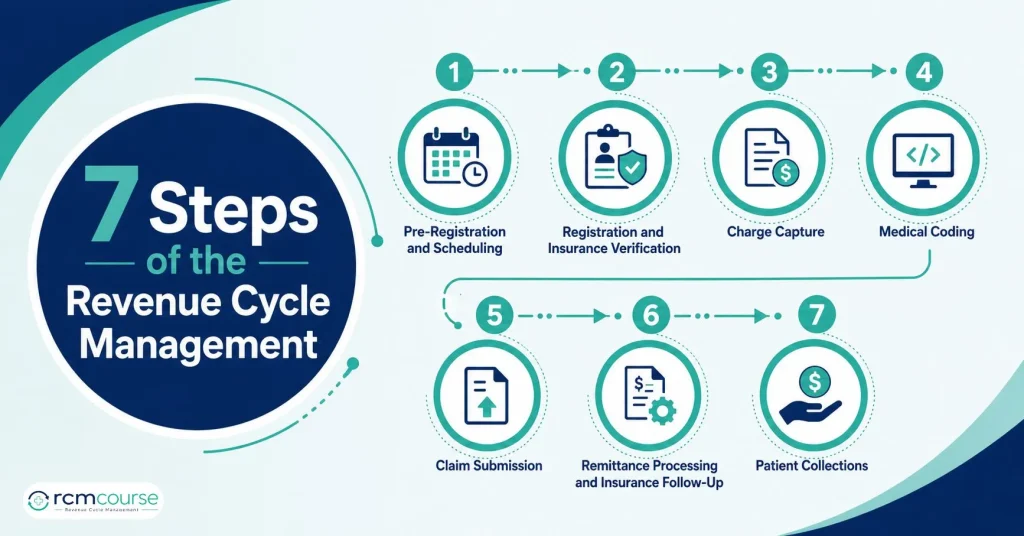
The healthcare revenue cycle is generally broken into seven steps, spanning the full journey from first contact to final payment.
1. Pre-registration and Scheduling
This is where the cycle actually begins, before the patient walks in. Staff collect demographic details and insurance information, often while the patient is still on the phone booking the appointment. Getting this step right matters enormously: inaccurate or incomplete data at the front end is one of the most common causes of downstream claim denials, according to ADSC’s breakdown of the seven RCM steps.
2. Registration and Insurance Verification
At check-in, staff confirm the details gathered during pre-registration and verify active cover. This includes confirming the plan type, deductible status, co-payment amount, and whether a referral or prior authorisation is required. A quick eligibility check here can prevent a denial that would otherwise surface weeks later.
3. Charge Capture
Every service, test, and supply used during the visit has to be translated into billable charges. This can happen automatically, with charges flowing from clinical documentation into the billing system, or manually, with front-desk or coding staff entering them by hand. Ancillary services are among the charges most commonly missed, which quietly leaves revenue on the table, as LBMC’s revenue cycle guide points out. AI-assisted coding tools are increasingly used to flag incomplete documentation before a charge slips through.
4. Medical Coding
Trained coders (or coding software with human review) translate the clinical documentation into standardised ICD-10, CPT, and HCPCS codes. Coding accuracy directly determines reimbursement. Undercoding leaves money unclaimed, while overcoding creates compliance risk.
5. Claim Submission
The coded claim is scrubbed for errors (missing modifiers, mismatched codes, invalid patient IDs) and submitted to the payer, typically through a clearing house that routes it to the correct insurance provider. Clean claims, meaning claims that pass through without payer rejection, are the single biggest driver of faster cash flow.
6. Remittance Processing and Insurance Follow-up
Once the payer adjudicates the claim, the provider receives an Explanation of Benefits (EOB) or Electronic Remittance Advice (ERA) detailing what was paid, adjusted, or denied. Denied or underpaid claims move into an appeals and follow-up workflow. This is where dedicated denial management teams earn their keep.
7. Patient Collections
Whatever remains after insurance pays, including co-payments, deductibles, co-insurance, or non-covered services, becomes the patient’s responsibility. Clear, upfront pricing estimates and flexible payment options at this stage significantly improve collection rates and patient satisfaction.
Some organisations expand this into a more granular 12- to 13-step model that separates sub-tasks such as prior authorisation, medical necessity review, or cash posting. The seven-step version above is the standard framework that almost every RCM team, vendor, and textbook builds upon.
What Are the Three Pillars of RCM?
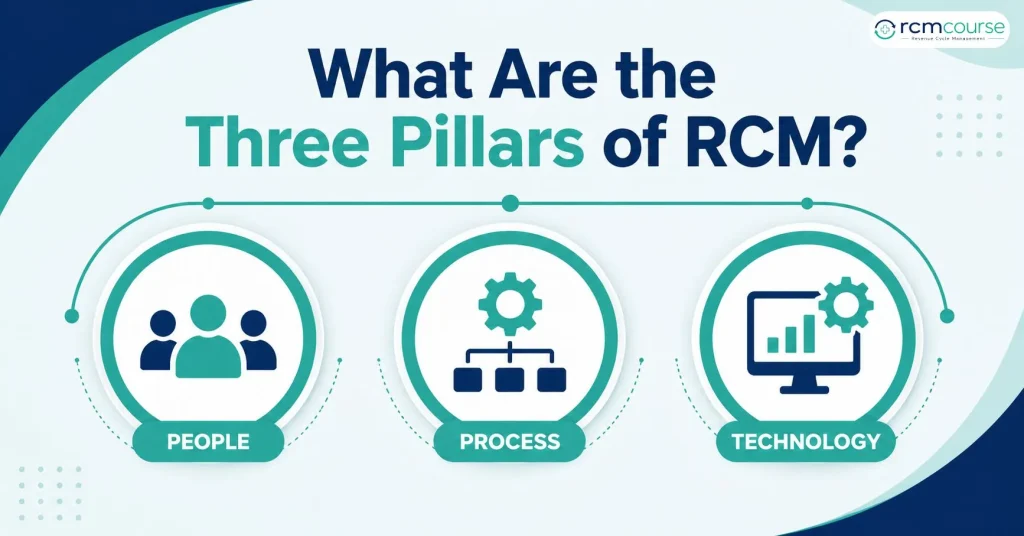
Ask any RCM leader what makes the difference between a revenue cycle that works and one that constantly leaks money, and the answer converges on the same three pillars: people, process, and technology.
- People: Skilled registration staff, coders, billers, and denial specialists are the ones who catch errors before they become denials. Human capital is often the most valuable, and most underinvested, asset in healthcare revenue cycle operations, as Cavanaugh & Co.’s analysis of RCM success factors notes.
- Process: Standardised, well-documented workflows for eligibility checks, charge capture, and follow-up reduce variation and prevent the same mistakes from being repeated across different staff or shifts.
- Technology: Automated billing and claims systems, revenue forecasting analytics, and EHRs that integrate seamlessly with billing software reduce administrative burden and improve accuracy, according to BDO’s three-pillar framework.
None of these pillars works in isolation. The best software cannot fix a broken front-desk process, and the best-trained staff cannot overcome a system that does not communicate with the payer’s clearing house.
A newer framework that some analysts use in 2026 divides the cycle itself into three operational phases: front-end revenue integrity, mid-cycle clinical precision, and back-end collection velocity. This maps neatly onto the seven steps above, with steps one and two representing the front end, steps three and four the mid-cycle, and steps five through seven the back end.
What Are the 4 Basic Revenue Cycle Activities?
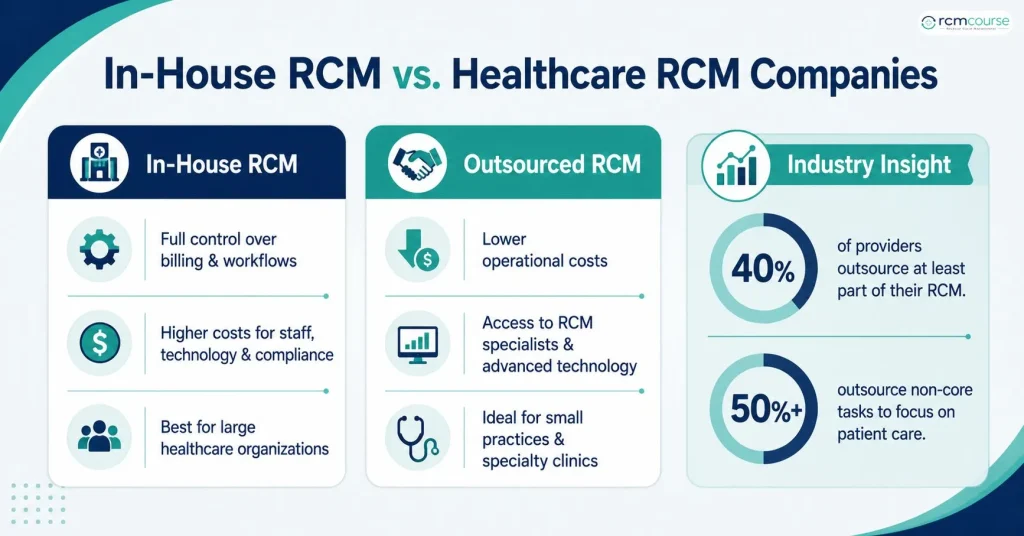
This question actually comes from general accounting and business systems literature rather than healthcare specifically. It is worth clarifying, because the two are often mixed up in search results. In accounting information systems (a framework popularised by textbooks such as Romney and Steinbart’s Accounting Information Systems), the revenue cycle in any business, whether retail, manufacturing, or services, breaks down into four basic activities:
- Sales order entry: Receiving and processing a customer’s order.
- Shipping: Fulfilling and delivering the goods or service.
- Billing: Invoicing the customer for what was delivered.
- Cash collections: Receiving and recording payment.
Translate that into healthcare terms, and the mapping is fairly direct: sales order entry becomes scheduling and registration, shipping becomes the actual delivery of care, billing becomes coding and claim submission, and cash collections become remittance processing plus patient collections.
If you are studying for an accounting or health information management course and see “the four basic revenue cycle activities”, this is the framework being referenced.” on an exam, this general business framework, not the healthcare-specific 7-step model, is almost always what’s being tested.
Why Does RCM Matter for Healthcare Organizations?
Hospital margins have been under sustained pressure. Recent industry data cited by Medical Billers and Coders shows median hospital operating margins hovering below 3%, with 40% of hospitals reporting negative margins in early 2026. Against that Against this backdrop, RCM stops being a back-office function and becomes a survival function. A few numbers make the stakes concrete:
- 41% of providers report denial rates exceeding 10%, according to Medical Billers and Coders, meaning a significant share of billed revenue is delayed or lost outright without active follow-up.
- Poor RCM execution can result in 5 to 10% revenue leakage, which equates to well over $100,000 a year for a mid-sized practice, according to Aspect Billing Solutions.
- Administrative costs represent a major share of total healthcare spending, and much of that burden sits within RCM workflows. That is exactly why automation and AI-assisted coding have gained traction so quickly.
Beyond the balance sheet, RCM directly shapes the patient experience. A patient who receives a clear, accurate estimate before a procedure and a simple, correct bill afterwards is more likely to trust the organisation than one who receives a surprise bill six months later due to a coding error.
What Are the Most Common RCM Challenges, and How Do You Fix Them?
Denials: The single biggest source of revenue leakage. Most denials trace back to eligibility errors, missing prior authorisation, or coding mismatches, all of which are preventable during steps one through four of the cycle. Fix: Front-load verification and pre-authorisation checks, and route denials into a dedicated follow-up queue instead of allowing them to age in a general worklist.
Staffing shortages: Experienced coders and billers are difficult to hire and retain, and staff turnover creates knowledge gaps that appear as errors. Fix: Pair automation (claim scrubbing and AI-assisted coding suggestions) with cross-training, so the process remains resilient despite individual staff turnover.
Fragmented systems: When the EHR, practice management system, and clearing house do not communicate effectively with each other, data has to be re-entered manually, and every re-entry point creates an opportunity for errors to occur. Fix: Prioritise integration and interoperability when selecting or upgrading RCM technology, rather than treating them as optional features.
Patient collections: With more costs shifted to high-deductible health plans, patient responsibility has become one of the largest and slowest-to-collect categories of receivables. Fix: Provide patients with upfront cost estimates and flexible payment plans instead of sending a single lump-sum bill after the service has been provided.
In-House RCM vs. Healthcare RCM Companies: Which Should You Choose?
Managing RCM entirely in-house gives an organisation full control over staffing, workflows, and patient communication, but it also requires ongoing investment in training, software, and compliance updates. Outsourcing to a dedicated healthcare RCM company shifts that responsibility to a specialist vendor, which can be a good fit for smaller practices without the scale to build a complete RCM department internally.
Roughly 40% of healthcare providers now outsource at least some RCM functions, primarily to reduce operational expenses, and more than half of surveyed providers are outsourcing non-core functions specifically so internal teams can focus on clinical care, according to figures reported by Medical Billers and Coders. The decision usually comes down to scale. Larger health systems tend to keep RCM in-house because they can spread technology and staffing investments across a large claim volume, while smaller practices and specialist clinics more often find a vendor relationship more cost-effective per claim processed.
Whichever path you choose, the same three pillars still apply. A vendor with weak process discipline or a limited technology stack will leak revenue just as easily as an under-resourced in-house team.
How Do You Build a Career in Healthcare RCM?
RCM is one of the more stable and in-demand career paths in healthcare administration, and it does not always require a clinical background. Common entry points include medical billing, medical coding, patient access and registration, and denial management roles. From there, certifications help formalise expertise and open the door to higher-level positions:
- Certified Revenue Cycle Representative (CRCR): A widely recognised entry-to-mid-level credential focused on revenue cycle fundamentals.
- Certified Professional Coder (CPC): The standard credential for medical coding roles, issued by AAPC.
- Certified Healthcare Financial Professional (CHFP): Geared towards those moving into RCM leadership and healthcare finance management.
None of these require a clinical licence, which is part of why RCM attracts people from accounting, business administration, and health information management backgrounds, as well as clinical staff transitioning into administrative roles.
Conclusion
Revenue cycle management tracks the full financial journey of a patient encounter, from the moment a visit is scheduled to the moment the balance is paid in full. The process runs through seven core steps: pre-registration, registration and insurance verification, charge capture, medical coding, claim submission, remittance processing and follow-up, and finally patient collections.
Behind those steps sit three pillars that determine whether the whole system holds up: people, process, and technology. Each one is capable of undermining the other two if it is neglected. It is also worth remembering that the “four basic revenue cycle activities” you may see referenced elsewhere (order entry, shipping, billing, and cash collections) come from general accounting literature rather than healthcare specifically, so do not confuse them with the seven-step clinical model above. Looking ahead, denials, staffing gaps, fragmented systems, and rising patient financial responsibility remain the biggest challenges providers face, but each one has a practical, process-level solution available today.
If you are evaluating your own organisation’s revenue cycle, the best place to start is by reviewing your denial rate and days in A/R for the last quarter. Those two numbers alone will tell you which of the seven steps requires attention first. From there, download our free RCM denial rate benchmarking worksheet to see how your numbers compare against practices of a similar size, and use it to identify which step is costing you the most revenue. Once you have completed that assessment, the natural next read in this series is “How to Reduce Claim Denials in Medical Billing,” which walks step by step through building the denial prevention workflow that this guide only summarises above.
Revenue Cycle Management (RCM) is the complete financial process a healthcare practice runs every time it sees a patient, from the moment an appointment is booked to the moment the balance is paid in full.
It has 13 distinct steps: pre-registration, registration, insurance verification, the patient encounter, medical coding, charge capture, claim submission, claim adjudication, payment posting, denials management, patient billing, accounts receivable (AR) follow-up, and collections.
Miss or mishandle any one of these steps, and the effect ripples forward. A wrong insurance ID at registration becomes a denied claim two weeks later, and a denied claim that is not worked becomes unpaid AR that may never be collected.
That is why practices that treat RCM as a single connected system, rather than a series of separate departments working independently, consistently collect more of what they are owed and collect it faster.
This guide explains all 13 steps in Revenue Cycle Management, highlights where healthcare practices commonly experience revenue leakage, and answers key questions about how each component works together, including the “3 Ps” framework used by RCM teams to optimise operations.
Table of Contents
What Is Revenue Cycle Management?
Revenue Cycle Management is the end-to-end process healthcare providers use to track a patient’s care journey from scheduling through to final payment, covering every administrative and clinical step that determines whether, and how much, the provider is reimbursed.
RCM spans front-office activities (such as scheduling and insurance verification), clinical documentation processes (including medical coding), and back-office financial operations (such as billing and collections).
RCM exists because, in the UK healthcare system, receiving payment is never automatic. It must be achieved through accurate documentation, correct coding, timely claim submission, and persistent follow-up with payers.
How Many Steps Are There in the Revenue Cycle?
The number of steps commonly cited for the revenue cycle ranges from 7 to 13, depending on how granular the source breaks it down. Some models combine registration and insurance verification into one step, or fold payment posting and denials management into a single “remittance processing” stage.
The 13-step version in this guide separates each distinct task so nothing gets lost, but the underlying process, schedule, verify, treat, code, bill, collect, is the same regardless of how many stages it is split into.
13 steps in Revenue Cycle Management : A Complete Process Breakdown
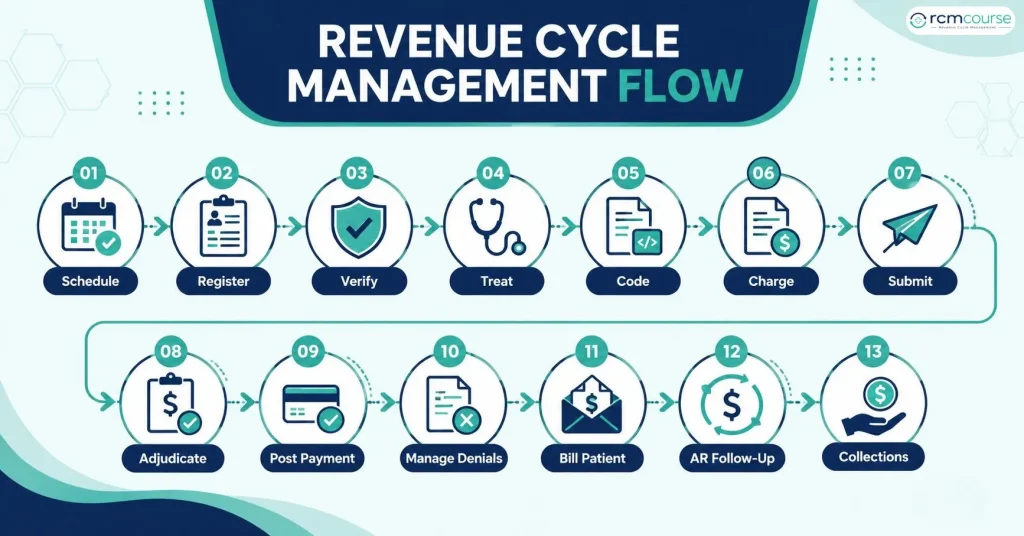
The revenue cycle runs in three broad phases: front-end (before care), mid-cycle (during and immediately after care), and back-end (after the claim is filed), made up of the 13 steps below.
1. Pre-Registration & Scheduling
The cycle starts before the patient ever walks in. When a patient books an appointment, staff collect basic demographic details and initial insurance information. Getting this step right matters more than it looks, since a misspelled name or an outdated insurance ID entered here can travel through the entire cycle and surface as a denial months later.
2. Registration
At check-in, staff formally verify the patient’s identity and insurance details against what was collected during scheduling. This is the practice’s last chance to catch a data error before it becomes a billing problem, so many high-performing practices treat registration accuracy as a tracked KPI, not just a front-desk task.
3. Insurance Verification
The practice contacts the payer directly to confirm active coverage, deductible and copay amounts, and to secure any prior authorisation the treatment requires. Skipping or rushing this step is one of the single biggest drivers of denied claims, because “the patient has insurance” and “the insurance covers this specific service” are two very different facts.
4. Encounter (Point of Service)
Care is delivered, and administrative staff typically collect the patient’s copayment at this point. Collecting at the point of service, rather than billing for it later, is consistently the cheapest and fastest way to collect patient-owed money, since post-visit collection rates drop the longer a balance sits unpaid.
5. Medical Coding
Certified coders (or the provider, depending on practice size) translate the clinical documentation from the visit into standardised CPT and ICD-10 codes. These codes are the language payers use to decide medical necessity and reimbursement, so coding accuracy directly determines whether a claim gets paid the first time or bounces back as a denial.
6. Charge Capture
The practice attaches the correct fee schedule to each code generated during coding, converting clinical documentation into a billable claim. This step can run automatically through EHR-integrated systems or manually through front-desk entry. Automated charge capture generally catches more of the ancillary services that manual processes tend to miss.
7. Claim Submission
The completed claim, including codes, patient data, and charges, is compiled and sent to the payer, usually through a clearinghouse that scrubs it for errors first. Claim scrubbing at this stage catches formatting and coding mismatches before the payer ever sees them, which is why practices that invest in scrubbing tools tend to see meaningfully higher first-pass acceptance rates.
8. Claim Processing & Adjudication
The payer reviews the claim to confirm the services rendered were covered and medically necessary under the patient’s plan. This is where the payer makes its call: approve, partially approve, or deny, and the outcome depends heavily on how clean the claim was going in.
9. Payment Posting
Once the payer approves the claim, the payment is posted to the patient’s account, and the payer issues an Explanation of Benefits (EOB) or Electronic Remittance Advice (ERA). Reconciling posted payments against the original claim promptly is what surfaces underpayments, amounts a payer approved but paid less than the contracted rate, before they’re written off unnoticed.
10. Denials Management
If the payer rejects the claim, the practice has to identify exactly why, correct the underlying issue, and either appeal or resubmit. Denials management is the step where revenue actually gets recovered rather than just tracked. Practices that route denials by root cause (eligibility, coding, authorisation, timely filing) resolve them far faster than those that work denials one by one as they arrive.
11. Patient Billing
Once insurance has paid its share, the practice bills the patient directly for the remaining balance, whether that’s deductibles, coinsurance, or non-covered services. Clear, itemised statements and multiple payment options (portal, text-to-pay, payment plans) consistently improve how much of this balance actually gets collected.
12. Accounts Receivable (AR) Follow-Up
Staff track every unpaid claim, contact payers for status updates, and keep pressure on ageing balances so cash flow stays steady. Most practices measure this with “days in AR,” the average time it takes a claim to convert to cash, and it’s one of the clearest single indicators of how healthy the overall revenue cycle is.
13. Collections & Final Resolution
Patient balances that go unpaid after final notices move into collections, either handled in-house or handed to a third-party agency. This is the last stage of the cycle, and practices that keep it small, rather than a routine destination for unpaid balances, are usually the ones getting steps 1 through 12 right upstream.
What Are the 3 P’s of Revenue Cycle Management?
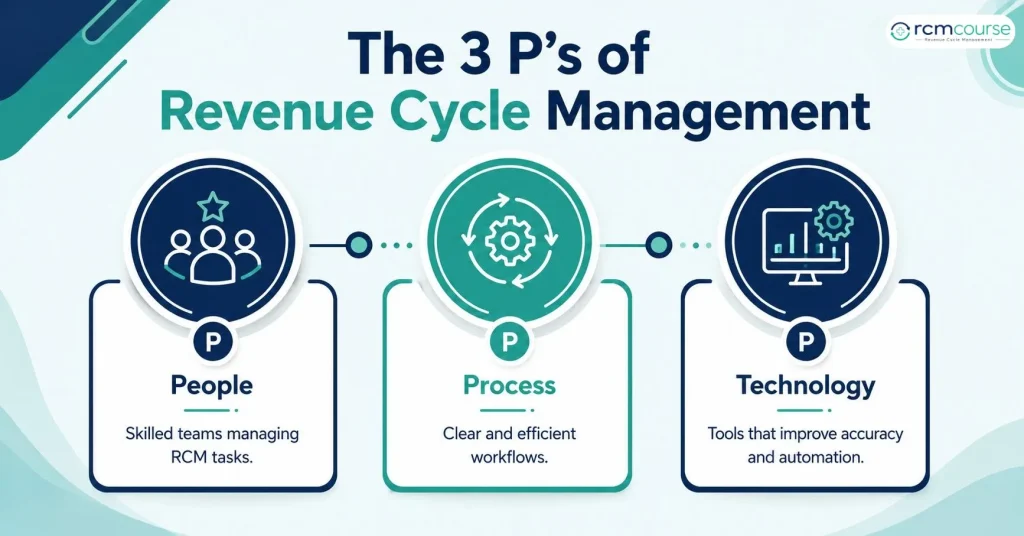
The 3 P’s of RCM are People, Process, and Technology, the three levers that determine how well the 13 steps above actually perform in practice. Skilled staff (people) follow defined, repeatable workflows (process) supported by billing and EHR systems (technology); RCM vendors increasingly differ in how they blend these three, with some leaning towards pure technology automation and others towards business process outsourcing.
In practice, the strongest results come from combining all three rather than over-relying on any single one. Technology alone cannot fix a bad process, and a great process without the right staff to run it stalls out just as quickly.
How Do the 13 Steps Group Into Front-End, Mid-Cycle, and Back-End RCM?
Most RCM software and staffing models organise the 13 steps into three functional groups instead of treating them as one long list:
Front-end (steps 1 to 4): Pre-registration, registration, insurance verification, and the encounter, covering everything that happens before or during the visit.
Mid-cycle (steps 5 to 7): Coding, charge capture, and claim submission, turning the visit into a billable, submitted claim.
Back-end (steps 8 to 13): Adjudication through collections, covering everything that determines whether and when the practice actually gets paid.
This grouping matters practically because most denials trace back to front-end errors, even though they do not surface until the back-end. Fixing insurance verification is almost always cheaper and faster than managing denials after the fact.
FAQs
What are the main benefits of Revenue Cycle Management?
The main benefits of Revenue Cycle Management include faster cash flow, fewer claim denials, reduced revenue leakage, lower administrative workload, improved billing compliance, better patient billing transparency, and more efficient healthcare operations.
Which step is most important in RCM?
Every step matters, but accurate registration and insurance verification are critical for preventing downstream claim denials and payment delays.
Why is Revenue Cycle Management important?
RCM helps healthcare providers manage payments, reduce claim errors, and maintain healthy cash flow.
How does RCM reduce claim denials?
It identifies errors in patient information, insurance, authorisation, coding, and documentation before claims are submitted.
Can RCM be automated?
Yes. Technology can automate tasks such as eligibility verification, claim submission, payment posting, and denial tracking.
Final Thoughts
RCM runs in 13 connected steps, grouped into front-end, mid-cycle, and back-end phases, and each phase depends on the accuracy of the one before it. Most claim denials actually originate from front-end errors like registration or eligibility mistakes, even though those errors do not surface until much later at the back-end.
The 3 P’s, People, Process, and Technology, describe the levers that determine how well the cycle performs rather than a separate set of steps to follow. Of all the metrics a practice can track, days in AR and denial rate are the two that most clearly reflect whether a revenue cycle is genuinely healthy.
If you are auditing your own process, start at the front end. Pull your last quarter’s denial reasons and check how many trace back to registration or eligibility errors. That single exercise usually reveals more than a top-to-bottom process rewrite.
Denial rates continue to rise across the healthcare industry, averaging nearly 11.8% in 2026, with more than 40% of providers experiencing denial rates of 10% or higher. For practices relying on a reactive revenue cycle approach, where denials are addressed only after they occur, revenue losses can continue to accumulate month after month.
To optimise Revenue Cycle Management (RCM) for long-term revenue stability, healthcare practices must focus on claims automation, accurate medical coding, and proactive denial management to reduce revenue loss and improve financial performance. These strategies help improve claim accuracy, reduce preventable denials, minimise revenue leakage, and create a more efficient and predictable revenue cycle.
How to Optimise RCM in Medical Billing for Long-Term Revenue Stability requires improving every stage of the revenue cycle, from patient scheduling and insurance verification to medical coding, claim submission, payment posting, and collections. A fragmented workflow, where verification, coding, billing, and collections operate independently without proper coordination, often leads to delayed reimbursements, increased denials, and lost revenue opportunities.
The solution is a connected, end-to-end RCM strategy built around six key areas: improving front-end accuracy, maintaining clean medical coding practices, strengthening denial prevention and management, enhancing patient collections, monitoring essential RCM KPIs, and ensuring compliance with payer guidelines.
This guide explores each optimisation strategy in detail, including practical actions and industry benchmarks that help healthcare practices achieve higher clean claim rates, reduce administrative inefficiencies, and build a more stable and sustainable revenue cycle.
Table of Contents
What Is RCM Optimisation?
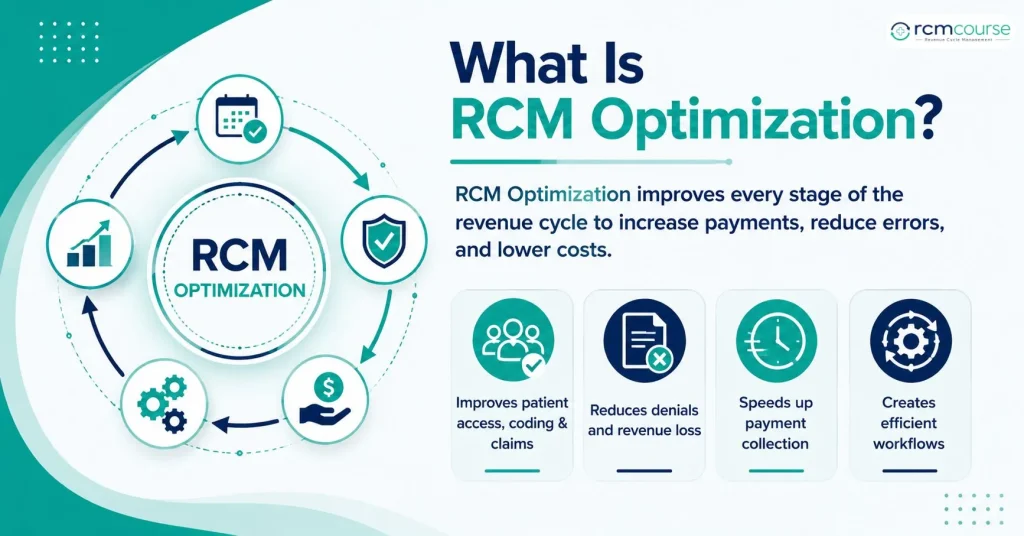
RCM Optimisation is the ongoing process of tightening every stage of the revenue cycle, patient access, coding, claims submission, denial handling, and collections, so more revenue is captured correctly the first time, faster, and at lower cost to collect. It’s not a one-time fix; it’s a discipline of measuring, catching leakage points, and closing them before they become write-offs.
Unlike basic billing, which just processes what’s in front of it, Optimisation treats the revenue cycle as one connected system. A gap in front-end verification doesn’t stay a front-end problem. It shows up three weeks later as a denial, then again as an aged AR bucket nobody wants to touch. Optimising means fixing the system, not just the symptom.
How Do You Optimise the Front End of the Revenue Cycle?

Front-end Optimisation means verifying eligibility, benefits, and patient data before the visit, because a claim built on bad information is denied before it’s ever coded. This single stage prevents the largest share of downstream denials, since eligibility and demographic errors are among the most common, and most preventable, denial causes.
In practice, this looks like:
- Real-time eligibility verification at scheduling and again at check-in, not just once a month.
- A Standardised intake checklist that captures insurance ID, group number, subscriber relationship, and demographics in the same format every time; inconsistent intake is one of the most common sources of rework.
- Prior Authorisation tracking built into scheduling, so a procedure never gets booked without the auth already confirmed or in motion.
- Patient financial Counselling at registration, so cost expectations are set before service, not after the bill arrives.
Practices that move eligibility checks upstream typically see fewer technical rejections within the first billing cycle, because the claim never leaves the building with bad data attached.
Why Does Coding Accuracy Determine Your Reimbursement?
Accurate coding and charge capture ensures every service actually performed gets billed at the correct code, modifier, and charge, because an undercoded or miscoded claim either gets denied or reimburses you for less than you earned. Coding errors and missing documentation remain leading drivers of denials across specialties, with rates commonly running 10 to 18% depending on complexity.
Three practices consistently reduce coding-related revenue loss:
- Charge capture audits run monthly, comparing rendered services against submitted charges to catch missed or duplicate charges.
- Documentation-to-code alignment checks, especially for time-based codes (like Behavioural health CPT codes) where minutes billed must exactly match chart documentation.
- AI-assisted claim scrubbing before submission, which flags code-modifier mismatches, bundling conflicts, and missing NCCI edits before the payer ever sees the claim. This is becoming a growing standard as payers deploy their own AI-driven claim review.
The goal is a clean claim rate above 95%, the percentage of claims accepted on first submission without correction. Every point below that benchmark represents claims that need manual rework, which costs real money: industry estimates put the cost to rework a single denied claim between $25 and $181.
How Do You Build a Denial Management Process That Actually Recovers Revenue?
Robust denial management means treating every denial as a data point, not just a task: Categorising why it happened, fixing the upstream cause, and appealing every recoverable dollar instead of writing it off. Roughly three in four denials on commercial plans stem from administrative or paperwork issues rather than genuine coverage disputes, which means most denials are winnable if someone actually works them.
An effective denial workflow has four parts:
- Categorise on receipt. Split denials into eligibility, Authorisation, coding, timely filing, and medical necessity buckets so patterns are visible immediately, not after a quarter of guessing.
- Root-cause the top three categories monthly and route the fix upstream (retrain front-desk staff, adjust a coding rule, tighten prior-auth scheduling) rather than just resubmitting and hoping.
- Appeal systematically, with templated, evidence-backed appeal letters for the most common denial reasons. Don’t let appeal writing depend on whoever has time that day.
- Track denial recovery rate as its own KPI, separate from the initial denial rate, since a high denial rate with strong recovery is a very different problem than a high denial rate with poor recovery.
Practices that build this loop instead of treating denials as one-off fires routinely bring denial rates down from the double digits toward the 5% benchmark that HFMA and MGMA data associate with well-run revenue cycles, without adding headcount, because the fixes happen upstream instead of in an ever-growing rework queue.
How Should You Streamline Patient Collections?
Streamlining patient collections means collecting the patient’s portion, Co-payments, deductibles, coinsurance, as early and as easily as possible, because patient responsibility is now the third-largest payer category behind Medicare and Medicaid, and it’s the hardest balance to collect once the patient has left the building.
The highest-leverage changes here:
- Collect at point of service using real-time benefit estimates, not after a statement mails weeks later.
- Offer multiple payment channels, including text-to-pay, card-on-file, and payment plans, since friction at payment is friction against collection.
- Send clear, jargon-free statements that explain what’s owed and why; confusing statements drive calls, disputes, and non-payment far more than the actual balance size.
- Set a firm but reasonable follow-up cadence for Ageing patient balances, rather than letting them drift silently into bad debt.
Patient collection rate doesn’t have one universal industry benchmark the way clean claim rate does, since it depends heavily on payer mix and deductible structure, but tracking it consistently, cohort over cohort, shows you whether your process is improving or leaking.
Which KPIs Actually Tell You the Revenue Cycle Is Healthy?
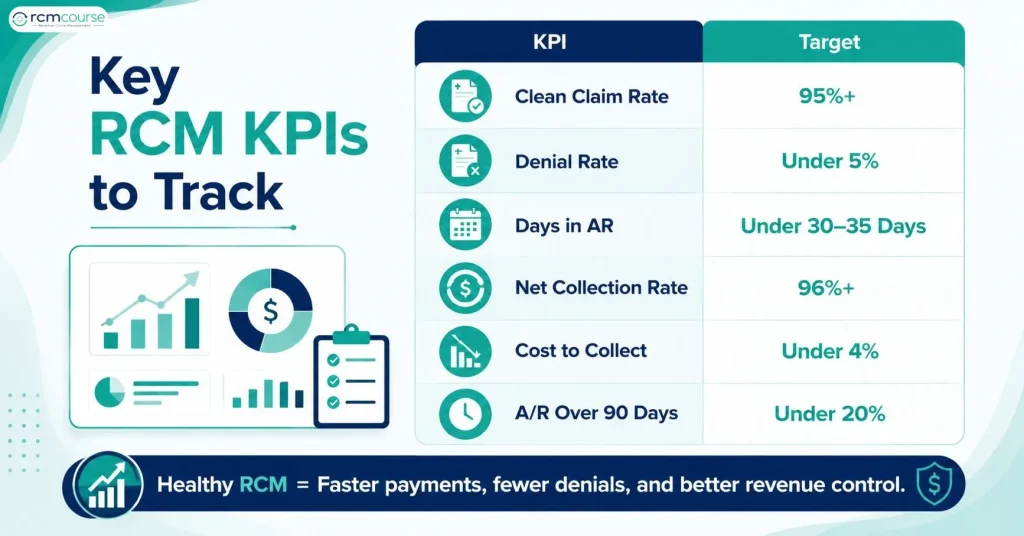
The core RCM KPIs to monitor are clean claim rate, denial rate, days in accounts receivable (AR), net collection rate, and cost to collect. Together they show whether revenue is moving through the cycle quickly, accurately, and completely. Track these five first before expanding to a fuller dashboard.
| KPI | What It Measures | 2026 Benchmark |
|---|---|---|
| Clean claim rate | % of claims accepted on first submission | 95%+ |
| Denial rate | % of claims denied by payers | Under 5% |
| Days in AR | Average days to collect after service | Under 30 to 35 days |
| Net collection rate | % of collectible revenue actually collected | 96%+ |
| Cost to collect | Cost of collections as % of net revenue | Under 4% |
| A/R over 90 days | % of receivables aged past 90 days | Under 20% |
A few practical notes on reading these together: a good average Days in AR number can hide a bad tail. A 35-day blended average can mask a portfolio where a third of claims are stuck past 100 days, so always pair Days in AR with the A/R-over-90-days figure. And net collection rate, not gross collection rate, is the number that reflects true performance, since gross collection rate is distorted by fee-schedule differences across payers.
Set up dashboards on three cadences: daily (rejections, point-of-service collections, eligibility failures, which need same-day action), weekly (denial trends, AR Ageing movement, charge lag), and monthly (the five core KPIs against benchmark, with any miss triggering a root-cause review that month, not next quarter).
How Do You Stay Compliant with Payer Guidelines Without Slowing Down Billing?
Staying compliant means building payer-specific rules, timely filing windows, prior-auth requirements, bundling edits, modifier rules, directly into your claim-scrubbing workflow, so compliance is checked automatically instead of relying on staff memory across dozens of payer contracts. Payer rules also change faster than most billing teams can manually track, and 2026 has brought tighter NCCI bundling edits and revised prior-Authorisation policies across several payer categories.
To keep compliance from becoming a bottleneck:
- Maintain a living payer rules matrix, one reference per payer covering timely filing, auth requirements, and documentation standards, reviewed at least quarterly.
- Build payer-specific edits into your clearinghouse or claim-scrubbing tool, not into a spreadsheet someone has to remember to check.
- Run periodic internal audits against your top payers’ current medical policies, since payer guidance updates without much warning.
- Keep documentation and coding teams looped into payer policy changes in real time, not through word-of-mouth after a denial spike already happened.
Compliance done well doesn’t slow billing down. It prevents the slowdowns caused by denials, appeals, and post-payment audits later.
Frequently Asked Questions
What Is RCM Optimisation?
RCM Optimisation is the continuous process of improving every stage of the revenue cycle, patient access, coding, claims, denials, and collections, to capture more revenue correctly on the first pass, at lower cost, and in less time. It treats the revenue cycle as one connected system rather than a series of separate departmental tasks.
What Are the Three Pillars of RCM?
The three pillars of RCM are front-end operations (patient access, eligibility, Authorisation), mid-cycle operations (coding, charge capture, claims submission), and back-end operations (denial management, payment posting, and collections). Strong RCM requires all three pillars working in sync. A weakness in one pillar shows up as a failure in the next.
How to Optimise RCM in Medical Billing for Long-Term Revenue Stability?
To optimise RCM in medical billing for long-term revenue stability, healthcare practices should strengthen every stage of the revenue cycle, from patient registration and insurance verification to coding, claims, denial management, and collections. A well-optimised RCM strategy reduces denials, prevents revenue leakage, accelerates reimbursements, and improves overall financial performance.
What is Revenue Cycle Management (RCM) in healthcare?
Revenue Cycle Management (RCM) in healthcare is the process of managing all financial activities involved in patient care, including registration, insurance verification, medical coding, claim submission, payment collection, and revenue tracking.
What Are the Key Metrics of RCM?
The key RCM metrics are clean claim rate (target 95%+), denial rate (target under 5%), days in accounts receivable (target under 30 to 35 days), net collection rate (target 96%+), and cost to collect (target under 4% of net revenue). These five give the clearest picture of revenue cycle health and should be reviewed monthly at minimum.
How Do You Optimise Revenue Cycle Management?
You Optimise RCM by tightening front-end verification, ensuring accurate coding and charge capture, building a proactive denial management workflow, streamlining patient collections, tracking core KPIs on a regular cadence, and keeping payer-guideline compliance built into your billing workflow rather than handled manually. Optimisation works best as one connected system, where a fix in one stage reduces the workload in the next.
What are the 13 steps in Revenue Cycle Management?
The 13 steps include scheduling, registration, insurance verification, patient care, coding, charge capture, claim submission, adjudication, payment posting, denials management, patient billing, AR follow-up and collections.
Conclusion
Long-term revenue stability doesn’t come from fixing one broken step in the billing process. It comes from treating the entire revenue cycle as one connected system. That starts with verifying eligibility and capturing complete, accurate patient data before the visit, since most preventable denials trace back to something that went wrong at the front desk.
From there, accurate coding and regular charge capture audits keep you from either losing revenue to undercoding or inviting denials through mismatched documentation, while a proactive denial management process, Categorising, root-causing, and appealing systematically, recovers the revenue that a reactive team would simply write off.
None of this works in isolation, though. Streamlined patient collections matter more each year as patient responsibility grows as a share of total revenue, and none of it can be sustained without discipline: tracking clean claim rate, denial rate, Days in AR, net collection rate, and cost to collect on a regular cadence, and treating any miss against benchmark as something to fix that month, not next quarter.
Built on top of all of it, payer-guideline compliance embedded directly into your workflow, rather than left to staff memory, keeps the whole system from sliding backward every time a payer updates its rules.
If your denial rate or Days in AR is off benchmark right now, the fastest next step isn’t a wholesale overhaul. It’s a 90-day denial audit to find your top three root causes, and building the fix around those first.

