13 Steps in Revenue Cycle Management (RCM): A Complete Guide to the Healthcare RCM Process
Marcus Aurelius
07-28-2026
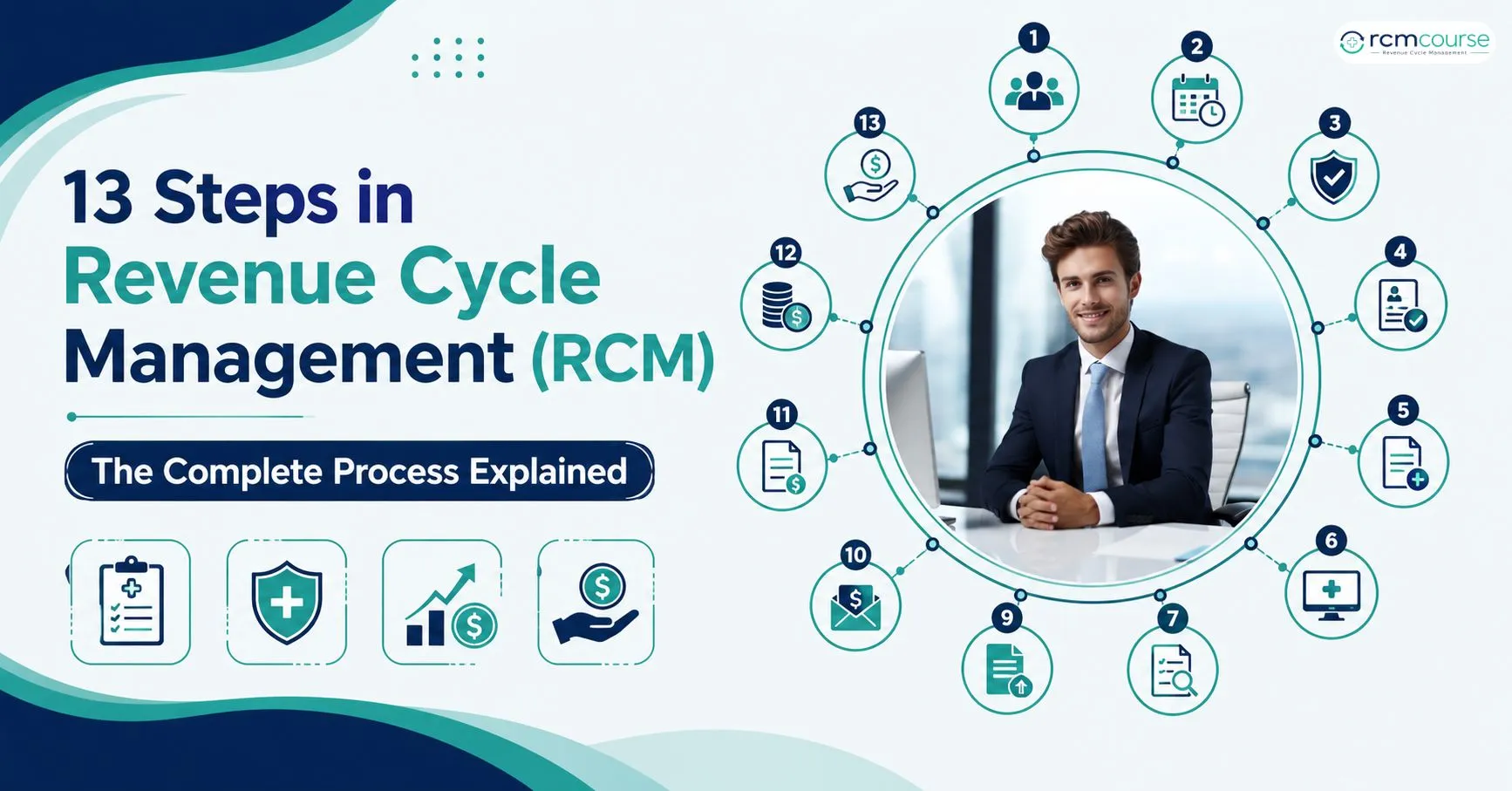
Revenue Cycle Management (RCM) is the complete financial process a healthcare practice runs every time it sees a patient, from the moment an appointment is booked to the moment the balance is paid in full.
It has 13 distinct steps: pre-registration, registration, insurance verification, the patient encounter, medical coding, charge capture, claim submission, claim adjudication, payment posting, denials management, patient billing, accounts receivable (AR) follow-up, and collections.
Miss or mishandle any one of these steps, and the effect ripples forward. A wrong insurance ID at registration becomes a denied claim two weeks later, and a denied claim that is not worked becomes unpaid AR that may never be collected.
That is why practices that treat RCM as a single connected system, rather than a series of separate departments working independently, consistently collect more of what they are owed and collect it faster.
This guide explains all 13 steps in Revenue Cycle Management, highlights where healthcare practices commonly experience revenue leakage, and answers key questions about how each component works together, including the “3 Ps” framework used by RCM teams to optimise operations.
Table of Contents
What Is Revenue Cycle Management?
Revenue Cycle Management is the end-to-end process healthcare providers use to track a patient’s care journey from scheduling through to final payment, covering every administrative and clinical step that determines whether, and how much, the provider is reimbursed.
RCM spans front-office activities (such as scheduling and insurance verification), clinical documentation processes (including medical coding), and back-office financial operations (such as billing and collections).
RCM exists because, in the UK healthcare system, receiving payment is never automatic. It must be achieved through accurate documentation, correct coding, timely claim submission, and persistent follow-up with payers.
How Many Steps Are There in the Revenue Cycle?
The number of steps commonly cited for the revenue cycle ranges from 7 to 13, depending on how granular the source breaks it down. Some models combine registration and insurance verification into one step, or fold payment posting and denials management into a single “remittance processing” stage.
The 13-step version in this guide separates each distinct task so nothing gets lost, but the underlying process, schedule, verify, treat, code, bill, collect, is the same regardless of how many stages it is split into.
13 steps in Revenue Cycle Management : A Complete Process Breakdown
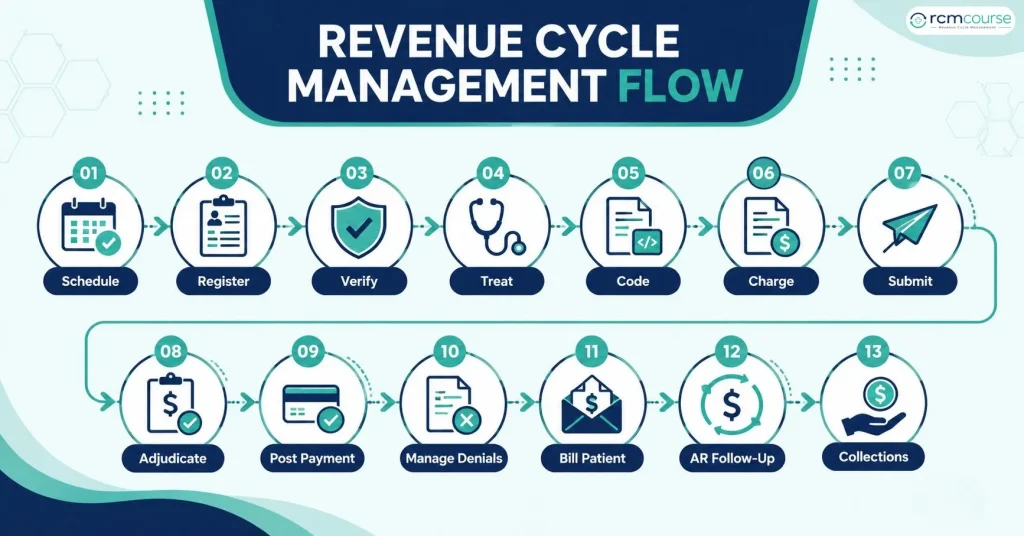
The revenue cycle runs in three broad phases: front-end (before care), mid-cycle (during and immediately after care), and back-end (after the claim is filed), made up of the 13 steps below.
1. Pre-Registration & Scheduling
The cycle starts before the patient ever walks in. When a patient books an appointment, staff collect basic demographic details and initial insurance information. Getting this step right matters more than it looks, since a misspelled name or an outdated insurance ID entered here can travel through the entire cycle and surface as a denial months later.
2. Registration
At check-in, staff formally verify the patient’s identity and insurance details against what was collected during scheduling. This is the practice’s last chance to catch a data error before it becomes a billing problem, so many high-performing practices treat registration accuracy as a tracked KPI, not just a front-desk task.
3. Insurance Verification
The practice contacts the payer directly to confirm active coverage, deductible and copay amounts, and to secure any prior authorisation the treatment requires. Skipping or rushing this step is one of the single biggest drivers of denied claims, because “the patient has insurance” and “the insurance covers this specific service” are two very different facts.
4. Encounter (Point of Service)
Care is delivered, and administrative staff typically collect the patient’s copayment at this point. Collecting at the point of service, rather than billing for it later, is consistently the cheapest and fastest way to collect patient-owed money, since post-visit collection rates drop the longer a balance sits unpaid.
5. Medical Coding
Certified coders (or the provider, depending on practice size) translate the clinical documentation from the visit into standardised CPT and ICD-10 codes. These codes are the language payers use to decide medical necessity and reimbursement, so coding accuracy directly determines whether a claim gets paid the first time or bounces back as a denial.
6. Charge Capture
The practice attaches the correct fee schedule to each code generated during coding, converting clinical documentation into a billable claim. This step can run automatically through EHR-integrated systems or manually through front-desk entry. Automated charge capture generally catches more of the ancillary services that manual processes tend to miss.
7. Claim Submission
The completed claim, including codes, patient data, and charges, is compiled and sent to the payer, usually through a clearinghouse that scrubs it for errors first. Claim scrubbing at this stage catches formatting and coding mismatches before the payer ever sees them, which is why practices that invest in scrubbing tools tend to see meaningfully higher first-pass acceptance rates.
8. Claim Processing & Adjudication
The payer reviews the claim to confirm the services rendered were covered and medically necessary under the patient’s plan. This is where the payer makes its call: approve, partially approve, or deny, and the outcome depends heavily on how clean the claim was going in.
9. Payment Posting
Once the payer approves the claim, the payment is posted to the patient’s account, and the payer issues an Explanation of Benefits (EOB) or Electronic Remittance Advice (ERA). Reconciling posted payments against the original claim promptly is what surfaces underpayments, amounts a payer approved but paid less than the contracted rate, before they’re written off unnoticed.
10. Denials Management
If the payer rejects the claim, the practice has to identify exactly why, correct the underlying issue, and either appeal or resubmit. Denials management is the step where revenue actually gets recovered rather than just tracked. Practices that route denials by root cause (eligibility, coding, authorisation, timely filing) resolve them far faster than those that work denials one by one as they arrive.
11. Patient Billing
Once insurance has paid its share, the practice bills the patient directly for the remaining balance, whether that’s deductibles, coinsurance, or non-covered services. Clear, itemised statements and multiple payment options (portal, text-to-pay, payment plans) consistently improve how much of this balance actually gets collected.
12. Accounts Receivable (AR) Follow-Up
Staff track every unpaid claim, contact payers for status updates, and keep pressure on ageing balances so cash flow stays steady. Most practices measure this with “days in AR,” the average time it takes a claim to convert to cash, and it’s one of the clearest single indicators of how healthy the overall revenue cycle is.
13. Collections & Final Resolution
Patient balances that go unpaid after final notices move into collections, either handled in-house or handed to a third-party agency. This is the last stage of the cycle, and practices that keep it small, rather than a routine destination for unpaid balances, are usually the ones getting steps 1 through 12 right upstream.
What Are the 3 P’s of Revenue Cycle Management?
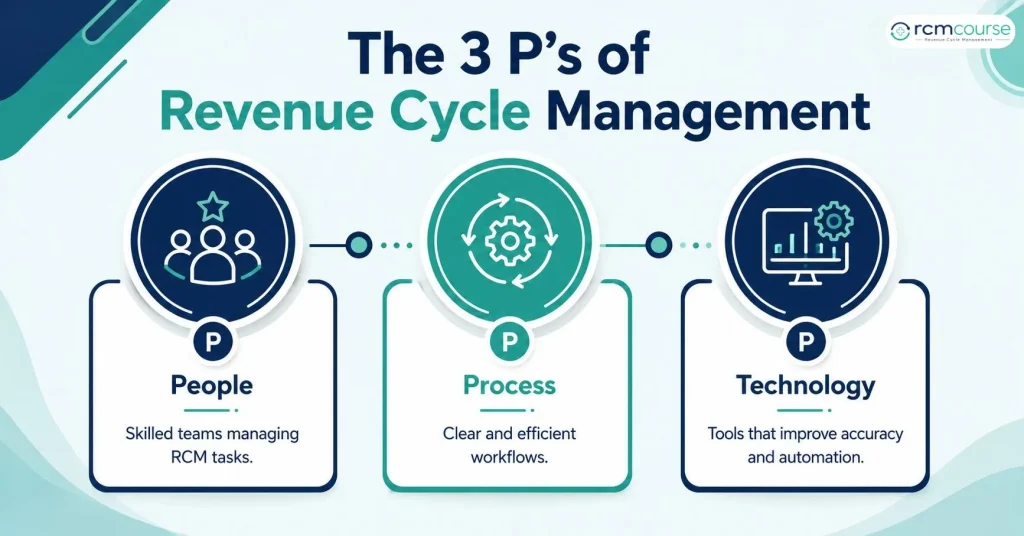
The 3 P’s of RCM are People, Process, and Technology, the three levers that determine how well the 13 steps above actually perform in practice. Skilled staff (people) follow defined, repeatable workflows (process) supported by billing and EHR systems (technology); RCM vendors increasingly differ in how they blend these three, with some leaning towards pure technology automation and others towards business process outsourcing.
In practice, the strongest results come from combining all three rather than over-relying on any single one. Technology alone cannot fix a bad process, and a great process without the right staff to run it stalls out just as quickly.
How Do the 13 Steps Group Into Front-End, Mid-Cycle, and Back-End RCM?
Most RCM software and staffing models organise the 13 steps into three functional groups instead of treating them as one long list:
Front-end (steps 1 to 4): Pre-registration, registration, insurance verification, and the encounter, covering everything that happens before or during the visit.
Mid-cycle (steps 5 to 7): Coding, charge capture, and claim submission, turning the visit into a billable, submitted claim.
Back-end (steps 8 to 13): Adjudication through collections, covering everything that determines whether and when the practice actually gets paid.
This grouping matters practically because most denials trace back to front-end errors, even though they do not surface until the back-end. Fixing insurance verification is almost always cheaper and faster than managing denials after the fact.
FAQs
What are the main benefits of Revenue Cycle Management?
The main benefits of Revenue Cycle Management include faster cash flow, fewer claim denials, reduced revenue leakage, lower administrative workload, improved billing compliance, better patient billing transparency, and more efficient healthcare operations.
Which step is most important in RCM?
Every step matters, but accurate registration and insurance verification are critical for preventing downstream claim denials and payment delays.
Why is Revenue Cycle Management important?
RCM helps healthcare providers manage payments, reduce claim errors, and maintain healthy cash flow.
How does RCM reduce claim denials?
It identifies errors in patient information, insurance, authorisation, coding, and documentation before claims are submitted.
Can RCM be automated?
Yes. Technology can automate tasks such as eligibility verification, claim submission, payment posting, and denial tracking.
Final Thoughts
RCM runs in 13 connected steps, grouped into front-end, mid-cycle, and back-end phases, and each phase depends on the accuracy of the one before it. Most claim denials actually originate from front-end errors like registration or eligibility mistakes, even though those errors do not surface until much later at the back-end.
The 3 P’s, People, Process, and Technology, describe the levers that determine how well the cycle performs rather than a separate set of steps to follow. Of all the metrics a practice can track, days in AR and denial rate are the two that most clearly reflect whether a revenue cycle is genuinely healthy.
If you are auditing your own process, start at the front end. Pull your last quarter’s denial reasons and check how many trace back to registration or eligibility errors. That single exercise usually reveals more than a top-to-bottom process rewrite.

