Revenue Cycle Management in Healthcare: A Complete Guide
Marcus Aurelius
08-04-2026

If a claim gets denied, a patient’s insurance goes unverified, or a charge never makes it into the billing system, the money is gone, or at least stuck for months. That’s the entire problem revenue cycle management (RCM) exists to solve.
Revenue cycle management in healthcare is the end-to-end financial process that tracks a patient’s care from the moment they schedule an appointment through to the moment their balance is paid in full. It covers scheduling, registration, insurance verification, charge capture, coding, claim submission, payment posting, denial management, and patient collections. The goal is simple to state and hard to execute: get providers paid accurately and on time while keeping the patient’s financial experience clear and predictable.
This guide walks through the seven steps of the healthcare revenue cycle, the three pillars that determine whether RCM succeeds or fails, where RCM fits into the broader business concept of a “revenue cycle”, the biggest challenges providers face in 2026, and how to build a career or a team around it. By the end, you’ll be able to map your own organisation’s revenue cycle, spot where revenue is leaking, and know what to fix first.
What Is Revenue Cycle Management in Healthcare?
RCM is the administrative and clinical function that connects patient care to provider payment. Every time a patient is scheduled, seen, coded, billed, or follows up on a bill, that action is part of the revenue cycle. In medical billing specifically, RCM is the operational engine, meaning the staff, software, and workflows that turn a documented encounter into a paid claim.
Three things make healthcare RCM harder than revenue cycles in most other industries:
Third-party payers: Unlike retail, the person receiving the service (the patient) usually isn’t the primary payer. Insurance companies, Medicare, and Medicaid sit in between, each with different rules, timelines, and documentation requirements.
Regulatory complexity: Coding standards (ICD-10, CPT, HCPCS), payer contracts, and compliance requirements (HIPAA, No Surprises Act, price transparency rules) all shape how revenue can legally be captured.
Clinical-financial handovers: Money only flows correctly if clinical documentation, coding, and billing are in sync. A documentation gap in the consulting room becomes a denied claim weeks later.
What Are the 7 Steps of the Revenue Cycle Management?
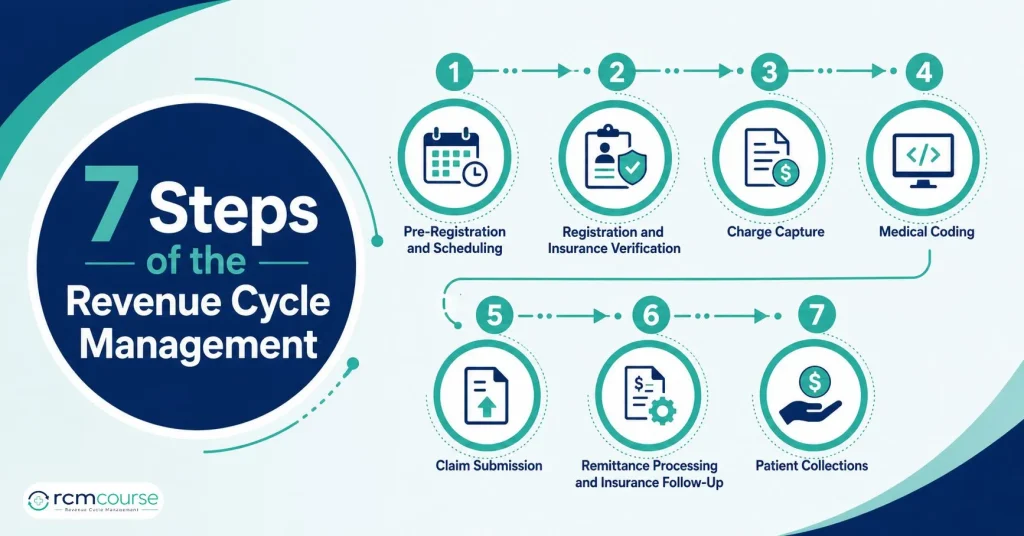
The healthcare revenue cycle is generally broken into seven steps, spanning the full journey from first contact to final payment.
1. Pre-registration and Scheduling
This is where the cycle actually begins, before the patient walks in. Staff collect demographic details and insurance information, often while the patient is still on the phone booking the appointment. Getting this step right matters enormously: inaccurate or incomplete data at the front end is one of the most common causes of downstream claim denials, according to ADSC’s breakdown of the seven RCM steps.
2. Registration and Insurance Verification
At check-in, staff confirm the details gathered during pre-registration and verify active cover. This includes confirming the plan type, deductible status, co-payment amount, and whether a referral or prior authorisation is required. A quick eligibility check here can prevent a denial that would otherwise surface weeks later.
3. Charge Capture
Every service, test, and supply used during the visit has to be translated into billable charges. This can happen automatically, with charges flowing from clinical documentation into the billing system, or manually, with front-desk or coding staff entering them by hand. Ancillary services are among the charges most commonly missed, which quietly leaves revenue on the table, as LBMC’s revenue cycle guide points out. AI-assisted coding tools are increasingly used to flag incomplete documentation before a charge slips through.
4. Medical Coding
Trained coders (or coding software with human review) translate the clinical documentation into standardised ICD-10, CPT, and HCPCS codes. Coding accuracy directly determines reimbursement. Undercoding leaves money unclaimed, while overcoding creates compliance risk.
5. Claim Submission
The coded claim is scrubbed for errors (missing modifiers, mismatched codes, invalid patient IDs) and submitted to the payer, typically through a clearing house that routes it to the correct insurance provider. Clean claims, meaning claims that pass through without payer rejection, are the single biggest driver of faster cash flow.
6. Remittance Processing and Insurance Follow-up
Once the payer adjudicates the claim, the provider receives an Explanation of Benefits (EOB) or Electronic Remittance Advice (ERA) detailing what was paid, adjusted, or denied. Denied or underpaid claims move into an appeals and follow-up workflow. This is where dedicated denial management teams earn their keep.
7. Patient Collections
Whatever remains after insurance pays, including co-payments, deductibles, co-insurance, or non-covered services, becomes the patient’s responsibility. Clear, upfront pricing estimates and flexible payment options at this stage significantly improve collection rates and patient satisfaction.
Some organisations expand this into a more granular 12- to 13-step model that separates sub-tasks such as prior authorisation, medical necessity review, or cash posting. The seven-step version above is the standard framework that almost every RCM team, vendor, and textbook builds upon.
What Are the Three Pillars of RCM?
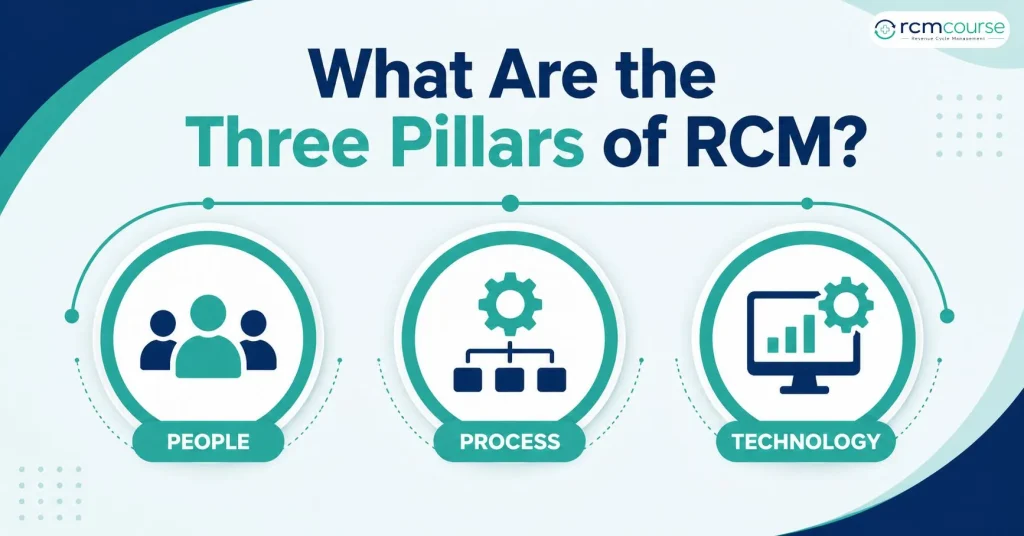
Ask any RCM leader what makes the difference between a revenue cycle that works and one that constantly leaks money, and the answer converges on the same three pillars: people, process, and technology.
- People: Skilled registration staff, coders, billers, and denial specialists are the ones who catch errors before they become denials. Human capital is often the most valuable, and most underinvested, asset in healthcare revenue cycle operations, as Cavanaugh & Co.’s analysis of RCM success factors notes.
- Process: Standardised, well-documented workflows for eligibility checks, charge capture, and follow-up reduce variation and prevent the same mistakes from being repeated across different staff or shifts.
- Technology: Automated billing and claims systems, revenue forecasting analytics, and EHRs that integrate seamlessly with billing software reduce administrative burden and improve accuracy, according to BDO’s three-pillar framework.
None of these pillars works in isolation. The best software cannot fix a broken front-desk process, and the best-trained staff cannot overcome a system that does not communicate with the payer’s clearing house.
A newer framework that some analysts use in 2026 divides the cycle itself into three operational phases: front-end revenue integrity, mid-cycle clinical precision, and back-end collection velocity. This maps neatly onto the seven steps above, with steps one and two representing the front end, steps three and four the mid-cycle, and steps five through seven the back end.
What Are the 4 Basic Revenue Cycle Activities?
This question actually comes from general accounting and business systems literature rather than healthcare specifically. It is worth clarifying, because the two are often mixed up in search results. In accounting information systems (a framework popularised by textbooks such as Romney and Steinbart’s Accounting Information Systems), the revenue cycle in any business, whether retail, manufacturing, or services, breaks down into four basic activities:
- Sales order entry: Receiving and processing a customer’s order.
- Shipping: Fulfilling and delivering the goods or service.
- Billing: Invoicing the customer for what was delivered.
- Cash collections: Receiving and recording payment.
Translate that into healthcare terms, and the mapping is fairly direct: sales order entry becomes scheduling and registration, shipping becomes the actual delivery of care, billing becomes coding and claim submission, and cash collections become remittance processing plus patient collections.
If you are studying for an accounting or health information management course and see “the four basic revenue cycle activities”, this is the framework being referenced.” on an exam, this general business framework, not the healthcare-specific 7-step model, is almost always what’s being tested.
Why Does RCM Matter for Healthcare Organizations?
Hospital margins have been under sustained pressure. Recent industry data cited by Medical Billers and Coders shows median hospital operating margins hovering below 3%, with 40% of hospitals reporting negative margins in early 2026. Against that Against this backdrop, RCM stops being a back-office function and becomes a survival function. A few numbers make the stakes concrete:
- 41% of providers report denial rates exceeding 10%, according to Medical Billers and Coders, meaning a significant share of billed revenue is delayed or lost outright without active follow-up.
- Poor RCM execution can result in 5 to 10% revenue leakage, which equates to well over $100,000 a year for a mid-sized practice, according to Aspect Billing Solutions.
- Administrative costs represent a major share of total healthcare spending, and much of that burden sits within RCM workflows. That is exactly why automation and AI-assisted coding have gained traction so quickly.
Beyond the balance sheet, RCM directly shapes the patient experience. A patient who receives a clear, accurate estimate before a procedure and a simple, correct bill afterwards is more likely to trust the organisation than one who receives a surprise bill six months later due to a coding error.
What Are the Most Common RCM Challenges, and How Do You Fix Them?
Denials: The single biggest source of revenue leakage. Most denials trace back to eligibility errors, missing prior authorisation, or coding mismatches, all of which are preventable during steps one through four of the cycle. Fix: Front-load verification and pre-authorisation checks, and route denials into a dedicated follow-up queue instead of allowing them to age in a general worklist.
Staffing shortages: Experienced coders and billers are difficult to hire and retain, and staff turnover creates knowledge gaps that appear as errors. Fix: Pair automation (claim scrubbing and AI-assisted coding suggestions) with cross-training, so the process remains resilient despite individual staff turnover.
Fragmented systems: When the EHR, practice management system, and clearing house do not communicate effectively with each other, data has to be re-entered manually, and every re-entry point creates an opportunity for errors to occur. Fix: Prioritise integration and interoperability when selecting or upgrading RCM technology, rather than treating them as optional features.
Patient collections: With more costs shifted to high-deductible health plans, patient responsibility has become one of the largest and slowest-to-collect categories of receivables. Fix: Provide patients with upfront cost estimates and flexible payment plans instead of sending a single lump-sum bill after the service has been provided.
In-House RCM vs. Healthcare RCM Companies: Which Should You Choose?
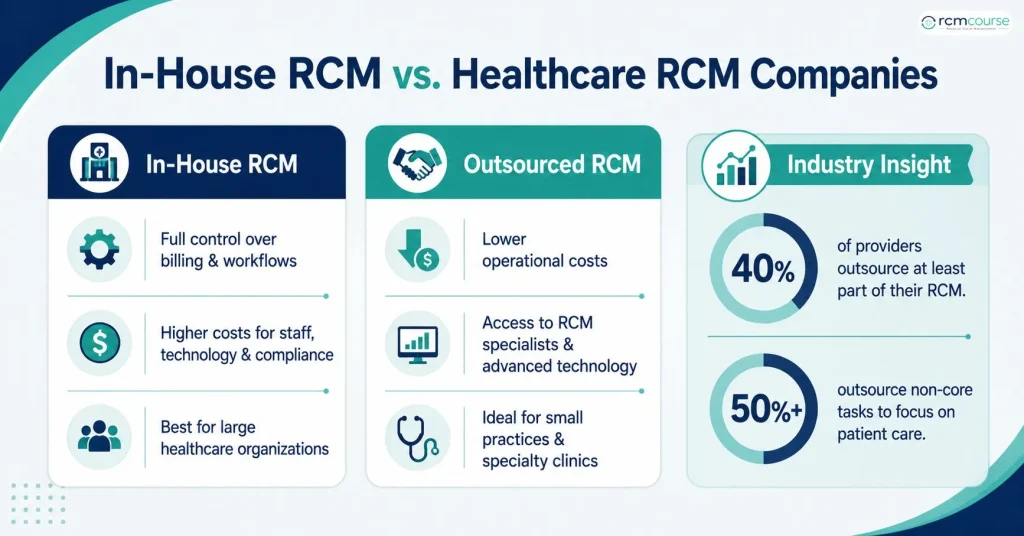
Managing RCM entirely in-house gives an organisation full control over staffing, workflows, and patient communication, but it also requires ongoing investment in training, software, and compliance updates. Outsourcing to a dedicated healthcare RCM company shifts that responsibility to a specialist vendor, which can be a good fit for smaller practices without the scale to build a complete RCM department internally.
Roughly 40% of healthcare providers now outsource at least some RCM functions, primarily to reduce operational expenses, and more than half of surveyed providers are outsourcing non-core functions specifically so internal teams can focus on clinical care, according to figures reported by Medical Billers and Coders. The decision usually comes down to scale. Larger health systems tend to keep RCM in-house because they can spread technology and staffing investments across a large claim volume, while smaller practices and specialist clinics more often find a vendor relationship more cost-effective per claim processed.
Whichever path you choose, the same three pillars still apply. A vendor with weak process discipline or a limited technology stack will leak revenue just as easily as an under-resourced in-house team.
How Do You Build a Career in Healthcare RCM?
RCM is one of the more stable and in-demand career paths in healthcare administration, and it does not always require a clinical background. Common entry points include medical billing, medical coding, patient access and registration, and denial management roles. From there, certifications help formalise expertise and open the door to higher-level positions:
- Certified Revenue Cycle Representative (CRCR): A widely recognised entry-to-mid-level credential focused on revenue cycle fundamentals.
- Certified Professional Coder (CPC): The standard credential for medical coding roles, issued by AAPC.
- Certified Healthcare Financial Professional (CHFP): Geared towards those moving into RCM leadership and healthcare finance management.
None of these require a clinical licence, which is part of why RCM attracts people from accounting, business administration, and health information management backgrounds, as well as clinical staff transitioning into administrative roles.
Conclusion
Revenue cycle management tracks the full financial journey of a patient encounter, from the moment a visit is scheduled to the moment the balance is paid in full. The process runs through seven core steps: pre-registration, registration and insurance verification, charge capture, medical coding, claim submission, remittance processing and follow-up, and finally patient collections.
Behind those steps sit three pillars that determine whether the whole system holds up: people, process, and technology. Each one is capable of undermining the other two if it is neglected. It is also worth remembering that the “four basic revenue cycle activities” you may see referenced elsewhere (order entry, shipping, billing, and cash collections) come from general accounting literature rather than healthcare specifically, so do not confuse them with the seven-step clinical model above. Looking ahead, denials, staffing gaps, fragmented systems, and rising patient financial responsibility remain the biggest challenges providers face, but each one has a practical, process-level solution available today.
If you are evaluating your own organisation’s revenue cycle, the best place to start is by reviewing your denial rate and days in A/R for the last quarter. Those two numbers alone will tell you which of the seven steps requires attention first. From there, download our free RCM denial rate benchmarking worksheet to see how your numbers compare against practices of a similar size, and use it to identify which step is costing you the most revenue. Once you have completed that assessment, the natural next read in this series is “How to Reduce Claim Denials in Medical Billing,” which walks step by step through building the denial prevention workflow that this guide only summarises above.

