How Revenue Cycle Management (RCM) Improves Medical Billing?
Marcus Aurelius
08-18-2026

Revenue Cycle Management (RCM) improves medical billing by reducing errors, preventing avoidable claim denials, accelerating reimbursements and helping healthcare providers collect more of the revenue they have earned. Instead of treating billing as a single back-office task, RCM connects every financial stage of the patient journey, from scheduling and insurance verification to coding, claim submission, payment posting and final collection.
This broader approach makes medical billing more accurate, proactive and efficient. By checking patient information early, confirming eligibility, managing prior authorisation, improving coding accuracy and reviewing claims before submission, RCM helps prevent many problems before they reach the payer. It also gives billing teams better visibility into denied claims, outstanding balances, underpayments and delays in accounts receivable.
In practice, this means fewer rejected claims, a higher clean claim rate, lower A/R days, improved cash flow and less administrative work for staff. RCM can also improve the patient financial experience by providing clearer cost estimates, simpler bills and more convenient digital payment options.
Understanding how Revenue Cycle Management (RCM) improves medical billing is therefore essential for healthcare providers that want to strengthen financial performance without creating additional administrative burden. The following sections explain the main ways RCM improves billing accuracy, claim performance, payment speed, denial management and revenue collection.
Table of Contents
What Is Revenue Cycle Management in Medical Billing?

Revenue cycle management is the end-to-end process of tracking a patient’s account from registration and insurance verification through to final payment. It covers everything that touches money: scheduling, eligibility checks, coding, claim submission, payment posting, denial management, and patient collections.
Short Definition
RCM is the administrative and financial process healthcare providers use to manage claims, payments, and revenue from the first patient contact to the last payment received. It brings clinical and financial data together so a practice can see, in real time, where money is moving and where it’s getting stuck.
How RCM Differs from Basic Medical Billing
Medical billing is one piece of RCM, not the whole thing. Billing typically starts after a visit has already happened: a coder assigns codes, a biller submits the claim, and the practice waits to see what comes back. RCM starts much earlier, at scheduling and eligibility verification, and continues well after the claim is submitted, through denial follow-up and patient payment collection.
Think of billing as a single stage in a longer race. RCM is the entire race, coached from start to finish, with checkpoints designed to stop problems before they cost the practice money.
6 Ways RCM Improves Medical Billing

1. Reduces Billing Errors
Most claim denials trace back to a small handful of preventable mistakes made before the claim is ever submitted. RCM builds error-catching checkpoints directly into the front end of the process, so mistakes get fixed while they’re cheap to fix, not after a payer has already rejected the claim.
Accurate patient data: RCM systems verify and standardise demographic and insurance details at registration, which is where a huge share of billing errors originate: a misspelt name, an outdated address, or a transposed policy number.
Eligibility verification: Confirming active coverage, plan type, and benefits before the appointment stops practices from billing for services a patient’s plan won’t cover.
Prior authorisation: RCM tracks which procedures need pre-approval and flags them early, so claims aren’t submitted, and then denied, for a service that needed sign-off first.
2. Improves Clean Claim Rates
A “clean claim” is one that’s accepted and paid the first time it’s submitted, with no errors, missing information, or coding issues. The clean claim rate is one of the clearest signs of a healthy revenue cycle, and RCM is built specifically to push that number up.
Claim scrubbing: Automated scrubbing tools check every claim against payer-specific rules before submission, catching mismatched codes, missing modifiers, and formatting errors that would otherwise bounce back.
Accurate medical coding: RCM pairs coding with real-time payer rule updates, so codes reflect current requirements rather than outdated fee schedules or deprecated codes.
Fewer rejected claims: By combining scrubbing and coding accuracy, RCM shrinks the pool of claims that get kicked back for correction, which means fewer resubmissions and less staff time spent chasing fixes.
3. Reduces Claim Denials
Denials are expensive in two ways: the direct cost of reworking and resubmitting a claim, and the delay to cash flow while the practice waits for payment. RCM tackles denials on both ends, prevention and recovery.
Detects common denial causes: RCM tracking surfaces the patterns behind denials, whether that’s a specific payer, a specific code, or a specific step in the process, so the practice can fix the root cause instead of firefighting each denial individually.
Improves denial prevention: Once a pattern is identified, RCM workflows adjust upstream steps, such as eligibility checks or coding review, to stop that type of denial from recurring.
Supports faster appeals: When a denial does happen, RCM keeps the documentation and claim history organised, so appeals can be filed quickly and with the right supporting evidence, rather than starting the paperwork trail from scratch.
4. Speeds Up Payments
Cash flow is the practical outcome that everything else in RCM is really working towards. A faster, cleaner cycle means money reaches the practice sooner and with less manual chasing.
Faster claim submission: Automation removes the delay between a service being provided and the claim being submitted, shortening the time payers have before the clock even starts on payment.
Automated payment posting: Payments and remittance advice get matched and posted automatically, so staff aren’t manually reconciling every line item against every claim.
Lower A/R days: With fewer errors, faster submission, and quicker posting, accounts receivable ages more slowly, which directly improves the practice’s working capital.
5. Improves Patient Payments
As patients shoulder more of their own healthcare costs through high-deductible plans, patient payments have become a bigger share of practice revenue, and a harder one to collect. RCM addresses this directly rather than treating it as an afterthought.
Cost estimates: Giving patients an accurate estimate before or at the point of care sets expectations early and reduces disputes and surprise bills later.
Clear bills: RCM platforms typically generate itemised, plain-language statements, which cuts down on confused calls to the billing office and speeds up payment.
Digital payment options: Online portals, text-to-pay, and card-on-file options make it easier for patients to pay promptly, which meaningfully raises patient collection rates compared with mailed paper statements alone.
6. Reduces Revenue Leakage
Revenue leakage is money the practice earned but never actually collected, and it’s often invisible until someone goes looking for it. RCM makes leakage visible and gives the practice a structured way to close the gap.
Identifies missed charges: RCM systems cross-check documentation against what was actually billed, catching services that were performed but never invoiced.
Tracks underpayments: By comparing what payers actually pay against contracted rates, RCM flags underpayments that would otherwise go unnoticed and unrecovered.
Recovers denied revenue: Structured denial workflows make sure denied claims are actually followed up and appealed, rather than written off simply because nobody had time to chase them.
How to Improve Revenue Cycle Management
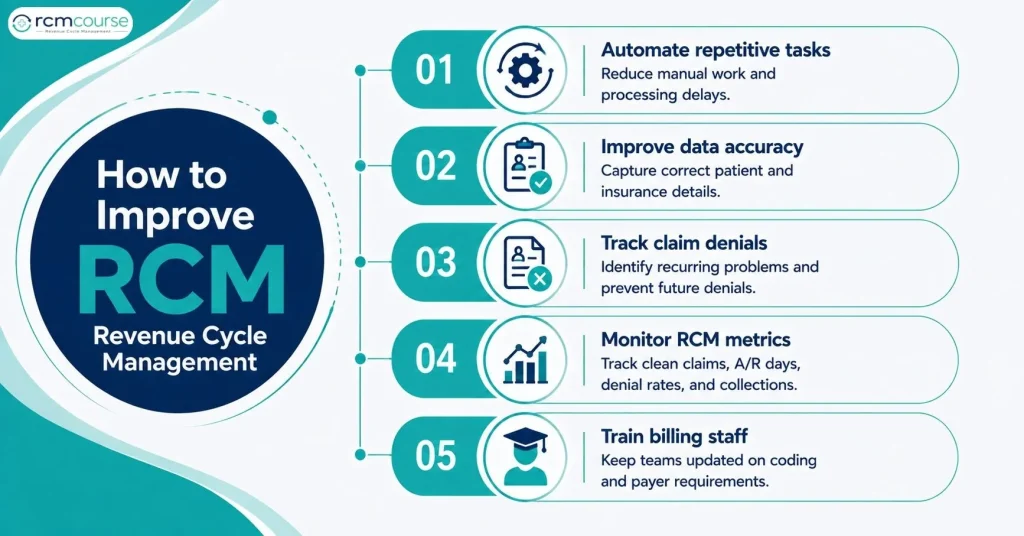
A few consistent habits tend to separate practices with a smooth revenue cycle from those constantly fighting fires:
- Automate repetitive tasks. Eligibility checks, claim scrubbing, and payment posting are all well suited to automation, freeing staff to focus on exceptions rather than routine processing.
- Improve front-end data accuracy. Since most downstream errors start at registration, investing in accurate data capture at the very first patient touchpoint pays off throughout the entire cycle.
- Track denials. Reviewing denial trends regularly, not just handling them one by one, is what turns denial management into denial prevention.
- Monitor key RCM metrics. Keep a close eye on clean claim rate, days in A/R, denial rate, and net collection rate, since these numbers tell you where the cycle is actually breaking down.
- Train billing staff. Payer rules and coding requirements change constantly, so ongoing training keeps the team’s day-to-day work aligned with current requirements rather than last year’s.
FAQs
How does RCM improve medical billing?
RCM improves medical billing by adding verification and error-checking steps throughout the entire billing process, not just at claim submission, which raises clean claim rates, reduces denials, and speeds up payment collection.
What is the difference between RCM and medical billing?
Medical billing is the process of coding and submitting claims after a visit; RCM is the broader end-to-end process that starts at scheduling and eligibility verification and continues through payment posting and denial recovery.
How does RCM reduce claim denials?
RCM reduces claim denials by identifying the root causes behind them, such as eligibility issues or coding errors, and adjusting upstream processes so those errors are caught before a claim is ever submitted.
What is the difference between Medical Billing vs Revenue Cycle Management?
Medical Billing focuses mainly on preparing claims and collecting payments, while Revenue Cycle Management covers the complete financial process from patient registration to final payment collection.
What are the main steps in healthcare RCM?
The main steps are patient registration and eligibility verification, prior authorisation, charge capture and coding, claim submission and scrubbing, payment posting, denial management, and patient billing and collections.
Conclusion
Revenue Cycle Management (RCM) improves medical billing by turning separate billing activities into one connected, end-to-end financial process. From accurate patient registration and insurance verification to clean claim submission, denial management and patient payment collection, every stage works together to reduce errors and improve revenue performance.
Effective RCM helps healthcare providers achieve higher clean claim rates, fewer denials, faster reimbursements, lower A/R days and better control over revenue leakage. It also reduces repetitive administrative work by using automation for tasks such as eligibility checks, claim scrubbing, payment posting and claim tracking.
The biggest improvement often starts before a claim is submitted. Accurate patient data, timely eligibility verification, correct coding and proper prior authorisation can prevent many downstream billing problems before they occur. When these front-end processes are combined with strong denial analysis, payment monitoring and patient-friendly billing, the entire revenue cycle becomes more efficient.
For healthcare organisations, improving RCM is not simply about getting claims paid faster. It is about creating a more reliable medical billing system that supports consistent cash flow, stronger financial control and a better experience for both staff and patients.

