Revenue cycle management (RCM) mistakes are one of the biggest reasons healthcare providers experience delayed payments, claim denials, and unnecessary administrative costs.
Common Revenue Cycle Management (RCM) mistakes include inaccurate patient information, medical coding errors, missing modifiers, incomplete documentation, and poor claim denial management.
These issues can lead to revenue loss, delayed reimbursements, and cash flow problems for healthcare organisations.
What Are Common RCM Mistakes? Understanding these errors is essential for medical billing teams because even small administrative or coding issues can disrupt the entire revenue cycle.
Incorrect medical coding, inaccurate patient details, and incomplete documentation can prevent healthcare providers from receiving timely payments and increase the risk of claim rejections.
Revenue cycle management covers every stage of the healthcare payment process, from patient registration and insurance verification to medical coding, claim submission, denial management, and final payment collection.
When one step contains an error, it can affect the entire workflow and create financial challenges for providers.
In this guide, we explore the most common RCM mistakes, why healthcare claims get denied, and practical strategies medical billing teams can use to improve accuracy, reduce claim denials, and strengthen their overall revenue cycle management process.
Table of Contents
What Is Revenue Cycle Management (RCM)?
Revenue cycle management is the end-to-end financial process that tracks a patient’s care journey from appointment booking through to final payment.
It covers registration, coding, billing, and collections, and it exists to make sure providers get paid accurately and on time for the care they deliver.
RCM runs through several connected stages, and a mistake at any one of them ripples through the rest:
- Patient registration and eligibility verification – confirming who the patient is and what their insurance actually covers
- Medical coding – translating clinical documentation into standardised ICD-10, CPT, and HCPCS codes
- Charge capture – recording every billable service performed
- Claim submission – sending accurate, complete claims to the correct payer
- Denial management – identifying, correcting, and resubmitting rejected claims
- Payment posting – reconciling what’s been paid against what was billed
- Patient collections – recovering any balance owed by the patient
Because these stages are sequential, an error early on (say, an eligibility check that misses an expired policy) doesn’t stay contained. It surfaces later as a denial, and by then it costs far more time and money to fix than it would have taken to catch upfront.
What Are the 5 Common Coding Errors in Medical Billing?

The five most common coding errors are incorrect diagnosis coding, upcoding, undercoding, incorrect modifier use, and duplicate or unbundled coding.
Each one either delays payment, triggers a denial, or exposes the practice to a compliance audit, so catching them before submission matters more than fixing them afterwards.
1. Incorrect Diagnosis Coding
This happens when a coder assigns the wrong ICD-10 code, or assigns a diagnosis that isn’t actually supported by the clinical documentation. Payers cross-check diagnosis codes against the procedure billed, so a mismatch is one of the fastest routes to a rejected claim.
The fix isn’t just “code more carefully”. It’s making sure documentation is specific enough to code correctly in the first place. Vague notes force coders to guess, and guessing is where errors creep in.
2. Upcoding Services
Upcoding means billing for a higher-level or more complex service than what was actually delivered, whether intentionally or through carelessness.
Beyond the immediate denial risk, upcoding is a compliance red flag that can trigger a full payer audit and, in serious cases, penalties under fraud regulations.
3. Undercoding
Undercoding is the quieter cousin of upcoding: failing to report all the billable services actually performed, often out of caution about being flagged for upcoding.
It doesn’t trigger denials the way upcoding does, but it steadily erodes revenue that the practice earned and never claimed.
4. Incorrect Use of Modifiers
CPT modifiers tell the payer important context, for example that a procedure was performed on both sides of the body, or that two services on the same day were genuinely distinct.
Missing a required modifier, or using the wrong one, is a common and entirely avoidable cause of claim denials.
5. Duplicate or Unbundled Coding Errors
Duplicate coding means billing the same service more than once, whether from a system glitch or manual re-entry. Unbundling means separating out procedures that payer rules require to be billed together as a single bundled code.
Both are treated as billing errors by payers, and repeated instances can look like a pattern rather than an accident.
What Are Some Common Coding Errors in Medical Billing?
Beyond the five headline errors above, most coding mistakes trace back to a handful of process gaps rather than one-off carelessness. Fixing the process fixes the recurring error.
The most frequent contributing causes include:
- Coding before reviewing the full clinical documentation
- Selecting the wrong CPT, HCPCS, or ICD-10 code from a similar-looking option
- Failing to update to the current year’s code set (ICD-10 and CPT both update annually)
- Working from incomplete medical records
- Attaching incorrect patient demographic or insurance information to a claim
- Missing a payer’s prior authorisation requirement before the service is billed
Each of these is a process failure, not a knowledge failure, which is exactly why they’re so fixable. A coder who knows the rules can still make these mistakes if the workflow around them is broken.
What Are the Top 5 Denials in Medical Billing?

The top five causes of claim denials are eligibility and insurance verification errors, missing prior authorisation, coding errors, claim filing errors, and medical necessity denials.
Most of these are preventable at the front end of the revenue cycle, before the claim is ever submitted.
1. Eligibility and Insurance Verification Errors
Denials in this category stem from outdated insurance details, coverage that expired before the date of service, or claims sent to the wrong payer entirely. Verifying eligibility at every visit, not just at initial registration, closes most of this gap.
2. Lack of Prior Authorisation
Some procedures and medications require payer sign-off before they’re performed. If that approval isn’t secured (or isn’t documented) beforehand, the claim is denied regardless of medical appropriateness. A standing checklist of which services require authorisation, reviewed at scheduling, prevents this.
3. Coding Errors
Diagnosis and procedure codes that don’t align with a specific payer’s requirements, along with incorrect modifiers or thin documentation, remain one of the largest denial categories. Payer-specific coding rules do vary, so a claim that’s technically correct for one insurer can still be denied by another.
4. Claim Filing Errors
These are the administrative slips: missing fields, the wrong claim form, or a claim submitted after the payer’s filing deadline. None of these involve clinical judgement at all, which makes them entirely preventable with a claim-scrubbing step before submission.
5. Medical Necessity Denials
A payer will deny a claim if the clinical documentation doesn’t clearly justify why the service was necessary. This is less about whether the care was appropriate and more about whether the notes prove it was, which is why documentation quality and coding accuracy are so tightly linked.
What Is the Golden Rule in Medical Billing?
The golden rule in medical billing is: “If it wasn’t documented, it wasn’t done.” No matter how necessary or well-performed a service was, if the clinical record doesn’t capture it clearly, it can’t be coded, billed, or defended in an audit.
This rule sits underneath almost every mistake covered above. Undercoding, medical necessity denials, and coding errors all trace back to documentation that’s too thin, too vague, or too late.
Strong documentation doesn’t just support one claim; it protects the practice if that claim is ever reviewed months later.
Following payer guidelines and compliance standards matters here too. A service can be documented perfectly and still get denied if it doesn’t meet a specific payer’s medical necessity criteria, which is why documentation and payer policy need to be checked together, not separately.
How RCM Mistakes Affect Healthcare Providers
RCM mistakes don’t just cost a single claim. They compound across the practice in ways that are easy to underestimate until you add them up:
- Delayed payments as claims cycle through correction and resubmission
- Increased claim denials, each one requiring staff time to identify and appeal
- Higher administrative costs from rework that a clean claim would have avoided entirely
- Compliance risk, particularly from upcoding or documentation gaps that attract audits
- Reduced profitability, as denied and delayed revenue drags down cash flow
The industry benchmark for a healthy clean claim rate sits around 90% or higher. Practices well below that aren’t looking at bad luck; they’re looking at a specific, fixable weak point somewhere in the cycle.
How to Prevent Common RCM Mistakes
Preventing RCM mistakes comes down to four areas: documentation accuracy, ongoing coder training, the right technology, and active denial monitoring.
None of these require a full department overhaul; each one is a targeted fix for a specific failure point covered earlier in this guide.
Improve Documentation Accuracy
Encourage providers to document at the point of care rather than from memory later, when detail is inevitably lost. Regular documentation audits, even a quick monthly sample review, catch gaps before they turn into denials.
Provide Ongoing Coding Training
Code sets change every year, and a coder trained on last year’s rules will make this year’s mistakes. Keep the team current on ICD-10 and CPT updates and on the specific policies of your top payers, since payer rules often diverge from the general coding guidelines.
Use Technology and Automation
A well-configured EHR, a claim-scrubbing tool that flags errors before submission, and automated eligibility verification at scheduling all catch mistakes before they become denials rather than after. The return on these tools shows up directly in a higher first-pass clean claim rate.
Monitor Denial Trends
Every denial is a diagnostic signal, not just a problem to fix and forget. Track denials by reason code, look for the ones that repeat, and build a corrective action plan around the pattern rather than the individual claim.
A practice that fixes the same denial reason five times a month has a process problem, not five separate mistakes.
Best Practices for Effective Revenue Cycle Management
Strong RCM performance rests on a few consistent habits rather than any single fix:
- Verify patient information and coverage before the service is delivered, not after
- Aim to submit a clean claim the first time, since resubmission is always slower and more expensive
- Keep coding practices current and consistent across the team
- Track the metrics that actually reveal where the cycle is breaking down:
- Clean claim rate – the percentage of claims accepted without correction
- Denial rate – the percentage of claims denied on first submission
- Days in accounts receivable – how long it takes, on average, to collect payment
- Collection rate – the percentage of billed revenue actually collected
These four metrics, tracked monthly, tell you more about the health of your revenue cycle than almost any other single report.
FAQs
- What are common RCM mistakes?
The most common RCM mistakes are incorrect diagnosis coding, upcoding, undercoding, modifier errors, duplicate or unbundled billing, and eligibility verification failures. Most stem from process gaps in documentation and pre-claim review rather than a coder’s lack of knowledge.
2. What are the 5 most common coding errors?
The five most common coding errors are incorrect diagnosis coding, upcoding, undercoding, incorrect modifier use, and duplicate or unbundled coding. Each one causes either a claim denial or a compliance risk if left uncorrected.
3. What causes medical billing claim denials?
Claim denials are most commonly caused by eligibility and insurance verification errors, missing prior authorisation, coding errors, claim filing mistakes, and insufficient documentation of medical necessity. The first two are preventable before the claim is even submitted.
4. What is the golden rule of medical billing?
The golden rule is “if it wasn’t documented, it wasn’t done.” Without clear supporting documentation, a service cannot be reliably coded, billed, or defended if the claim is ever audited.
5. How can healthcare providers reduce RCM errors?
Providers reduce RCM errors by improving documentation accuracy at the point of care, keeping coders trained on annual code updates, using claim-scrubbing and eligibility verification technology, and actively monitoring denial trends to fix recurring patterns rather than individual claims.
Conclusion
Most revenue cycle management mistakes are not caused by a single major failure. They usually come from repeated process gaps, such as inaccurate documentation, incorrect coding, missed authorisation requirements, or incomplete claim reviews.
Over time, these small errors can lead to delayed payments, increased denials, compliance risks, and lost revenue.
The key to reducing RCM errors is creating a consistent and proactive approach.
Healthcare providers can improve their revenue cycle by maintaining accurate documentation, providing regular medical coding training, using technology to identify claim issues early, and analysing denial patterns to prevent repeated problems.
A strong RCM process is not only about fixing rejected claims. It is about preventing mistakes before they happen.
By improving accuracy across registration, coding, billing, and collections, healthcare organisations can create a more efficient revenue cycle, improve financial performance, and ensure that every service delivered is properly documented and reimbursed.
Understanding the difference between Medical Billing vs Revenue Cycle Management is essential for healthcare organisations that want to improve financial performance, reduce claim issues, and maintain a smooth payment process.
Although these terms are often used interchangeably, they represent different parts of the healthcare revenue process. Medical billing focuses on coding, submitting, and tracking insurance claims, while Revenue Cycle Management (RCM) covers the entire financial journey of a patient account, from scheduling through final payment collection.
Medical billing plays a vital role in ensuring healthcare providers receive accurate reimbursement for services delivered. However, it only represents one stage of the wider revenue cycle.
RCM takes a broader approach by managing every financial touchpoint, including patient registration, insurance verification, prior authorisation, claims processing, denial management, collections, and performance analytics.
Understanding how these two functions work together helps healthcare organisations identify inefficiencies, prevent revenue loss, and improve overall financial health.
What Is Medical Billing?
Medical billing is the process of translating a documented healthcare service into a claim, submitting that claim to a payer, and collecting the resulting payment from the insurer and the patient.
It sits downstream of the clinical visit — the appointment has already happened, and the job now is to get paid accurately and quickly for it.
Think of medical billing as the transactional engine of a healthcare practice. A biller doesn’t decide whether a patient is eligible for a service or whether prior authorization was obtained — that happens earlier in the cycle.
Instead, a biller works with what’s already documented: the diagnosis, the procedure, and the payer rules that determine reimbursement.
What Does the Medical Billing Process Include?
The medical billing process includes coding, claim submission, claim tracking, payment posting, and patient billing — the steps needed to convert a completed visit into collected revenue.
Each step depends on accuracy in the one before it, so an error in coding ripples all the way through to a denied claim weeks later.
- Medical coding using ICD-10 and CPT. Diagnoses are translated into ICD-10 codes and procedures into CPT (or HCPCS) codes, forming the backbone of every claim.
- Claim creation and submission. The biller compiles coded data, patient demographics, and payer information into a clean claim and submits it — usually electronically through a clearinghouse.
- Claim tracking and follow-up. Claims are monitored for acceptance, rejection, or denial, with billers following up on anything stuck in the payer’s system.
- Payment posting. Payments and adjustments from insurers (and patients) are recorded against the correct account and claim line.
- Patient billing. Once insurance has paid its portion, the remaining balance is billed directly to the patient.
- Handling unpaid balances. Overdue patient balances move into statements, reminders, and — eventually — collections.
What Is Revenue Cycle Management in Medical Billing?
Revenue cycle management is the complete administrative and financial process that tracks a patient’s account from the first scheduled appointment through final payment — covering everything that happens before, during, and after the clinical visit. Where billing starts once a service is documented, RCM starts the moment a patient calls to book.
That earlier starting point matters. A large share of denied claims trace back to problems that occur before a claim is ever created — an unverified eligibility status, a missing prior authorization, or an incorrect patient ID captured at check-in.
RCM exists to catch those issues upstream, which is why it’s best understood as the framework billing operates inside of, not a separate competing process.
What Does the Revenue Cycle Management Process Include?
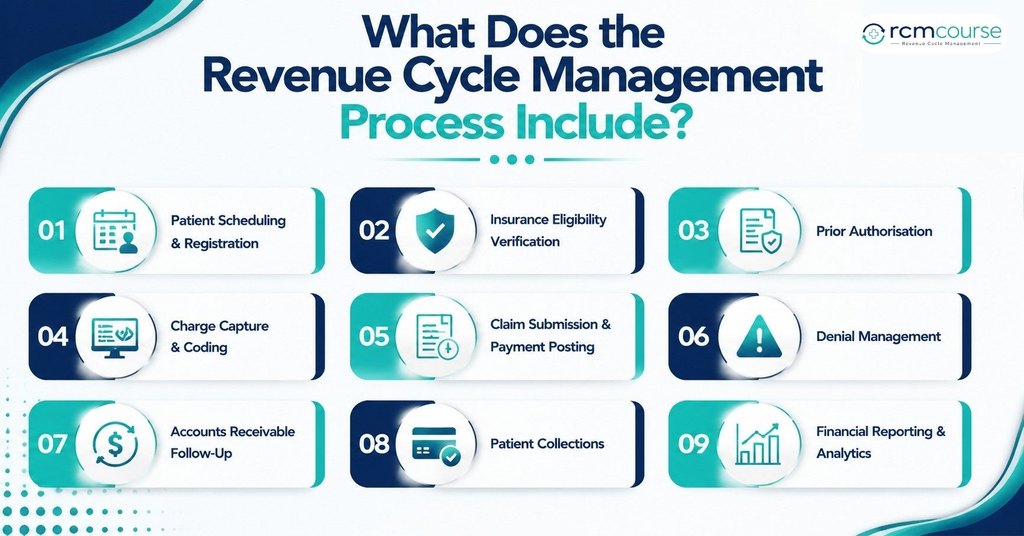
The RCM process includes every administrative and financial touchpoint tied to a patient account, from scheduling through final collections and reporting. It spans front-office, mid-cycle, and back-office functions that billing alone doesn’t cover.
- Patient scheduling and registration — capturing accurate demographic and insurance information at the first point of contact.
- Insurance eligibility verification — confirming active coverage and benefits before the visit occurs.
- Prior authorization — securing payer approval for services that require it, ahead of time.
- Charge capture and coding — documenting and coding the services actually rendered.
- Claim submission — the same core function found in medical billing, but managed as one stage among many.
- Payment posting — recording insurer and patient payments against the account.
- Denial management — identifying, correcting, and appealing denied claims, and tracking why they happened.
- Accounts receivable (AR) follow-up — actively working aged, unpaid claims until they’re resolved.
- Patient collections — managing patient-owed balances, payment plans, and financial communication.
- Financial reporting and analytics — measuring KPIs like clean claim rate, days in AR, and denial rate to improve performance over time.
Medical Billing vs Revenue Cycle Management: What Are the Key Differences?
The clearest way to see the difference is side by side. Billing is a subset of activities focused on claims and payment; RCM is the operating system those activities run inside of.
| Comparison | Medical Billing | Revenue Cycle Management |
| Scope | Specific billing activities | Entire financial lifecycle |
| Starting Point | Usually after services are documented | Before the patient visit |
| Main Focus | Claims and payments | Financial performance |
| Insurance Verification | Limited/not core | Core function |
| Claim Submission | Yes | Yes |
| Denial Management | Mainly resolving individual denials | Resolving and preventing denials |
| Analytics | Limited | Extensive KPI and financial analysis |
| Patient Collections | Yes | Managed across the full cycle |
What Are the Main Responsibilities of Medical Billing?

Medical billing involves accurate coding and charge entry, timely claims submission and tracking, and precise payment posting and patient billing to keep the revenue cycle moving efficiently.
1. Medical Coding and Charge Entry
Billers (often working alongside dedicated coders) are responsible for translating clinical documentation into accurate ICD-10 and CPT codes and entering the corresponding charges.
Getting this step right the first time is the single biggest lever for reducing downstream denials, since a mismatched or unsupported code is one of the most common rejection reasons payers cite.
2. Claims Submission and Tracking
Once coded, claims are prepared, formatted to payer specifications, and submitted — typically through a clearinghouse that scrubs the claim for errors before it reaches the payer.
Billers then monitor claim status, flagging anything that stalls or bounces back so it can be corrected and resubmitted quickly.
3. Payment Posting and Patient Billing
After a payer adjudicates a claim, billers post the payment, apply any contractual adjustments, and calculate what’s left for the patient to pay.
That remaining balance moves to patient statements, and any amount that goes unpaid past a defined window is escalated toward collections.
What Are the Main Responsibilities of Revenue Cycle Management?

Revenue Cycle Management covers patient registration, financial clearance, claims and AR management, and denial prevention to optimise the healthcare organisation’s revenue flow.
1. Patient Registration and Insurance Eligibility
RCM begins with getting patient demographic and insurance details right at the very first touchpoint, then verifying eligibility and benefits before the appointment happens.
A single incorrect digit in a policy number at registration can cause a denial weeks later — which is exactly the kind of failure RCM is built to prevent.
2. Prior Authorization and Financial Clearance
Certain procedures require payer sign-off before they’re performed, and RCM teams are responsible for securing that approval ahead of time.
This stage also covers financial clearance — making sure the patient understands their expected out-of-pocket responsibility before care is delivered, which reduces billing surprises and bad debt later.
3. Claims, Payments and Accounts Receivable
RCM owns the same claims and payment posting functions found in billing, but places them inside a continuous AR management process.
Instead of treating each claim as a one-off transaction, RCM teams actively monitor aging accounts receivable and work unpaid claims until they’re resolved — not just submitted.
4. Denial Management and Prevention
RCM treats denials as a data problem, not just a paperwork problem. Beyond correcting and resubmitting individual denied claims, RCM teams analyze denial patterns by payer, code, and root cause, then feed those insights back into front-end processes to prevent the same denial from happening again.
Revenue Cycle Analytics
RCM relies on a defined set of KPIs to measure financial health and catch problems early, including:
- Clean claim rate — the percentage of claims accepted on first submission without correction.
- Days in AR — the average number of days it takes to collect payment after a claim is submitted.
- Denial rate — the percentage of claims denied by payers.
- Collection performance — how much of billed, allowable revenue is actually collected.
How Do Medical Billing and Revenue Cycle Management Work Together?
Medical billing is the engine inside the larger RCM machine — RCM sets up the conditions for a clean claim, and billing executes the claims-and-payment step at the center of that process.
Neither functions well in isolation: RCM without strong billing execution still leaves money on the table, and billing without RCM’s upstream checks means chasing preventable denials indefinitely.
The relationship typically flows like this:
Patient Scheduling → Eligibility → Treatment → Coding → Medical Billing → Payment → Denial/AR Follow-up → Analytics
Framed this way, billing isn’t a standalone department bolted onto the practice — it’s one stage in a connected loop where each stage’s output becomes the next stage’s input, and the analytics stage feeds insights back to the very first step.
Why Is Revenue Cycle Management Broader Than Medical Billing?
RCM is broader because it manages both revenue generation and revenue collection, while medical billing focuses almost entirely on the collection half.
RCM’s front-end functions — scheduling, eligibility, prior authorization, financial clearance — exist to generate revenue cleanly in the first place, by preventing errors before they can turn into denied or delayed claims.
That upstream focus is what separates the two in practice. Medical billing mainly processes what’s already been documented and tries to collect on it.
RCM asks a different question at every stage: how do we prevent a financial problem before it occurs? It also uses performance data — clean claim rate, denial trends, days in AR — to continuously improve the organization’s overall financial health, not just resolve individual claims.
Medical Billing vs RCM: Which Does a Healthcare Organization Need?
Medical billing and RCM aren’t competing alternatives — a healthcare organization needs both, because one is a necessary function nested inside the other.
Medical billing is essential for the mechanical work of processing claims and getting paid; effective RCM incorporates that billing function alongside the front-end, back-end, and analytical processes that keep the whole financial lifecycle healthy.
In practice, most growing practices don’t choose between “better billing” and “better RCM” — they start by tightening billing accuracy, then expand into full RCM as they realize how many denials and delays originate before a claim is ever created.
Frequently Asked Questions
Is RCM the Same as Medical Billing?
No. RCM is the entire financial lifecycle of a patient account, from scheduling through final payment, while medical billing is one function within that lifecycle — specifically, converting documented services into claims and collecting on them.
Is Billing Part of the Revenue Cycle?
Yes. Medical billing is a core stage within revenue cycle management, sitting between charge capture/coding and payment posting. It couldn’t exist without the earlier RCM stages (registration, eligibility, authorization) feeding it accurate information.
What Is the Difference Between Revenue and Billing?
Revenue refers to the total money a healthcare organization earns for services rendered, while billing is the operational process used to claim and collect that revenue. Revenue is the outcome; billing is one of the mechanisms used to achieve it.
What Is AR in Medical Billing?
AR, or accounts receivable, refers to the money owed to a healthcare organization for services already rendered but not yet paid. In billing and RCM, “days in AR” is a key metric tracking how long it takes on average to collect that outstanding balance.
What Is Denial Management in Medical Billing?
Denial management is the process of identifying why a claim was denied, correcting the underlying issue, and resubmitting or appealing it with the payer. Within full RCM, denial management also includes tracking denial trends to prevent the same errors from recurring.
How does RCM support healthcare billing teams?
RCM supports healthcare billing teams by providing structured processes for managing claims, payments, denials, and financial reporting.
Conclusion
Medical billing and Revenue Cycle Management are closely connected but serve different purposes within the healthcare financial process.
Medical billing focuses on the accurate preparation, submission, and collection of claims, while RCM manages the complete journey of healthcare revenue from the first patient interaction to final payment.
A successful healthcare organisation requires both effective billing practices and strong RCM strategies. While accurate billing ensures claims are processed correctly, comprehensive RCM helps prevent problems before they occur through better registration, eligibility checks, denial prevention, and financial analysis.
By combining both approaches, healthcare providers can improve cash flow, reduce delays, and create a more efficient revenue cycle.
Claim denials in medical billing can be reduced by preventing errors before a claim reaches the payer. The most effective strategies include verifying patient and insurance information, confirming eligibility and prior authorisation requirements, improving coding and documentation accuracy, scrubbing claims before submission, and tracking denial trends to prevent repeat problems.
Medical claim denials can delay reimbursement, increase administrative work, raise accounts receivable, and contribute to lost revenue. Many are preventable because they result from recurring issues such as incorrect patient information, inactive insurance coverage, missing authorisation, coding errors, incomplete documentation, duplicate claims, and payer-specific billing requirements.
Effective claim denial management therefore combines prevention, correction, and continuous analysis. Tracking why claims are denied helps healthcare organisations identify recurring problems, improve billing workflows, and prevent the same errors from affecting future claims.
This guide explains how to reduce claim denials in medical billing, the most common causes of denials, how to manage denied claims effectively, and how denial tracking, claim scrubbing, and technology can support cleaner claims, faster reimbursement, and stronger revenue cycle performance.
What Is a Claim Denial in Medical Billing?
A claim denial happens when a payer receives and fully processes a claim, then decides it will not pay it. The claim was valid enough to reach adjudication, but something in it, whether a coding issue, a missing authorisation, or a medical necessity question, meant the payer refused payment.
Denied claims matter because they directly delay or reduce reimbursement. The specific denial reason on the remittance advice determines what happens next: some denials can simply be corrected and resubmitted, others require additional documentation, and some need a formal appeal.
Claim Denial vs Claim Rejection: What Is the Difference?

A denied claim has been processed by the payer and refused payment, while a rejected claim was never processed at all because it failed a basic validation check. Rejections usually come back almost immediately, often before the claim even reaches the payer’s adjudication system, because of a technical error such as an invalid member ID or a formatting mistake.
Knowing which one you are dealing with matters because the fix is different. A rejection needs a straightforward correction and resubmission. A denial needs you to understand the payer’s specific reason for refusing payment before you touch the claim again, otherwise you risk submitting the same error twice.
How to Reduce Claim Denials in Medical Billing : Most Common Reasons for Claim Denials?

The vast majority of medical billing denials come from a relatively small group of recurring problems. Many of these issues happen before the claim is submitted, during patient registration, insurance verification, authorisation, coding, documentation, or provider setup. Identifying these problems early is far more efficient than correcting or appealing claims after payment has already been delayed.
Understanding the most common reasons for claim denials also helps healthcare organisations identify which part of the revenue cycle needs improvement. Some denials originate at the front desk, while others are caused by coding, clinical documentation, credentialing, or claim submission errors.
Incorrect Patient or Insurance Information
Incorrect patient or insurance information is one of the most preventable causes of claim denials. Even a small data-entry error can prevent a payer from correctly matching a claim to the patient’s insurance record.
Common problems include:
- Misspelt patient names
- Incorrect dates of birth
- Wrong member or policy numbers
- Missing subscriber information
- Incorrect group numbers
- Billing the wrong insurance company
- Using outdated insurance information
- Submitting a claim after coverage has expired
These errors often begin during registration. For example, a patient may have changed insurance plans since their previous visit, but the old payer information remains in the billing system. If staff do not confirm the current insurance card and patient details, the claim may be sent to the wrong payer or linked to inactive coverage.
The best way to prevent these denials is to verify demographic and insurance information at every relevant encounter and update the billing system immediately when changes are identified.
Eligibility and Coverage Problems
Eligibility denials occur when the patient’s insurance coverage is inactive, the service is not covered under the plan, or payer requirements were not identified before treatment.
Simply confirming that a patient has insurance is not enough. Billing teams should verify whether the policy is active on the date of service and whether the planned treatment is covered under that specific benefit plan.
Common eligibility and coverage problems include:
- Inactive insurance coverage
- Coverage ending before the date of service
- Services excluded from the patient’s plan
- Incorrect primary or secondary insurance
- Benefit limits already reached
- Services requiring prior authorisation
- Referral requirements not identified
- Incorrect coordination of benefits information
These denials can be especially costly because the problem may not be discovered until after care has already been provided.
Real-time eligibility verification can help staff confirm coverage status, benefit details, copayments, deductibles, and payer requirements before the patient receives the service.
Missing Prior Authorisation or Referral
Many insurance plans require approval before certain procedures, treatments, diagnostic tests, or specialist services are provided. If the required prior authorisation is missing, expired, or does not match the service billed, the payer may refuse payment.
Prior authorisation denials can occur when:
- Authorisation was never obtained
- Authorisation was requested too late
- The approved dates do not cover the service date
- The approved procedure differs from the procedure performed
- The authorised number of visits or units has been exceeded
- An authorisation number was entered incorrectly
- A required specialist referral was missing or expired
Billing and clinical teams should therefore confirm authorisation requirements before scheduled services are delivered.
The authorisation record should clearly document the approved service, effective dates, number of visits or units, authorisation number, and any payer-specific conditions. If the planned treatment changes, the authorisation may also need to be updated before the new service is provided.
Medical Necessity Issues
Medical necessity denials happen when the payer determines that the submitted documentation does not sufficiently justify why a service, procedure, or treatment was required.
The service may have been clinically appropriate, but the claim can still be denied if the documentation or diagnosis information does not meet the payer’s coverage criteria.
Common causes include:
- Diagnosis codes that do not support the procedure
- Missing clinical justification
- Incomplete medical records
- Documentation that does not demonstrate severity
- Services outside payer coverage criteria
- Frequency limits being exceeded
- Required supporting records not submitted
Medical necessity is closely connected to both clinical documentation and coding accuracy. The diagnosis reported on the claim should reflect the patient’s documented condition, while the medical record should clearly explain why the billed service was required.
Healthcare organisations can reduce these denials by reviewing payer medical policies for frequently performed procedures and making sure clinical documentation supports the service before the claim is submitted.
Coding Errors
Coding errors are a major source of claim denials because payers rely on diagnosis, procedure, and modifier codes to determine what service was performed and whether it qualifies for reimbursement.
Common coding-related denial causes include:
- Incorrect CPT codes
- Incorrect HCPCS codes
- Incorrect ICD-10-CM diagnosis codes
- Missing modifiers
- Incorrect modifier use
- Diagnosis and procedure mismatches
- Outdated or deleted codes
- Incorrect code sequencing
- Unbundling or bundling problems
- Coding that is not supported by documentation
For example, a procedure may be coded correctly, but the diagnosis code reported with it may not support medical necessity under the payer’s policy. Similarly, a missing modifier can change how the payer interprets the service and result in reduced or denied payment.
Coding teams should use the most current code sets, follow official coding guidelines, review payer-specific requirements, and confirm that documentation supports every code reported on the claim.
Regular coding audits and ongoing staff training can also help identify patterns before they become repeated denials.
Provider Credentialing Problems
Provider credentialing determines whether a healthcare professional is recognised by a payer and authorised to bill for covered services.
Claims may be denied when:
- A new provider has not completed credentialing
- Credentialing has expired
- Recredentialing was not completed on time
- Provider identifiers do not match payer records
- The provider is not enrolled for a particular service location
- The provider is considered out of network
- Incorrect National Provider Identifier information is submitted
- Group and individual provider records do not match
Credentialing problems can create significant payment delays because correcting the claim alone may not resolve the issue. The underlying provider enrolment or payer record may first need to be updated.
Healthcare organisations should maintain a credentialing calendar, monitor expiration and recredentialing dates, and verify provider information whenever a clinician joins the organisation, changes locations, or begins billing a new payer.
Duplicate Claims
Duplicate claim denials occur when a payer receives what appears to be the same claim more than once.
This can happen when:
- Staff resubmit a claim without checking its status
- A claim is transmitted twice accidentally
- A previously denied claim is submitted again unchanged
- A corrected claim is sent as a new claim
- Multiple departments submit the same service
- The original claim reference number is missing
A claim that appears unpaid is not necessarily lost. It may still be in processing, suspended for review, or awaiting additional information.
Before resubmitting a claim, billing staff should check the payer portal, clearinghouse, or claim tracking system to determine its current status.
When corrections are necessary, teams should follow the payer’s corrected claim process rather than simply submitting the same claim again. This helps prevent the corrected submission from being treated as a duplicate.
Incorrect Place of Service or Revenue Codes
Place-of-service and revenue code errors can cause denials because they tell the payer where the service was performed and what type of facility or department provided it.
A mismatch between these codes and the billed procedure can make the claim appear inconsistent.
Common problems include:
- Using the wrong place-of-service code
- Reporting an office service as a hospital service
- Incorrect facility coding
- Revenue codes that do not match the procedure
- Incorrect default codes in the billing system
- Inconsistencies between the claim and medical record
- Using outdated internal billing configurations
These errors can occur when billing systems automatically populate codes based on old templates or incorrect default settings.
Healthcare organisations should therefore periodically review billing-system configurations, confirm that place-of-service and revenue codes reflect where care was actually delivered, and make sure they align with the procedure and payer requirements.
Why Identifying the Root Cause Matters
Fixing a single denied claim may recover one payment, but identifying the root cause of the denial can prevent the same problem from affecting dozens or hundreds of future claims.
For example:
- Repeated eligibility denials may point to weak front-desk verification.
- Frequent authorisation denials may indicate a scheduling workflow problem.
- Coding denials may suggest a need for additional coder training or audits.
- Documentation denials may reveal gaps between clinicians and billing teams.
- Credentialing denials may indicate poor tracking of provider enrolment dates.
For this reason, healthcare organisations should not treat denials as isolated billing problems. Each denial provides data that can be used to improve the revenue cycle, strengthen workflows, and reduce future revenue loss.
10 Ways to Reduce Claim Denials in Medical Billing

Reducing claim denials in medical billing depends on identifying and correcting problems before the claim is submitted to the payer. The most effective denial prevention process starts at patient registration and continues through eligibility verification, authorisation, coding, documentation, credentialing, claim scrubbing, and final submission.
The following ten steps create a practical front-to-back workflow that can help healthcare organisations submit cleaner claims, reduce avoidable rework, and improve reimbursement performance.
1. Verify Insurance Eligibility Before Every Visit
Insurance eligibility should be checked before every scheduled service, even when the patient has visited the organisation before. Coverage can change between appointments, and relying on previously stored information can lead to avoidable denials.
Billing or front-desk staff should confirm:
- The patient’s insurance policy is active.
- Coverage is valid on the planned date of service.
- Effective and termination dates are correct.
- The scheduled service is covered under the patient’s plan.
- Copayment and deductible requirements are understood.
- Prior authorisation is required or not required.
- Referral requirements apply.
- Benefit limits have not already been reached.
- Primary and secondary insurance are correctly identified.
Eligibility verification should focus on the specific service being provided, not simply whether the patient has active insurance.
For example, a patient may have active coverage but their plan may exclude a particular procedure or require prior authorisation before payment is considered. Identifying this before treatment allows staff to resolve the issue before the claim is created.
Where available, real-time eligibility verification tools can make this process faster and more consistent by retrieving payer information electronically.
2. Collect Accurate Patient Information
Accurate patient information is essential because even small registration errors can cause claim rejections or denials.
Staff should verify information directly with the patient rather than relying entirely on information already stored in the system.
Important details include:
- Full legal name
- Correct spelling
- Date of birth
- Current address
- Member or policy number
- Group number
- Subscriber name
- Patient relationship to subscriber
- Primary insurance
- Secondary insurance
- Current payer information
Insurance details should ideally be confirmed from the patient’s insurance card rather than from memory or old records.
This information should also be reviewed at every appropriate visit. A patient’s insurer, employer-sponsored plan, policy number, or secondary coverage may change at any time.
A reliable registration process can prevent errors from moving downstream into coding, claim generation, submission, and denial management.
3. Obtain Prior Authorisation Before Services
Prior authorisation is required by many payers for certain procedures, imaging services, medications, specialist treatments, and other higher-cost services.
If authorisation is required but not obtained before the service is delivered, the claim may be denied even when the treatment itself was medically appropriate.
Before the service takes place, staff should confirm:
- Whether prior authorisation is required.
- Which procedure or service has been approved.
- The authorisation number.
- The approved date range.
- The number of approved visits.
- The number of approved units.
- Any payer-specific restrictions.
- Whether the authorisation matches the actual planned service.
Authorisation details should be recorded accurately in the patient’s record and billing system.
Staff should also check whether the clinical plan has changed. If a different service, procedure, or number of units is provided from what the payer originally approved, the existing authorisation may no longer be sufficient.
A structured authorisation workflow helps prevent services from being delivered before payer requirements have been completed.
4. Verify Referral Requirements
Some payer plans require patients to obtain a referral before receiving specialist care.
A claim may be denied when:
- No referral was obtained.
- The referral has expired.
- The referral does not cover the service provided.
- The referral is for a different specialist.
- The referral dates do not include the actual service date.
- The permitted number of visits has already been used.
Referral requirements should therefore be checked during scheduling or eligibility verification, not after treatment has taken place.
Staff should confirm that the referral is valid and correctly documented before the appointment. Where necessary, the referring provider should be contacted early enough to resolve any missing information.
Including referral verification within the pre-service workflow can prevent another common source of avoidable denials.
5. Improve CPT, HCPCS and ICD-10 Coding Accuracy
Accurate medical coding plays a central role in claim approval because payers use coded information to understand what condition was treated and what service was provided.
Coding staff should make sure that:
- CPT codes accurately represent procedures and services.
- HCPCS codes are appropriate where required.
- ICD-10-CM codes reflect the documented diagnosis.
- Diagnosis codes support the procedures billed.
- Required modifiers are included.
- Modifiers are applied correctly.
- Codes are reported at the appropriate level of specificity.
- Code sequencing follows applicable guidelines.
- Documentation supports every reported code.
Using an incorrect diagnosis or procedure code can result in a denial even when the service itself was appropriate.
For example, the procedure code may be valid, but the diagnosis submitted with it may not support medical necessity under the payer’s policy.
Coding teams should avoid selecting codes based on assumptions or previous claims. Codes should always be based on the current clinical documentation.
Regular coding audits and targeted education can help identify recurring errors before they become repeated denial patterns.
6. Strengthen Clinical Documentation
Clinical documentation provides the evidence supporting the services reported on a claim.
Documentation should clearly explain:
- Why the patient received care.
- The patient’s relevant condition or symptoms.
- What services were performed.
- Why the service was medically necessary.
- The treatment or procedure provided.
- Relevant clinical findings.
- The provider’s assessment and plan.
A payer reviewer should be able to understand why the service was necessary without having to interpret vague or incomplete notes.
Documentation must also support the diagnosis and procedure codes submitted on the claim.
For example, if a higher-level service is billed, the medical record should contain sufficient information to support that level. If a particular procedure is reported, the documentation should clearly demonstrate that the procedure was actually performed.
Incomplete, inconsistent, or unclear documentation can lead to medical necessity denials, coding corrections, audit exposure, or delayed reimbursement.
Close communication between clinicians, coders, and billing staff can help identify documentation gaps early.
7. Keep Billing Codes Updated
Medical code sets and billing rules change regularly. Using deleted, outdated, or incorrect codes can cause otherwise valid claims to be denied.
Healthcare organisations should have a structured process for reviewing updates to:
- ICD-10-CM codes
- CPT codes
- HCPCS codes
- Modifiers
- Payer-specific billing rules
- Claim edits
- Internal billing configurations
When code changes take effect, outdated codes should be removed from templates, billing software, charge masters, and frequently used favourites.
Updating reference materials alone is not enough if the billing system continues to populate an old code automatically.
Billing, coding, compliance, and IT teams should therefore coordinate system updates to make sure the electronic health record, practice management system, and claims platform use current information.
Staff should also receive education when major code or rule changes affect commonly billed services.
8. Maintain Provider Credentialing
Provider credentialing problems can stop payment even when the patient information, coding, and documentation are correct.
Before a provider begins billing a payer, healthcare organisations should confirm that the provider has completed the required enrolment and credentialing process.
Important information to monitor includes:
- Credentialing status
- Effective dates
- Recredentialing deadlines
- National Provider Identifier details
- Tax identification information
- Practice location
- Group affiliation
- Network status
- Payer enrolment status
Credentialing should be completed before services are billed whenever possible.
Organisations should also monitor expiration dates and recredentialing requirements rather than waiting until claims start being denied.
Provider information submitted on the claim should match the information held by the payer. Differences in names, identifiers, locations, or group details can create payment problems.
Maintaining a central credentialing calendar can help billing and administrative teams avoid preventable credentialing-related denials.
9. Use Claim Scrubbing Before Submission
Claim scrubbing is one of the most effective final checks before a claim reaches the payer.
A claim scrubber reviews claim data for potential errors and alerts staff when something may need correction.
Common checks include:
- Missing patient information
- Invalid diagnosis codes
- Invalid procedure codes
- Missing modifiers
- Incorrect modifier combinations
- Diagnosis-procedure mismatches
- Duplicate claims
- Provider information errors
- Place-of-service issues
- Missing required fields
- Payer-specific formatting problems
Claim scrubbing does not replace accurate registration, coding, or documentation. Instead, it works as an additional quality-control layer.
Errors identified during claim scrubbing should be corrected before transmission rather than ignored and submitted anyway.
Organisations can also review scrubber reports to identify recurring mistakes. If the same error appears repeatedly, the underlying workflow may need to be changed rather than correcting each claim individually.
10. Submit Clean Claims on Time
The final step is making sure claims are complete, accurate, and submitted within payer deadlines.
Before submission, billing teams should confirm that:
- Patient information is complete.
- Insurance information is current.
- Eligibility has been verified.
- Required authorisation has been obtained.
- Required referrals are available.
- Provider information is correct.
- Coding is accurate.
- Documentation supports the claim.
- Required modifiers are included.
- Claim edits have been resolved.
- The claim passes scrubbing checks.
- The payer’s timely filing deadline has not been exceeded.
Timely filing limits vary by payer and contract, so billing teams should maintain a clear process for monitoring submission deadlines.
Claims should also be tracked after submission.
Staff should confirm whether each claim has been:
- Accepted
- Rejected
- Pending
- Adjudicated
- Paid
- Partially paid
- Denied
Active claim tracking allows problems to be identified early rather than waiting until an account becomes significantly overdue.
Build Denial Prevention Into the Entire Revenue Cycle
The strongest denial prevention strategy does not depend on one department. It requires coordination between scheduling, registration, eligibility teams, clinical staff, coders, billing specialists, credentialing teams, and revenue cycle managers.
Each stage should include its own quality checks.
For example:
- Registration teams verify patient information.
- Eligibility teams confirm coverage.
- Authorisation teams complete payer requirements.
- Clinicians create complete documentation.
- Coders assign accurate codes.
- Billing teams scrub and submit claims.
- Revenue cycle teams monitor denials and identify patterns.
When each department addresses errors at the point where they originate, fewer problems reach the payer.
The goal is not simply to correct denied claims faster. It is to build a repeatable denial prevention process that improves clean claim submission, reduces avoidable administrative work, speeds up reimbursement, and prevents the same errors from occurring again.
How Do You Manage a Denied Claim Effectively?

Managing a denial well means identifying the exact reason it happened, fixing the underlying cause rather than resubmitting blindly, and appealing when the denial is genuinely incorrect. Rushing this process usually just produces a second denial.
Identify the Exact Denial Reason
Review the remittance advice or payer response line by line, and record the specific denial reason and adjustment codes rather than a general summary. Determine whether the root cause is administrative, coding-related, eligibility-related, or clinical, since that determines the entire next step.
Correct the Claim Before Resubmitting
Fix the actual underlying error, not just the symptom, and follow the payer’s specific corrected-claim process rather than treating it like a fresh submission. Include the original claim reference number where the payer requires it, and never simply resubmit the same claim unchanged and hope for a different outcome.
Appeal Denials When Appropriate
Determine whether the denial is genuinely eligible for appeal, gather the supporting documentation the payer will actually need, and follow that payer’s specific appeal requirements exactly. Submit within the payer’s appeal deadline, and track the appeal through to resolution rather than assuming it was received.
How Do You Track Denial Trends to Prevent Repeat Errors?
Tracking denial trends means monitoring key metrics, running root cause analysis on the patterns you find, and turning that data into concrete workflow and training changes. Without this step, teams end up fixing the same denial reason over and over instead of eliminating it.
Monitor Key Denial Metrics
Useful metrics include the initial denial rate, denial rate broken down by payer, denial rate by provider, denial rate by CPT or procedure code, denial reason categories, and the appeal success or recovery rate. Tracking these separately, rather than as one blended number, is what actually reveals where the problem is coming from.
Perform Root Cause Analysis
Repeated denials almost always originate from one of a small number of places: registration, eligibility verification, authorisation, coding, documentation, credentialing, claim submission, or payer-specific requirements. Root cause analysis means tracing each denial category back to which of these stages actually failed.
Turn Denial Data Into Corrective Action
Identify the highest-volume denial categories first, since fixing those delivers the biggest return. Prioritise the denials that were genuinely preventable, assign responsibility to the relevant department, update the workflow that caused the error, retrain staff where the data shows a knowledge gap, and monitor whether the denial rate actually improves afterwards.
How Can Technology Help Reduce Claim Denials?
Technology reduces denials most effectively when it catches errors before a claim ever reaches the payer, rather than only helping staff manage denials after they happen. Useful tools include:
- Real-time eligibility verification
- Electronic prior authorisation
- Automated claim scrubbers
- Coding validation software
- Electronic claim tracking
- Denial analytics dashboards
- Automated payer rule checks
- EMR and billing-system validation
The practices that see the biggest drop in denial rates treat these tools as a front-end filter, not a back-end clean-up crew.
Claim Denial Prevention Checklist
Before submitting any claim, confirm the following:
- Patient information is correct
- Insurance coverage is active
- Benefits have been verified
- Required authorisation has been obtained
- Required referral is available
- Provider credentialing is current
- CPT/HCPCS codes are correct
- ICD-10 codes support the service
- Required modifiers are included
- Documentation supports medical necessity
- Place-of-service and revenue codes are correct
- The claim passes claim-scrubbing checks
- The claim is submitted within the payer deadline
Why Does Preventing Claim Denials Matter?
Preventing claim denials matters because it directly protects a practice’s cash flow and reduces the administrative cost of chasing payment. The practical benefits include:
- Faster reimbursement
- Improved clean claim rate
- Lower administrative workload
- Reduced claim rework
- Lower accounts receivable
- Less revenue leakage
- More predictable cash flow
- Better overall revenue cycle performance
Frequently Asked Questions
What is the best way to reduce claim denials in medical billing?
The best way is to prevent errors before a claim is ever submitted: verify eligibility and patient information up front, confirm authorisations and referrals, code and document accurately, and run every claim through a scrubber before submission.
What are the most common reasons for medical claim denials?
The most common reasons are incorrect patient or insurance information, eligibility and coverage problems, missing prior authorisation or referrals, medical necessity issues, coding errors, credentialing problems, duplicate claims, and incorrect place-of-service or revenue codes.
What are the three types of claim denials?
Denials are generally grouped into administrative denials (data or process errors), clinical or medical necessity denials (documentation or coverage criteria not met), and technical denials (coding, modifier, or billing rule errors).
What are the four common denial codes in medical billing?
Frequently seen categories include denials for missing or invalid authorisation, denials for non-covered services, denials for duplicate claims, and denials for missing or incomplete information, though exact codes vary by payer.
What is a CO-252 denial?
A CO-252 denial means the claim lacks required documentation or attachments the payer needs to make a payment decision. The claim must be resubmitted with the missing documentation attached.
What is the difference between a rejected claim and a denied claim?
A rejected claim never completes payer processing because of a basic error, while a denied claim was fully processed and then refused payment for a specific reason.
Can a denied medical claim be resubmitted?
Yes, most denied claims can be corrected and resubmitted following the payer’s corrected-claim process, though some require an appeal instead if the denial reason is a coverage or medical necessity decision rather than an administrative error.
How does insurance verification reduce claim denials?
Verifying insurance before the visit confirms coverage is active, benefits apply to the planned service, and any authorisation or referral requirements are known in advance, which prevents the majority of eligibility-related denials before they happen.
How can coding errors cause claim denials?
Incorrect or outdated CPT, HCPCS, or ICD-10 codes, mismatched diagnosis and procedure codes, or missing modifiers all cause the payer’s system to flag the claim as invalid or unsupported, resulting in a denial.
How can claim scrubbing prevent denials?
Claim scrubbing software checks a claim for missing data, invalid codes, modifier errors, and mismatches before submission, catching the same issues a payer would flag but early enough to fix them at no cost in time or rework.
How many steps are there in Revenue Cycle Management (RCM)?
Revenue Cycle Management can be divided into 13 key steps, covering the full financial journey from patient scheduling and registration to insurance verification, coding, claim submission, payment posting, denial management, follow-up, and final patient collections.
How often should healthcare organisations analyse denial trends?
Most revenue cycle teams review denial trends monthly at minimum, with high-volume practices tracking key metrics weekly so recurring problems are caught and corrected before they compound.
Conclusion
Reducing claim denials in medical billing starts with preventing errors before claims reach the payer. Accurate patient information, insurance eligibility checks, prior authorisation, correct coding, complete documentation, provider credentialing, claim scrubbing, and timely submission all play an important role in improving clean claim performance.
When a denial does occur, the goal should be to identify the exact cause, correct the issue properly, and use the denial data to prevent the same problem from happening again. Tracking denial trends by payer, provider, service, coding issue, and workflow stage helps healthcare organisations turn individual claim problems into long-term process improvements.
The strongest denial management strategy combines prevention, accurate claim submission, effective follow-up, and continuous analysis. By building these practices into the revenue cycle, healthcare organisations can reduce administrative rework, speed up reimbursement, strengthen cash flow, and create a more efficient and reliable medical billing process.
To support your denial management efforts, download our RCM Denial Rate Benchmarking Worksheet and use it to track performance, analyse denial trends, identify improvement areas, and strengthen your revenue cycle management strategy.
If a claim gets denied, a patient’s insurance goes unverified, or a charge never makes it into the billing system, the money is gone, or at least stuck for months. That’s the entire problem revenue cycle management (RCM) exists to solve.
Revenue cycle management in healthcare is the end-to-end financial process that tracks a patient’s care from the moment they schedule an appointment through to the moment their balance is paid in full. It covers scheduling, registration, insurance verification, charge capture, coding, claim submission, payment posting, denial management, and patient collections. The goal is simple to state and hard to execute: get providers paid accurately and on time while keeping the patient’s financial experience clear and predictable.
This guide walks through the seven steps of the healthcare revenue cycle, the three pillars that determine whether RCM succeeds or fails, where RCM fits into the broader business concept of a “revenue cycle”, the biggest challenges providers face in 2026, and how to build a career or a team around it. By the end, you’ll be able to map your own organisation’s revenue cycle, spot where revenue is leaking, and know what to fix first.
What Is Revenue Cycle Management in Healthcare?
RCM is the administrative and clinical function that connects patient care to provider payment. Every time a patient is scheduled, seen, coded, billed, or follows up on a bill, that action is part of the revenue cycle. In medical billing specifically, RCM is the operational engine, meaning the staff, software, and workflows that turn a documented encounter into a paid claim.
Three things make healthcare RCM harder than revenue cycles in most other industries:
Third-party payers: Unlike retail, the person receiving the service (the patient) usually isn’t the primary payer. Insurance companies, Medicare, and Medicaid sit in between, each with different rules, timelines, and documentation requirements.
Regulatory complexity: Coding standards (ICD-10, CPT, HCPCS), payer contracts, and compliance requirements (HIPAA, No Surprises Act, price transparency rules) all shape how revenue can legally be captured.
Clinical-financial handovers: Money only flows correctly if clinical documentation, coding, and billing are in sync. A documentation gap in the consulting room becomes a denied claim weeks later.
What Are the 7 Steps of the Revenue Cycle Management?
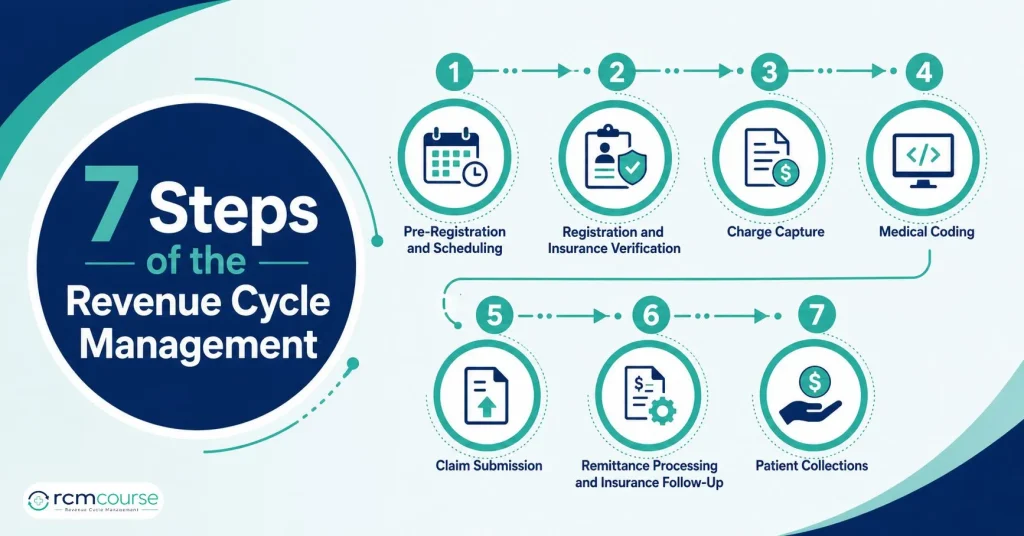
The healthcare revenue cycle is generally broken into seven steps, spanning the full journey from first contact to final payment.
1. Pre-registration and Scheduling
This is where the cycle actually begins, before the patient walks in. Staff collect demographic details and insurance information, often while the patient is still on the phone booking the appointment. Getting this step right matters enormously: inaccurate or incomplete data at the front end is one of the most common causes of downstream claim denials, according to ADSC’s breakdown of the seven RCM steps.
2. Registration and Insurance Verification
At check-in, staff confirm the details gathered during pre-registration and verify active cover. This includes confirming the plan type, deductible status, co-payment amount, and whether a referral or prior authorisation is required. A quick eligibility check here can prevent a denial that would otherwise surface weeks later.
3. Charge Capture
Every service, test, and supply used during the visit has to be translated into billable charges. This can happen automatically, with charges flowing from clinical documentation into the billing system, or manually, with front-desk or coding staff entering them by hand. Ancillary services are among the charges most commonly missed, which quietly leaves revenue on the table, as LBMC’s revenue cycle guide points out. AI-assisted coding tools are increasingly used to flag incomplete documentation before a charge slips through.
4. Medical Coding
Trained coders (or coding software with human review) translate the clinical documentation into standardised ICD-10, CPT, and HCPCS codes. Coding accuracy directly determines reimbursement. Undercoding leaves money unclaimed, while overcoding creates compliance risk.
5. Claim Submission
The coded claim is scrubbed for errors (missing modifiers, mismatched codes, invalid patient IDs) and submitted to the payer, typically through a clearing house that routes it to the correct insurance provider. Clean claims, meaning claims that pass through without payer rejection, are the single biggest driver of faster cash flow.
6. Remittance Processing and Insurance Follow-up
Once the payer adjudicates the claim, the provider receives an Explanation of Benefits (EOB) or Electronic Remittance Advice (ERA) detailing what was paid, adjusted, or denied. Denied or underpaid claims move into an appeals and follow-up workflow. This is where dedicated denial management teams earn their keep.
7. Patient Collections
Whatever remains after insurance pays, including co-payments, deductibles, co-insurance, or non-covered services, becomes the patient’s responsibility. Clear, upfront pricing estimates and flexible payment options at this stage significantly improve collection rates and patient satisfaction.
Some organisations expand this into a more granular 12- to 13-step model that separates sub-tasks such as prior authorisation, medical necessity review, or cash posting. The seven-step version above is the standard framework that almost every RCM team, vendor, and textbook builds upon.
What Are the Three Pillars of RCM?
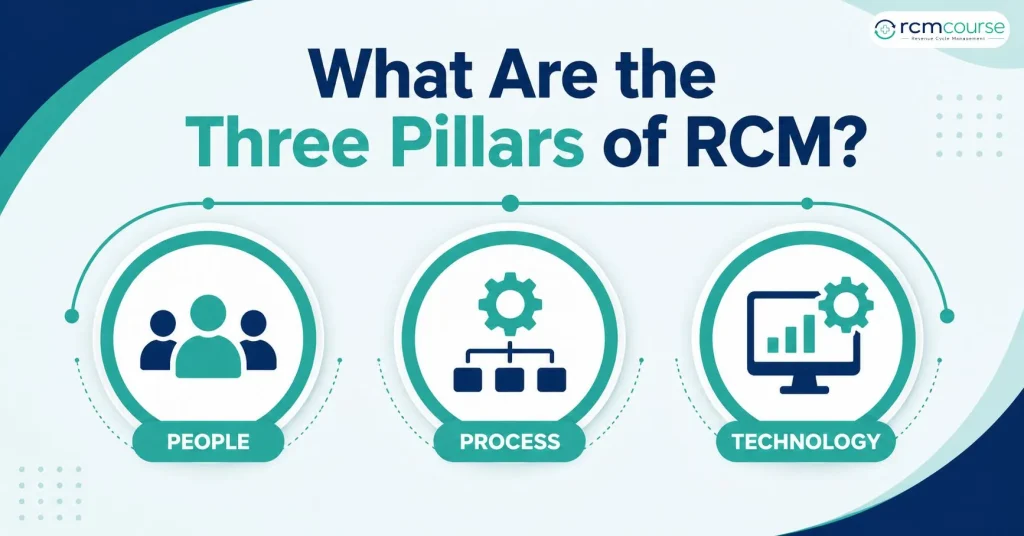
Ask any RCM leader what makes the difference between a revenue cycle that works and one that constantly leaks money, and the answer converges on the same three pillars: people, process, and technology.
- People: Skilled registration staff, coders, billers, and denial specialists are the ones who catch errors before they become denials. Human capital is often the most valuable, and most underinvested, asset in healthcare revenue cycle operations, as Cavanaugh & Co.’s analysis of RCM success factors notes.
- Process: Standardised, well-documented workflows for eligibility checks, charge capture, and follow-up reduce variation and prevent the same mistakes from being repeated across different staff or shifts.
- Technology: Automated billing and claims systems, revenue forecasting analytics, and EHRs that integrate seamlessly with billing software reduce administrative burden and improve accuracy, according to BDO’s three-pillar framework.
None of these pillars works in isolation. The best software cannot fix a broken front-desk process, and the best-trained staff cannot overcome a system that does not communicate with the payer’s clearing house.
A newer framework that some analysts use in 2026 divides the cycle itself into three operational phases: front-end revenue integrity, mid-cycle clinical precision, and back-end collection velocity. This maps neatly onto the seven steps above, with steps one and two representing the front end, steps three and four the mid-cycle, and steps five through seven the back end.
What Are the 4 Basic Revenue Cycle Activities?
This question actually comes from general accounting and business systems literature rather than healthcare specifically. It is worth clarifying, because the two are often mixed up in search results. In accounting information systems (a framework popularised by textbooks such as Romney and Steinbart’s Accounting Information Systems), the revenue cycle in any business, whether retail, manufacturing, or services, breaks down into four basic activities:
- Sales order entry: Receiving and processing a customer’s order.
- Shipping: Fulfilling and delivering the goods or service.
- Billing: Invoicing the customer for what was delivered.
- Cash collections: Receiving and recording payment.
Translate that into healthcare terms, and the mapping is fairly direct: sales order entry becomes scheduling and registration, shipping becomes the actual delivery of care, billing becomes coding and claim submission, and cash collections become remittance processing plus patient collections.
If you are studying for an accounting or health information management course and see “the four basic revenue cycle activities”, this is the framework being referenced.” on an exam, this general business framework, not the healthcare-specific 7-step model, is almost always what’s being tested.
Why Does RCM Matter for Healthcare Organizations?
Hospital margins have been under sustained pressure. Recent industry data cited by Medical Billers and Coders shows median hospital operating margins hovering below 3%, with 40% of hospitals reporting negative margins in early 2026. Against that Against this backdrop, RCM stops being a back-office function and becomes a survival function. A few numbers make the stakes concrete:
- 41% of providers report denial rates exceeding 10%, according to Medical Billers and Coders, meaning a significant share of billed revenue is delayed or lost outright without active follow-up.
- Poor RCM execution can result in 5 to 10% revenue leakage, which equates to well over $100,000 a year for a mid-sized practice, according to Aspect Billing Solutions.
- Administrative costs represent a major share of total healthcare spending, and much of that burden sits within RCM workflows. That is exactly why automation and AI-assisted coding have gained traction so quickly.
Beyond the balance sheet, RCM directly shapes the patient experience. A patient who receives a clear, accurate estimate before a procedure and a simple, correct bill afterwards is more likely to trust the organisation than one who receives a surprise bill six months later due to a coding error.
What Are the Most Common RCM Challenges, and How Do You Fix Them?
Denials: The single biggest source of revenue leakage. Most denials trace back to eligibility errors, missing prior authorisation, or coding mismatches, all of which are preventable during steps one through four of the cycle. Fix: Front-load verification and pre-authorisation checks, and route denials into a dedicated follow-up queue instead of allowing them to age in a general worklist.
Staffing shortages: Experienced coders and billers are difficult to hire and retain, and staff turnover creates knowledge gaps that appear as errors. Fix: Pair automation (claim scrubbing and AI-assisted coding suggestions) with cross-training, so the process remains resilient despite individual staff turnover.
Fragmented systems: When the EHR, practice management system, and clearing house do not communicate effectively with each other, data has to be re-entered manually, and every re-entry point creates an opportunity for errors to occur. Fix: Prioritise integration and interoperability when selecting or upgrading RCM technology, rather than treating them as optional features.
Patient collections: With more costs shifted to high-deductible health plans, patient responsibility has become one of the largest and slowest-to-collect categories of receivables. Fix: Provide patients with upfront cost estimates and flexible payment plans instead of sending a single lump-sum bill after the service has been provided.
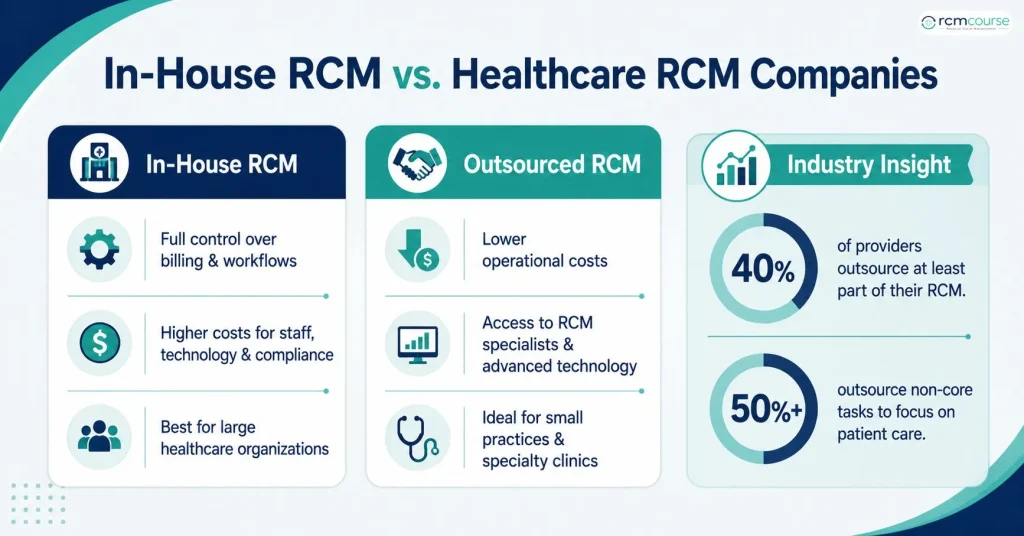
In-House RCM vs. Healthcare RCM Companies: Which Should You Choose?
Managing RCM entirely in-house gives an organisation full control over staffing, workflows, and patient communication, but it also requires ongoing investment in training, software, and compliance updates. Outsourcing to a dedicated healthcare RCM company shifts that responsibility to a specialist vendor, which can be a good fit for smaller practices without the scale to build a complete RCM department internally.
Roughly 40% of healthcare providers now outsource at least some RCM functions, primarily to reduce operational expenses, and more than half of surveyed providers are outsourcing non-core functions specifically so internal teams can focus on clinical care, according to figures reported by Medical Billers and Coders. The decision usually comes down to scale. Larger health systems tend to keep RCM in-house because they can spread technology and staffing investments across a large claim volume, while smaller practices and specialist clinics more often find a vendor relationship more cost-effective per claim processed.
Whichever path you choose, the same three pillars still apply. A vendor with weak process discipline or a limited technology stack will leak revenue just as easily as an under-resourced in-house team.
How Do You Build a Career in Healthcare RCM?
RCM is one of the more stable and in-demand career paths in healthcare administration, and it does not always require a clinical background. Common entry points include medical billing, medical coding, patient access and registration, and denial management roles. From there, certifications help formalise expertise and open the door to higher-level positions:
- Certified Revenue Cycle Representative (CRCR): A widely recognised entry-to-mid-level credential focused on revenue cycle fundamentals.
- Certified Professional Coder (CPC): The standard credential for medical coding roles, issued by AAPC.
- Certified Healthcare Financial Professional (CHFP): Geared towards those moving into RCM leadership and healthcare finance management.
None of these require a clinical licence, which is part of why RCM attracts people from accounting, business administration, and health information management backgrounds, as well as clinical staff transitioning into administrative roles.
Conclusion
Revenue cycle management tracks the full financial journey of a patient encounter, from the moment a visit is scheduled to the moment the balance is paid in full. The process runs through seven core steps: pre-registration, registration and insurance verification, charge capture, medical coding, claim submission, remittance processing and follow-up, and finally patient collections.
Behind those steps sit three pillars that determine whether the whole system holds up: people, process, and technology. Each one is capable of undermining the other two if it is neglected. It is also worth remembering that the “four basic revenue cycle activities” you may see referenced elsewhere (order entry, shipping, billing, and cash collections) come from general accounting literature rather than healthcare specifically, so do not confuse them with the seven-step clinical model above. Looking ahead, denials, staffing gaps, fragmented systems, and rising patient financial responsibility remain the biggest challenges providers face, but each one has a practical, process-level solution available today.
If you are evaluating your own organisation’s revenue cycle, the best place to start is by reviewing your denial rate and days in A/R for the last quarter. Those two numbers alone will tell you which of the seven steps requires attention first. From there, download our free RCM denial rate benchmarking worksheet to see how your numbers compare against practices of a similar size, and use it to identify which step is costing you the most revenue. Once you have completed that assessment, the natural next read in this series is “How to Reduce Claim Denials in Medical Billing,” which walks step by step through building the denial prevention workflow that this guide only summarises above.
Revenue Cycle Management (RCM) is the complete financial process a healthcare practice runs every time it sees a patient, from the moment an appointment is booked to the moment the balance is paid in full.
It has 13 distinct steps: pre-registration, registration, insurance verification, the patient encounter, medical coding, charge capture, claim submission, claim adjudication, payment posting, denials management, patient billing, accounts receivable (AR) follow-up, and collections.
Miss or mishandle any one of these steps, and the effect ripples forward. A wrong insurance ID at registration becomes a denied claim two weeks later, and a denied claim that is not worked becomes unpaid AR that may never be collected.
That is why practices that treat RCM as a single connected system, rather than a series of separate departments working independently, consistently collect more of what they are owed and collect it faster.
This guide explains all 13 steps in Revenue Cycle Management, highlights where healthcare practices commonly experience revenue leakage, and answers key questions about how each component works together, including the “3 Ps” framework used by RCM teams to optimise operations.
Table of Contents
What Is Revenue Cycle Management?
Revenue Cycle Management is the end-to-end process healthcare providers use to track a patient’s care journey from scheduling through to final payment, covering every administrative and clinical step that determines whether, and how much, the provider is reimbursed.
RCM spans front-office activities (such as scheduling and insurance verification), clinical documentation processes (including medical coding), and back-office financial operations (such as billing and collections).
RCM exists because, in the UK healthcare system, receiving payment is never automatic. It must be achieved through accurate documentation, correct coding, timely claim submission, and persistent follow-up with payers.
How Many Steps Are There in the Revenue Cycle?
The number of steps commonly cited for the revenue cycle ranges from 7 to 13, depending on how granular the source breaks it down. Some models combine registration and insurance verification into one step, or fold payment posting and denials management into a single “remittance processing” stage.
The 13-step version in this guide separates each distinct task so nothing gets lost, but the underlying process, schedule, verify, treat, code, bill, collect, is the same regardless of how many stages it is split into.
13 steps in Revenue Cycle Management : A Complete Process Breakdown
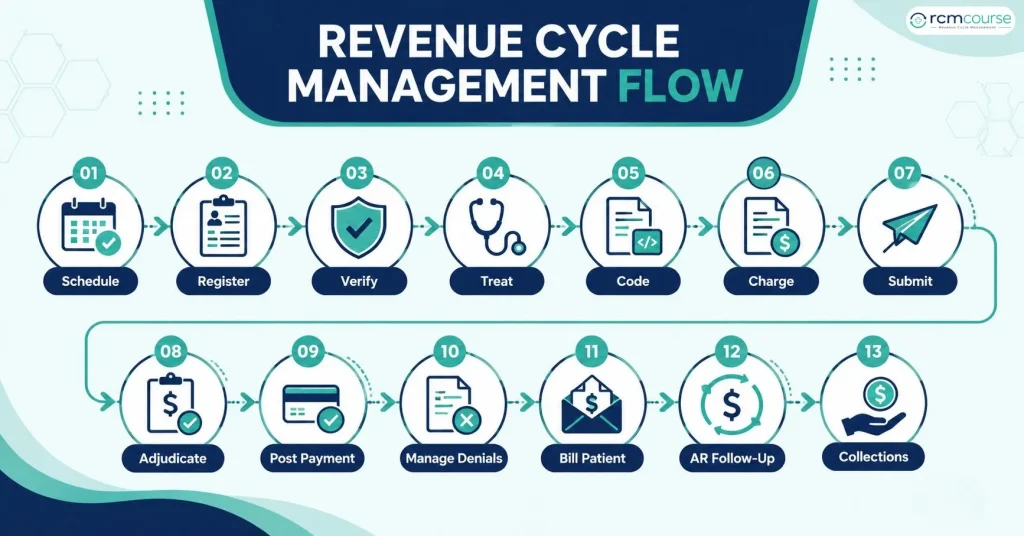
The revenue cycle runs in three broad phases: front-end (before care), mid-cycle (during and immediately after care), and back-end (after the claim is filed), made up of the 13 steps below.
1. Pre-Registration & Scheduling
The cycle starts before the patient ever walks in. When a patient books an appointment, staff collect basic demographic details and initial insurance information. Getting this step right matters more than it looks, since a misspelled name or an outdated insurance ID entered here can travel through the entire cycle and surface as a denial months later.
2. Registration
At check-in, staff formally verify the patient’s identity and insurance details against what was collected during scheduling. This is the practice’s last chance to catch a data error before it becomes a billing problem, so many high-performing practices treat registration accuracy as a tracked KPI, not just a front-desk task.
3. Insurance Verification
The practice contacts the payer directly to confirm active coverage, deductible and copay amounts, and to secure any prior authorisation the treatment requires. Skipping or rushing this step is one of the single biggest drivers of denied claims, because “the patient has insurance” and “the insurance covers this specific service” are two very different facts.
4. Encounter (Point of Service)
Care is delivered, and administrative staff typically collect the patient’s copayment at this point. Collecting at the point of service, rather than billing for it later, is consistently the cheapest and fastest way to collect patient-owed money, since post-visit collection rates drop the longer a balance sits unpaid.
5. Medical Coding
Certified coders (or the provider, depending on practice size) translate the clinical documentation from the visit into standardised CPT and ICD-10 codes. These codes are the language payers use to decide medical necessity and reimbursement, so coding accuracy directly determines whether a claim gets paid the first time or bounces back as a denial.
6. Charge Capture
The practice attaches the correct fee schedule to each code generated during coding, converting clinical documentation into a billable claim. This step can run automatically through EHR-integrated systems or manually through front-desk entry. Automated charge capture generally catches more of the ancillary services that manual processes tend to miss.
7. Claim Submission
The completed claim, including codes, patient data, and charges, is compiled and sent to the payer, usually through a clearinghouse that scrubs it for errors first. Claim scrubbing at this stage catches formatting and coding mismatches before the payer ever sees them, which is why practices that invest in scrubbing tools tend to see meaningfully higher first-pass acceptance rates.
8. Claim Processing & Adjudication
The payer reviews the claim to confirm the services rendered were covered and medically necessary under the patient’s plan. This is where the payer makes its call: approve, partially approve, or deny, and the outcome depends heavily on how clean the claim was going in.
9. Payment Posting
Once the payer approves the claim, the payment is posted to the patient’s account, and the payer issues an Explanation of Benefits (EOB) or Electronic Remittance Advice (ERA). Reconciling posted payments against the original claim promptly is what surfaces underpayments, amounts a payer approved but paid less than the contracted rate, before they’re written off unnoticed.
10. Denials Management
If the payer rejects the claim, the practice has to identify exactly why, correct the underlying issue, and either appeal or resubmit. Denials management is the step where revenue actually gets recovered rather than just tracked. Practices that route denials by root cause (eligibility, coding, authorisation, timely filing) resolve them far faster than those that work denials one by one as they arrive.
11. Patient Billing
Once insurance has paid its share, the practice bills the patient directly for the remaining balance, whether that’s deductibles, coinsurance, or non-covered services. Clear, itemised statements and multiple payment options (portal, text-to-pay, payment plans) consistently improve how much of this balance actually gets collected.
12. Accounts Receivable (AR) Follow-Up
Staff track every unpaid claim, contact payers for status updates, and keep pressure on ageing balances so cash flow stays steady. Most practices measure this with “days in AR,” the average time it takes a claim to convert to cash, and it’s one of the clearest single indicators of how healthy the overall revenue cycle is.
13. Collections & Final Resolution
Patient balances that go unpaid after final notices move into collections, either handled in-house or handed to a third-party agency. This is the last stage of the cycle, and practices that keep it small, rather than a routine destination for unpaid balances, are usually the ones getting steps 1 through 12 right upstream.
What Are the 3 P’s of Revenue Cycle Management?
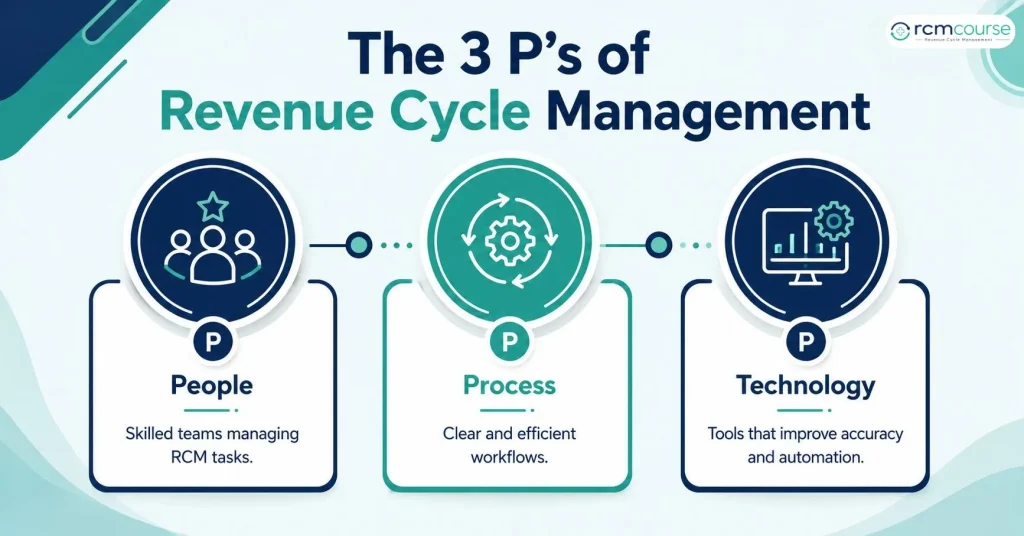
The 3 P’s of RCM are People, Process, and Technology, the three levers that determine how well the 13 steps above actually perform in practice. Skilled staff (people) follow defined, repeatable workflows (process) supported by billing and EHR systems (technology); RCM vendors increasingly differ in how they blend these three, with some leaning towards pure technology automation and others towards business process outsourcing.
In practice, the strongest results come from combining all three rather than over-relying on any single one. Technology alone cannot fix a bad process, and a great process without the right staff to run it stalls out just as quickly.
How Do the 13 Steps Group Into Front-End, Mid-Cycle, and Back-End RCM?
Most RCM software and staffing models organise the 13 steps into three functional groups instead of treating them as one long list:
Front-end (steps 1 to 4): Pre-registration, registration, insurance verification, and the encounter, covering everything that happens before or during the visit.
Mid-cycle (steps 5 to 7): Coding, charge capture, and claim submission, turning the visit into a billable, submitted claim.
Back-end (steps 8 to 13): Adjudication through collections, covering everything that determines whether and when the practice actually gets paid.
This grouping matters practically because most denials trace back to front-end errors, even though they do not surface until the back-end. Fixing insurance verification is almost always cheaper and faster than managing denials after the fact.
FAQs
What are the main benefits of Revenue Cycle Management?
The main benefits of Revenue Cycle Management include faster cash flow, fewer claim denials, reduced revenue leakage, lower administrative workload, improved billing compliance, better patient billing transparency, and more efficient healthcare operations.
Which step is most important in RCM?
Every step matters, but accurate registration and insurance verification are critical for preventing downstream claim denials and payment delays.
Why is Revenue Cycle Management important?
RCM helps healthcare providers manage payments, reduce claim errors, and maintain healthy cash flow.
How does RCM reduce claim denials?
It identifies errors in patient information, insurance, authorisation, coding, and documentation before claims are submitted.
Can RCM be automated?
Yes. Technology can automate tasks such as eligibility verification, claim submission, payment posting, and denial tracking.
Final Thoughts
RCM runs in 13 connected steps, grouped into front-end, mid-cycle, and back-end phases, and each phase depends on the accuracy of the one before it. Most claim denials actually originate from front-end errors like registration or eligibility mistakes, even though those errors do not surface until much later at the back-end.
The 3 P’s, People, Process, and Technology, describe the levers that determine how well the cycle performs rather than a separate set of steps to follow. Of all the metrics a practice can track, days in AR and denial rate are the two that most clearly reflect whether a revenue cycle is genuinely healthy.
If you are auditing your own process, start at the front end. Pull your last quarter’s denial reasons and check how many trace back to registration or eligibility errors. That single exercise usually reveals more than a top-to-bottom process rewrite.
Denial rates continue to rise across the healthcare industry, averaging nearly 11.8% in 2026, with more than 40% of providers experiencing denial rates of 10% or higher. For practices relying on a reactive revenue cycle approach, where denials are addressed only after they occur, revenue losses can continue to accumulate month after month.
To optimise Revenue Cycle Management (RCM) for long-term revenue stability, healthcare practices must focus on claims automation, accurate medical coding, and proactive denial management to reduce revenue loss and improve financial performance. These strategies help improve claim accuracy, reduce preventable denials, minimise revenue leakage, and create a more efficient and predictable revenue cycle.
How to Optimise RCM in Medical Billing for Long-Term Revenue Stability requires improving every stage of the revenue cycle, from patient scheduling and insurance verification to medical coding, claim submission, payment posting, and collections. A fragmented workflow, where verification, coding, billing, and collections operate independently without proper coordination, often leads to delayed reimbursements, increased denials, and lost revenue opportunities.
The solution is a connected, end-to-end RCM strategy built around six key areas: improving front-end accuracy, maintaining clean medical coding practices, strengthening denial prevention and management, enhancing patient collections, monitoring essential RCM KPIs, and ensuring compliance with payer guidelines.
This guide explores each optimisation strategy in detail, including practical actions and industry benchmarks that help healthcare practices achieve higher clean claim rates, reduce administrative inefficiencies, and build a more stable and sustainable revenue cycle.
Table of Contents
What Is RCM Optimisation?
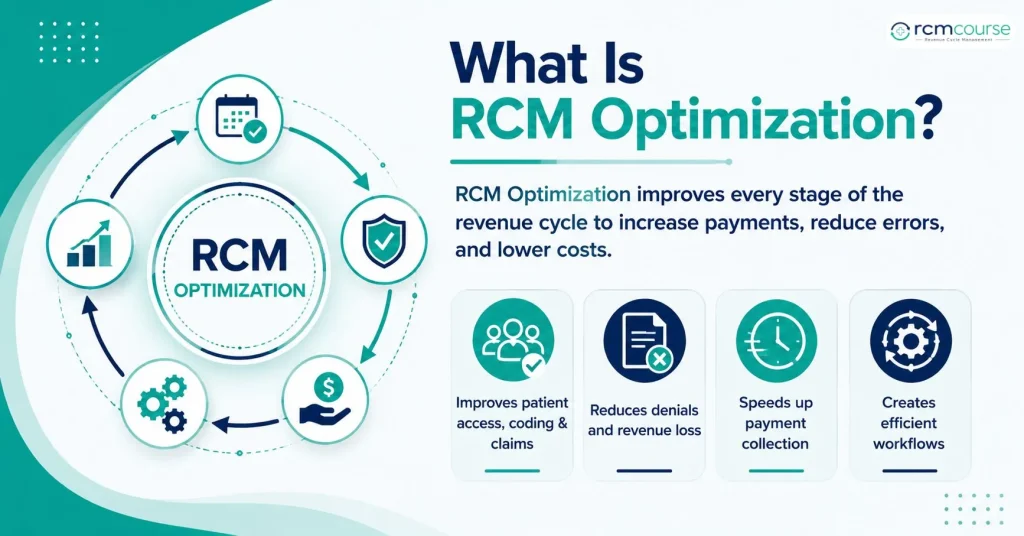
RCM Optimisation is the ongoing process of tightening every stage of the revenue cycle, patient access, coding, claims submission, denial handling, and collections, so more revenue is captured correctly the first time, faster, and at lower cost to collect. It’s not a one-time fix; it’s a discipline of measuring, catching leakage points, and closing them before they become write-offs.
Unlike basic billing, which just processes what’s in front of it, Optimisation treats the revenue cycle as one connected system. A gap in front-end verification doesn’t stay a front-end problem. It shows up three weeks later as a denial, then again as an aged AR bucket nobody wants to touch. Optimising means fixing the system, not just the symptom.
How Do You Optimise the Front End of the Revenue Cycle?

Front-end Optimisation means verifying eligibility, benefits, and patient data before the visit, because a claim built on bad information is denied before it’s ever coded. This single stage prevents the largest share of downstream denials, since eligibility and demographic errors are among the most common, and most preventable, denial causes.
In practice, this looks like:
- Real-time eligibility verification at scheduling and again at check-in, not just once a month.
- A Standardised intake checklist that captures insurance ID, group number, subscriber relationship, and demographics in the same format every time; inconsistent intake is one of the most common sources of rework.
- Prior Authorisation tracking built into scheduling, so a procedure never gets booked without the auth already confirmed or in motion.
- Patient financial Counselling at registration, so cost expectations are set before service, not after the bill arrives.
Practices that move eligibility checks upstream typically see fewer technical rejections within the first billing cycle, because the claim never leaves the building with bad data attached.
Why Does Coding Accuracy Determine Your Reimbursement?
Accurate coding and charge capture ensures every service actually performed gets billed at the correct code, modifier, and charge, because an undercoded or miscoded claim either gets denied or reimburses you for less than you earned. Coding errors and missing documentation remain leading drivers of denials across specialties, with rates commonly running 10 to 18% depending on complexity.
Three practices consistently reduce coding-related revenue loss:
- Charge capture audits run monthly, comparing rendered services against submitted charges to catch missed or duplicate charges.
- Documentation-to-code alignment checks, especially for time-based codes (like Behavioural health CPT codes) where minutes billed must exactly match chart documentation.
- AI-assisted claim scrubbing before submission, which flags code-modifier mismatches, bundling conflicts, and missing NCCI edits before the payer ever sees the claim. This is becoming a growing standard as payers deploy their own AI-driven claim review.
The goal is a clean claim rate above 95%, the percentage of claims accepted on first submission without correction. Every point below that benchmark represents claims that need manual rework, which costs real money: industry estimates put the cost to rework a single denied claim between $25 and $181.
How Do You Build a Denial Management Process That Actually Recovers Revenue?
Robust denial management means treating every denial as a data point, not just a task: Categorising why it happened, fixing the upstream cause, and appealing every recoverable dollar instead of writing it off. Roughly three in four denials on commercial plans stem from administrative or paperwork issues rather than genuine coverage disputes, which means most denials are winnable if someone actually works them.
An effective denial workflow has four parts:
- Categorise on receipt. Split denials into eligibility, Authorisation, coding, timely filing, and medical necessity buckets so patterns are visible immediately, not after a quarter of guessing.
- Root-cause the top three categories monthly and route the fix upstream (retrain front-desk staff, adjust a coding rule, tighten prior-auth scheduling) rather than just resubmitting and hoping.
- Appeal systematically, with templated, evidence-backed appeal letters for the most common denial reasons. Don’t let appeal writing depend on whoever has time that day.
- Track denial recovery rate as its own KPI, separate from the initial denial rate, since a high denial rate with strong recovery is a very different problem than a high denial rate with poor recovery.
Practices that build this loop instead of treating denials as one-off fires routinely bring denial rates down from the double digits toward the 5% benchmark that HFMA and MGMA data associate with well-run revenue cycles, without adding headcount, because the fixes happen upstream instead of in an ever-growing rework queue.
How Should You Streamline Patient Collections?
Streamlining patient collections means collecting the patient’s portion, Co-payments, deductibles, coinsurance, as early and as easily as possible, because patient responsibility is now the third-largest payer category behind Medicare and Medicaid, and it’s the hardest balance to collect once the patient has left the building.
The highest-leverage changes here:
- Collect at point of service using real-time benefit estimates, not after a statement mails weeks later.
- Offer multiple payment channels, including text-to-pay, card-on-file, and payment plans, since friction at payment is friction against collection.
- Send clear, jargon-free statements that explain what’s owed and why; confusing statements drive calls, disputes, and non-payment far more than the actual balance size.
- Set a firm but reasonable follow-up cadence for Ageing patient balances, rather than letting them drift silently into bad debt.
Patient collection rate doesn’t have one universal industry benchmark the way clean claim rate does, since it depends heavily on payer mix and deductible structure, but tracking it consistently, cohort over cohort, shows you whether your process is improving or leaking.
Which KPIs Actually Tell You the Revenue Cycle Is Healthy?
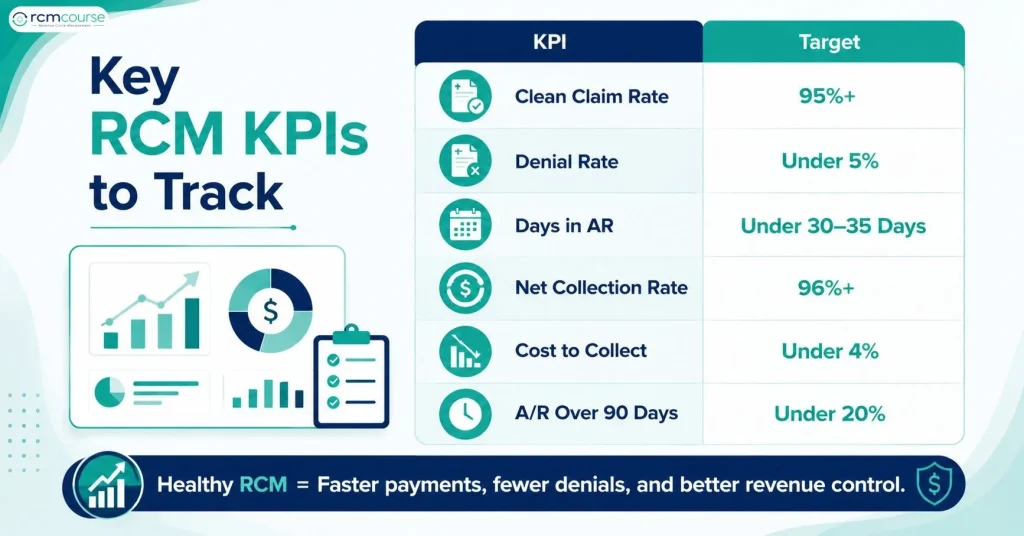
The core RCM KPIs to monitor are clean claim rate, denial rate, days in accounts receivable (AR), net collection rate, and cost to collect. Together they show whether revenue is moving through the cycle quickly, accurately, and completely. Track these five first before expanding to a fuller dashboard.
| KPI | What It Measures | 2026 Benchmark |
|---|---|---|
| Clean claim rate | % of claims accepted on first submission | 95%+ |
| Denial rate | % of claims denied by payers | Under 5% |
| Days in AR | Average days to collect after service | Under 30 to 35 days |
| Net collection rate | % of collectible revenue actually collected | 96%+ |
| Cost to collect | Cost of collections as % of net revenue | Under 4% |
| A/R over 90 days | % of receivables aged past 90 days | Under 20% |
A few practical notes on reading these together: a good average Days in AR number can hide a bad tail. A 35-day blended average can mask a portfolio where a third of claims are stuck past 100 days, so always pair Days in AR with the A/R-over-90-days figure. And net collection rate, not gross collection rate, is the number that reflects true performance, since gross collection rate is distorted by fee-schedule differences across payers.
Set up dashboards on three cadences: daily (rejections, point-of-service collections, eligibility failures, which need same-day action), weekly (denial trends, AR Ageing movement, charge lag), and monthly (the five core KPIs against benchmark, with any miss triggering a root-cause review that month, not next quarter).
How Do You Stay Compliant with Payer Guidelines Without Slowing Down Billing?
Staying compliant means building payer-specific rules, timely filing windows, prior-auth requirements, bundling edits, modifier rules, directly into your claim-scrubbing workflow, so compliance is checked automatically instead of relying on staff memory across dozens of payer contracts. Payer rules also change faster than most billing teams can manually track, and 2026 has brought tighter NCCI bundling edits and revised prior-Authorisation policies across several payer categories.
To keep compliance from becoming a bottleneck:
- Maintain a living payer rules matrix, one reference per payer covering timely filing, auth requirements, and documentation standards, reviewed at least quarterly.
- Build payer-specific edits into your clearinghouse or claim-scrubbing tool, not into a spreadsheet someone has to remember to check.
- Run periodic internal audits against your top payers’ current medical policies, since payer guidance updates without much warning.
- Keep documentation and coding teams looped into payer policy changes in real time, not through word-of-mouth after a denial spike already happened.
Compliance done well doesn’t slow billing down. It prevents the slowdowns caused by denials, appeals, and post-payment audits later.
Frequently Asked Questions
What Is RCM Optimisation?
RCM Optimisation is the continuous process of improving every stage of the revenue cycle, patient access, coding, claims, denials, and collections, to capture more revenue correctly on the first pass, at lower cost, and in less time. It treats the revenue cycle as one connected system rather than a series of separate departmental tasks.
What Are the Three Pillars of RCM?
The three pillars of RCM are front-end operations (patient access, eligibility, Authorisation), mid-cycle operations (coding, charge capture, claims submission), and back-end operations (denial management, payment posting, and collections). Strong RCM requires all three pillars working in sync. A weakness in one pillar shows up as a failure in the next.
How to Optimise RCM in Medical Billing for Long-Term Revenue Stability?
To optimise RCM in medical billing for long-term revenue stability, healthcare practices should strengthen every stage of the revenue cycle, from patient registration and insurance verification to coding, claims, denial management, and collections. A well-optimised RCM strategy reduces denials, prevents revenue leakage, accelerates reimbursements, and improves overall financial performance.
What is Revenue Cycle Management (RCM) in healthcare?
Revenue Cycle Management (RCM) in healthcare is the process of managing all financial activities involved in patient care, including registration, insurance verification, medical coding, claim submission, payment collection, and revenue tracking.
What Are the Key Metrics of RCM?
The key RCM metrics are clean claim rate (target 95%+), denial rate (target under 5%), days in accounts receivable (target under 30 to 35 days), net collection rate (target 96%+), and cost to collect (target under 4% of net revenue). These five give the clearest picture of revenue cycle health and should be reviewed monthly at minimum.
How Do You Optimise Revenue Cycle Management?
You Optimise RCM by tightening front-end verification, ensuring accurate coding and charge capture, building a proactive denial management workflow, streamlining patient collections, tracking core KPIs on a regular cadence, and keeping payer-guideline compliance built into your billing workflow rather than handled manually. Optimisation works best as one connected system, where a fix in one stage reduces the workload in the next.
What are the 13 steps in Revenue Cycle Management?
The 13 steps include scheduling, registration, insurance verification, patient care, coding, charge capture, claim submission, adjudication, payment posting, denials management, patient billing, AR follow-up and collections.
Conclusion
Long-term revenue stability doesn’t come from fixing one broken step in the billing process. It comes from treating the entire revenue cycle as one connected system. That starts with verifying eligibility and capturing complete, accurate patient data before the visit, since most preventable denials trace back to something that went wrong at the front desk.
From there, accurate coding and regular charge capture audits keep you from either losing revenue to undercoding or inviting denials through mismatched documentation, while a proactive denial management process, Categorising, root-causing, and appealing systematically, recovers the revenue that a reactive team would simply write off.
None of this works in isolation, though. Streamlined patient collections matter more each year as patient responsibility grows as a share of total revenue, and none of it can be sustained without discipline: tracking clean claim rate, denial rate, Days in AR, net collection rate, and cost to collect on a regular cadence, and treating any miss against benchmark as something to fix that month, not next quarter.
Built on top of all of it, payer-guideline compliance embedded directly into your workflow, rather than left to staff memory, keeps the whole system from sliding backward every time a payer updates its rules.
If your denial rate or Days in AR is off benchmark right now, the fastest next step isn’t a wholesale overhaul. It’s a 90-day denial audit to find your top three root causes, and building the fix around those first.

