Medical Billing vs Revenue Cycle Management: What’s the Difference?
Marcus Aurelius
08-26-2026

Understanding the difference between Medical Billing vs Revenue Cycle Management is essential for healthcare organisations that want to improve financial performance, reduce claim issues, and maintain a smooth payment process.
Although these terms are often used interchangeably, they represent different parts of the healthcare revenue process. Medical billing focuses on coding, submitting, and tracking insurance claims, while Revenue Cycle Management (RCM) covers the entire financial journey of a patient account, from scheduling through final payment collection.
Medical billing plays a vital role in ensuring healthcare providers receive accurate reimbursement for services delivered. However, it only represents one stage of the wider revenue cycle.
RCM takes a broader approach by managing every financial touchpoint, including patient registration, insurance verification, prior authorisation, claims processing, denial management, collections, and performance analytics.
Understanding how these two functions work together helps healthcare organisations identify inefficiencies, prevent revenue loss, and improve overall financial health.
What Is Medical Billing?
Medical billing is the process of translating a documented healthcare service into a claim, submitting that claim to a payer, and collecting the resulting payment from the insurer and the patient.
It sits downstream of the clinical visit — the appointment has already happened, and the job now is to get paid accurately and quickly for it.
Think of medical billing as the transactional engine of a healthcare practice. A biller doesn’t decide whether a patient is eligible for a service or whether prior authorization was obtained — that happens earlier in the cycle.
Instead, a biller works with what’s already documented: the diagnosis, the procedure, and the payer rules that determine reimbursement.
What Does the Medical Billing Process Include?
The medical billing process includes coding, claim submission, claim tracking, payment posting, and patient billing — the steps needed to convert a completed visit into collected revenue.
Each step depends on accuracy in the one before it, so an error in coding ripples all the way through to a denied claim weeks later.
- Medical coding using ICD-10 and CPT. Diagnoses are translated into ICD-10 codes and procedures into CPT (or HCPCS) codes, forming the backbone of every claim.
- Claim creation and submission. The biller compiles coded data, patient demographics, and payer information into a clean claim and submits it — usually electronically through a clearinghouse.
- Claim tracking and follow-up. Claims are monitored for acceptance, rejection, or denial, with billers following up on anything stuck in the payer’s system.
- Payment posting. Payments and adjustments from insurers (and patients) are recorded against the correct account and claim line.
- Patient billing. Once insurance has paid its portion, the remaining balance is billed directly to the patient.
- Handling unpaid balances. Overdue patient balances move into statements, reminders, and — eventually — collections.
What Is Revenue Cycle Management in Medical Billing?
Revenue cycle management is the complete administrative and financial process that tracks a patient’s account from the first scheduled appointment through final payment — covering everything that happens before, during, and after the clinical visit. Where billing starts once a service is documented, RCM starts the moment a patient calls to book.
That earlier starting point matters. A large share of denied claims trace back to problems that occur before a claim is ever created — an unverified eligibility status, a missing prior authorization, or an incorrect patient ID captured at check-in.
RCM exists to catch those issues upstream, which is why it’s best understood as the framework billing operates inside of, not a separate competing process.
What Does the Revenue Cycle Management Process Include?
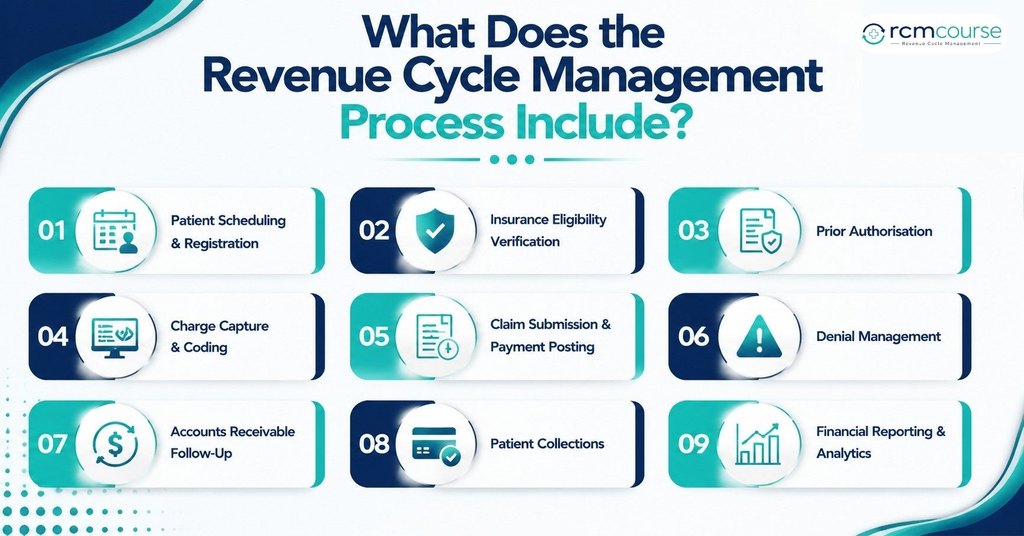
The RCM process includes every administrative and financial touchpoint tied to a patient account, from scheduling through final collections and reporting. It spans front-office, mid-cycle, and back-office functions that billing alone doesn’t cover.
- Patient scheduling and registration — capturing accurate demographic and insurance information at the first point of contact.
- Insurance eligibility verification — confirming active coverage and benefits before the visit occurs.
- Prior authorization — securing payer approval for services that require it, ahead of time.
- Charge capture and coding — documenting and coding the services actually rendered.
- Claim submission — the same core function found in medical billing, but managed as one stage among many.
- Payment posting — recording insurer and patient payments against the account.
- Denial management — identifying, correcting, and appealing denied claims, and tracking why they happened.
- Accounts receivable (AR) follow-up — actively working aged, unpaid claims until they’re resolved.
- Patient collections — managing patient-owed balances, payment plans, and financial communication.
- Financial reporting and analytics — measuring KPIs like clean claim rate, days in AR, and denial rate to improve performance over time.
Medical Billing vs Revenue Cycle Management: What Are the Key Differences?
The clearest way to see the difference is side by side. Billing is a subset of activities focused on claims and payment; RCM is the operating system those activities run inside of.
| Comparison | Medical Billing | Revenue Cycle Management |
| Scope | Specific billing activities | Entire financial lifecycle |
| Starting Point | Usually after services are documented | Before the patient visit |
| Main Focus | Claims and payments | Financial performance |
| Insurance Verification | Limited/not core | Core function |
| Claim Submission | Yes | Yes |
| Denial Management | Mainly resolving individual denials | Resolving and preventing denials |
| Analytics | Limited | Extensive KPI and financial analysis |
| Patient Collections | Yes | Managed across the full cycle |
What Are the Main Responsibilities of Medical Billing?

Medical billing involves accurate coding and charge entry, timely claims submission and tracking, and precise payment posting and patient billing to keep the revenue cycle moving efficiently.
1. Medical Coding and Charge Entry
Billers (often working alongside dedicated coders) are responsible for translating clinical documentation into accurate ICD-10 and CPT codes and entering the corresponding charges.
Getting this step right the first time is the single biggest lever for reducing downstream denials, since a mismatched or unsupported code is one of the most common rejection reasons payers cite.
2. Claims Submission and Tracking
Once coded, claims are prepared, formatted to payer specifications, and submitted — typically through a clearinghouse that scrubs the claim for errors before it reaches the payer.
Billers then monitor claim status, flagging anything that stalls or bounces back so it can be corrected and resubmitted quickly.
3. Payment Posting and Patient Billing
After a payer adjudicates a claim, billers post the payment, apply any contractual adjustments, and calculate what’s left for the patient to pay.
That remaining balance moves to patient statements, and any amount that goes unpaid past a defined window is escalated toward collections.
What Are the Main Responsibilities of Revenue Cycle Management?

Revenue Cycle Management covers patient registration, financial clearance, claims and AR management, and denial prevention to optimise the healthcare organisation’s revenue flow.
1. Patient Registration and Insurance Eligibility
RCM begins with getting patient demographic and insurance details right at the very first touchpoint, then verifying eligibility and benefits before the appointment happens.
A single incorrect digit in a policy number at registration can cause a denial weeks later — which is exactly the kind of failure RCM is built to prevent.
2. Prior Authorization and Financial Clearance
Certain procedures require payer sign-off before they’re performed, and RCM teams are responsible for securing that approval ahead of time.
This stage also covers financial clearance — making sure the patient understands their expected out-of-pocket responsibility before care is delivered, which reduces billing surprises and bad debt later.
3. Claims, Payments and Accounts Receivable
RCM owns the same claims and payment posting functions found in billing, but places them inside a continuous AR management process.
Instead of treating each claim as a one-off transaction, RCM teams actively monitor aging accounts receivable and work unpaid claims until they’re resolved — not just submitted.
4. Denial Management and Prevention
RCM treats denials as a data problem, not just a paperwork problem. Beyond correcting and resubmitting individual denied claims, RCM teams analyze denial patterns by payer, code, and root cause, then feed those insights back into front-end processes to prevent the same denial from happening again.
Revenue Cycle Analytics
RCM relies on a defined set of KPIs to measure financial health and catch problems early, including:
- Clean claim rate — the percentage of claims accepted on first submission without correction.
- Days in AR — the average number of days it takes to collect payment after a claim is submitted.
- Denial rate — the percentage of claims denied by payers.
- Collection performance — how much of billed, allowable revenue is actually collected.
How Do Medical Billing and Revenue Cycle Management Work Together?
Medical billing is the engine inside the larger RCM machine — RCM sets up the conditions for a clean claim, and billing executes the claims-and-payment step at the center of that process.
Neither functions well in isolation: RCM without strong billing execution still leaves money on the table, and billing without RCM’s upstream checks means chasing preventable denials indefinitely.
The relationship typically flows like this:
Patient Scheduling → Eligibility → Treatment → Coding → Medical Billing → Payment → Denial/AR Follow-up → Analytics
Framed this way, billing isn’t a standalone department bolted onto the practice — it’s one stage in a connected loop where each stage’s output becomes the next stage’s input, and the analytics stage feeds insights back to the very first step.
Why Is Revenue Cycle Management Broader Than Medical Billing?
RCM is broader because it manages both revenue generation and revenue collection, while medical billing focuses almost entirely on the collection half.
RCM’s front-end functions — scheduling, eligibility, prior authorization, financial clearance — exist to generate revenue cleanly in the first place, by preventing errors before they can turn into denied or delayed claims.
That upstream focus is what separates the two in practice. Medical billing mainly processes what’s already been documented and tries to collect on it.
RCM asks a different question at every stage: how do we prevent a financial problem before it occurs? It also uses performance data — clean claim rate, denial trends, days in AR — to continuously improve the organization’s overall financial health, not just resolve individual claims.
Medical Billing vs RCM: Which Does a Healthcare Organization Need?
Medical billing and RCM aren’t competing alternatives — a healthcare organization needs both, because one is a necessary function nested inside the other.
Medical billing is essential for the mechanical work of processing claims and getting paid; effective RCM incorporates that billing function alongside the front-end, back-end, and analytical processes that keep the whole financial lifecycle healthy.
In practice, most growing practices don’t choose between “better billing” and “better RCM” — they start by tightening billing accuracy, then expand into full RCM as they realize how many denials and delays originate before a claim is ever created.
Frequently Asked Questions
Is RCM the Same as Medical Billing?
No. RCM is the entire financial lifecycle of a patient account, from scheduling through final payment, while medical billing is one function within that lifecycle — specifically, converting documented services into claims and collecting on them.
Is Billing Part of the Revenue Cycle?
Yes. Medical billing is a core stage within revenue cycle management, sitting between charge capture/coding and payment posting. It couldn’t exist without the earlier RCM stages (registration, eligibility, authorization) feeding it accurate information.
What Is the Difference Between Revenue and Billing?
Revenue refers to the total money a healthcare organization earns for services rendered, while billing is the operational process used to claim and collect that revenue. Revenue is the outcome; billing is one of the mechanisms used to achieve it.
What Is AR in Medical Billing?
AR, or accounts receivable, refers to the money owed to a healthcare organization for services already rendered but not yet paid. In billing and RCM, “days in AR” is a key metric tracking how long it takes on average to collect that outstanding balance.
What Is Denial Management in Medical Billing?
Denial management is the process of identifying why a claim was denied, correcting the underlying issue, and resubmitting or appealing it with the payer. Within full RCM, denial management also includes tracking denial trends to prevent the same errors from recurring.
How does RCM support healthcare billing teams?
RCM supports healthcare billing teams by providing structured processes for managing claims, payments, denials, and financial reporting.
Conclusion
Medical billing and Revenue Cycle Management are closely connected but serve different purposes within the healthcare financial process.
Medical billing focuses on the accurate preparation, submission, and collection of claims, while RCM manages the complete journey of healthcare revenue from the first patient interaction to final payment.
A successful healthcare organisation requires both effective billing practices and strong RCM strategies. While accurate billing ensures claims are processed correctly, comprehensive RCM helps prevent problems before they occur through better registration, eligibility checks, denial prevention, and financial analysis.
By combining both approaches, healthcare providers can improve cash flow, reduce delays, and create a more efficient revenue cycle.

