What Is RCM in Medical Billing? Definition, Role and Benefits
Marcus Aurelius
08-16-2026

Revenue Cycle Management, commonly known as RCM, plays a central role in keeping healthcare billing accurate, efficient and financially sustainable. It connects the administrative and financial activities involved in patient care, from registration and insurance verification to claim submission, payment posting, denial management and final collection.
In medical billing, RCM is the complete financial process used to manage revenue throughout a patient’s journey. Medical billing is only one part of this wider cycle. RCM also focuses on preventing errors before claims are submitted, improving clean claim rates, reducing denials and accelerating reimbursement.
A strong RCM process can help healthcare providers reduce revenue leakage, improve cash flow, minimise administrative rework and create a clearer billing experience for patients.
This guide explains what RCM is in medical billing, how it works, how it differs from traditional medical billing, and why it is important for healthcare organisations.
What Is RCM in Medical Billing?
RCM is the complete financial lifecycle of a patient encounter, covering everything from the moment an appointment is booked to the moment the account is fully paid and closed.
It typically includes:
- Patient registration and scheduling
- Insurance eligibility verification
- Medical coding
- Charge capture
- Claims submission
- Payment posting
- Denial management
- Patient billing and collections
Medical billing sits inside this cycle rather than replacing it. Billing handles the claim itself: coding the service, submitting it to the payer, and processing the payment that comes back. RCM manages everything around that claim too, checking the patient was eligible before treatment even started, and following up on the account long after the claim has been submitted.
Is Medical Billing Part of RCM?
Yes. Medical billing is one component of Revenue Cycle Management. RCM includes billing but also manages the activities that happen before a claim is created and after it is submitted, such as eligibility checks, denial follow-up and patient collections.
6 Ways RCM Improves the Billing Process

RCM improves billing by catching problems at each stage of the cycle rather than waiting for a rejected claim to reveal them. Here is how that plays out in practice.
1. Prevents Errors Before They Happen
Most claim rejections trace back to something that went wrong before treatment was even provided, incorrect patient details, an inactive policy, or a service that needed prior authorisation. RCM verifies insurance and eligibility upfront, so these issues are caught at check-in rather than weeks later when a claim is denied.
2. Boosts Clean Claim Rates
A clean claim is one that gets accepted and paid the first time, with no corrections needed. RCM software scrubs claims automatically before submission, checking for missing information, incorrect codes and payer-specific rule violations. Practices with strong claim scrubbing routinely submit far fewer claims that bounce back.
3. Fixes Denied Claims Faster
When a claim is denied, RCM does not just resubmit it and hope for a different result. It analyses why the claim was rejected, corrects the underlying data, and resubmits with the fix applied. Over time, this also surfaces patterns, if the same payer keeps rejecting the same code, that is a signal to fix the process, not just the individual claim.
4. Speeds Up Payment
Days in accounts receivable (AR) is one of the clearest signs of a healthy revenue cycle. RCM shortens this by following up on unpaid claims persistently instead of letting them sit in a queue. The faster a claim moves from submission to payment, the healthier the practice’s cash flow.
5. Reduces Revenue Leakage
Missed charges, undercoding and claims that simply never get followed up all quietly drain revenue. RCM uses data and reporting to spot these gaps, work that is nearly impossible to do with billing alone, since billing typically only tracks claims that have already been submitted.
6. Improves Patient Trust
Confusing bills and limited payment options frustrate patients and slow down collections. RCM supports clear, itemised statements and easy online payment, which improves the patient’s experience and gets balances paid sooner.
How Is RCM Different From Traditional Medical Billing?
The clearest way to see the difference is side by side.
| Traditional Billing | Revenue Cycle Management |
| Focuses on submitting claims and waiting for payment | Manages the full financial lifecycle, before, during and after treatment |
| Starts after the patient has been treated | Starts at scheduling, with eligibility checks before treatment |
| Reacts to denials as they arrive | Analyses denial patterns to prevent repeat errors |
| Tracks individual transactions | Tracks the overall financial workflow and performance |
| Limited reporting | Uses data analytics to find systemic bottlenecks |
Traditional billing is transactional. It asks: was this claim paid? RCM is operational. It asks: why do claims like this get denied, and what needs to change so it stops happening?
Why Is RCM Important in the Healthcare Industry?
Healthcare organisations run on reimbursement for services already delivered, which makes an efficient revenue cycle a matter of financial survival, not just administrative tidiness.
- Protects revenue. Providers only get paid for care they have already given, so every denied or delayed claim is money already spent that has not come back yet.
- Supports financial stability. Predictable cash flow allows practices to pay staff, maintain equipment and invest in patient care without relying on reserves.
- Reduces administrative waste. Automated eligibility checks and claim scrubbing cut down on the repetitive manual correction work that eats up staff time.
- Supports compliance. Consistent coding and documentation standards reduce the risk of compliance issues with payers and regulators.
- Improves patient experience. Clear communication about costs and easy payment options build trust and reduce disputes.
The RCM Process, Step by Step
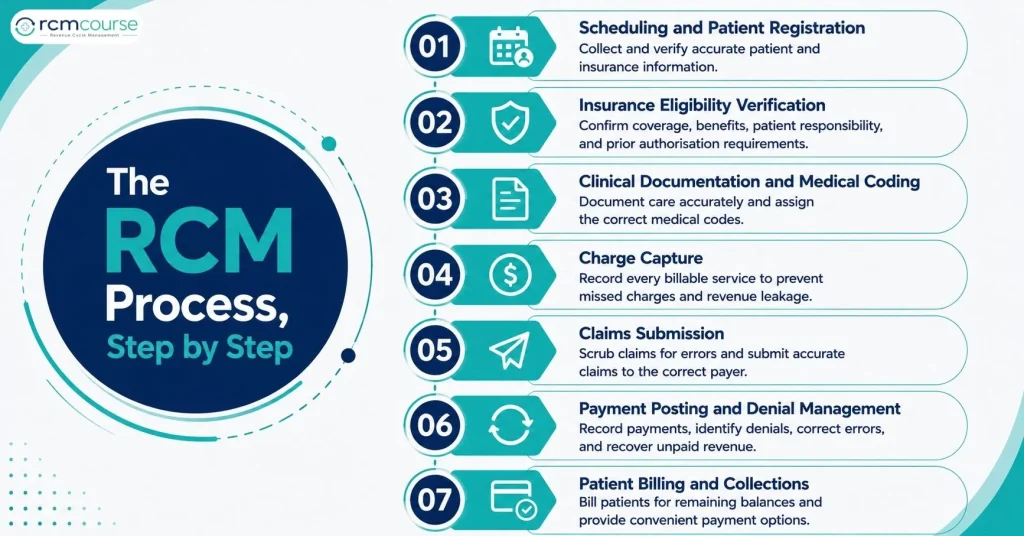
A typical Revenue Cycle Management (RCM) process moves through seven connected stages. Each stage plays an important role in ensuring healthcare providers capture charges accurately, submit clean claims, receive timely reimbursement, and collect any remaining patient balances.
1. Scheduling and Patient Registration
The revenue cycle begins when a patient schedules an appointment and provides their personal and insurance information. Accurate registration is essential because incorrect information can create problems later in the billing process.
During registration, the healthcare provider typically collects and verifies details such as:
- Patient name, date of birth, address, and contact information
- Insurance provider and policy details
- Member and group numbers
- Referring provider information, where required
- Appointment and service details
- Relevant demographic information
Accurate registration reduces the risk of claim rejections caused by incorrect or incomplete patient information. It also creates the foundation for eligibility verification, billing, and claims processing.
2. Insurance Eligibility Verification
Before treatment is provided, the practice verifies whether the patient’s insurance is active and whether the planned service is covered under the patient’s health plan.
Eligibility verification may confirm:
- Whether the insurance policy is active
- Coverage and benefit details
- Copayments and deductibles
- Coinsurance requirements
- Out-of-pocket limits
- Service-specific coverage
- Prior authorisation requirements
Performing these checks before treatment helps prevent unexpected billing problems. For example, if a service requires prior authorisation, the practice can obtain approval before providing the service rather than discovering the issue after the claim has been denied.
3. Clinical Documentation and Medical Coding
After the patient receives care, the healthcare provider documents the services, diagnoses, procedures, and treatments provided. This clinical information is then translated into appropriate medical codes.
Depending on the service and healthcare setting, coding may involve systems such as ICD-10-CM, CPT, and HCPCS Level II.
Accurate coding is essential because these codes communicate to the payer what condition was treated and what services were provided. Incorrect, incomplete, or unsupported coding can result in claim rejections, denials, payment delays, or compliance issues.
4. Charge Capture
Charge capture ensures that every billable service provided to the patient is recorded and included in the billing process.
The practice reviews clinical documentation and other relevant records to identify services that should be billed. These may include consultations, procedures, diagnostic tests, treatments, supplies, or other billable services.
Effective charge capture helps prevent revenue leakage, which occurs when services are provided but the associated charges are missed or incorrectly recorded.
A missed charge may appear small on an individual claim, but repeated missed charges across hundreds or thousands of encounters can create a significant financial impact on a healthcare organisation.
5. Claims Submission
Once patient information, insurance details, documentation, codes, and charges have been reviewed, the claim is prepared for submission to the appropriate payer.
Before submission, many RCM processes use claim scrubbing to identify potential problems, such as:
- Missing patient or insurance information
- Invalid or outdated codes
- Incorrect modifiers
- Coding inconsistencies
- Missing required information
- Payer-specific billing rule violations
Claims that pass these checks are submitted electronically to the payer for processing. Accurate and timely submission helps reduce avoidable rejections and speeds up the reimbursement process.
6. Payment Posting and Denial Management
After the payer processes a claim, the healthcare organisation receives payment and an explanation of how the claim was adjudicated. The payment is posted to the appropriate patient account and matched against the original claim.
If the payer pays less than expected or denies the claim, the billing team investigates the reason.
Denial management may involve:
- Reviewing the denial reason
- Identifying the underlying error
- Correcting patient, coding, or claim information
- Obtaining additional documentation
- Resubmitting the claim
- Filing an appeal when appropriate
- Following up with the payer
Effective denial management helps providers recover revenue that might otherwise remain unpaid or eventually be written off.
7. Patient Billing and Collections
After insurance has processed the claim, any remaining balance that is the patient’s responsibility is transferred to patient billing.
The patient’s balance may include deductibles, copayments, coinsurance, or other amounts not covered by insurance. The provider sends a statement explaining the amount owed and provides available payment methods.
Modern RCM processes may support:
- Online payment portals
- Electronic statements
- Text-to-pay options
- Automated payment reminders
- Payment plans
- Digital receipts
The cycle continues until the outstanding balance is paid, adjusted appropriately, or otherwise resolved according to the provider’s billing and collection policies.
How the Seven Stages Work Together
These seven stages are not independent tasks. They form a connected revenue cycle, meaning an error at one stage can create problems several stages later.
For example, an incorrect insurance policy number during registration can cause an eligibility verification failure. If that issue is not identified before treatment, the resulting claim may later be rejected or denied. The billing team then has to investigate the problem, correct the information, resubmit the claim, and wait for the payer to process it.
This is why effective Revenue Cycle Management in Healthcare focuses on the entire process rather than treating registration, coding, billing, payment posting, and collections as separate functions. The goal is to identify problems as early as possible, maintain accurate information throughout the cycle, and ensure the healthcare provider receives appropriate reimbursement for the services it delivers.
Frequently Asked Questions
What is RCM in medical billing?
RCM, or Revenue Cycle Management, is the process healthcare organisations use to manage the entire financial journey of a patient encounter, from scheduling and eligibility checks through to claims submission and final payment. Medical billing is one part of this broader process.
What is the role of revenue cycle management in medical billing?
RCM’s role is to coordinate everything that affects whether a claim gets paid correctly and on time. This includes verifying eligibility before treatment, scrubbing claims for errors, managing denials, and following up on outstanding balances until the account is resolved.
How do the Steps in Revenue Cycle Management improve healthcare payments?
The Steps in Revenue Cycle Management help maintain accurate billing information, prevent errors, improve claim approval rates, and ensure healthcare providers receive payments efficiently.
How is RCM different from medical billing?
Medical billing focuses narrowly on submitting a claim and processing the payment that comes back. RCM covers the full financial lifecycle, including everything that happens before the claim is created and after it is submitted, using data to spot and fix recurring problems.
Why is revenue cycle management important in the healthcare industry?
RCM protects revenue that has already been earned through delivered care, supports stable cash flow, reduces administrative rework, and improves the patient’s financial experience. Without it, practices lose money to denied claims, slow collections and preventable billing errors.
Conclusion
Revenue Cycle Management provides healthcare organisations with a structured way to manage the entire financial journey of patient care. Rather than focusing only on submitting claims, RCM connects registration, eligibility verification, coding, charge capture, claims processing, payment posting, denial management and patient collections.
A well-managed revenue cycle can prevent errors before claims reach payers, improve clean claim rates, reduce avoidable denials and shorten payment delays. It can also help providers identify missed charges and underpayments while giving patients clearer information about their financial responsibilities.
The key difference is that medical billing is one part of RCM, while RCM manages the complete revenue cycle. When each stage works together effectively, healthcare providers can reduce administrative rework, protect revenue, maintain healthier cash flow and create a smoother billing experience for patients.
Ultimately, understanding what RCM is in medical billing helps explain why successful healthcare billing begins long before a claim is submitted and continues until every account is appropriately resolved.

