How to Optimise RCM in Medical Billing for Long-Term Revenue Stability
Marcus Aurelius
07-27-2026

Denial rates continue to rise across the healthcare industry, averaging nearly 11.8% in 2026, with more than 40% of providers experiencing denial rates of 10% or higher. For practices relying on a reactive revenue cycle approach, where denials are addressed only after they occur, revenue losses can continue to accumulate month after month.
To optimise Revenue Cycle Management (RCM) for long-term revenue stability, healthcare practices must focus on claims automation, accurate medical coding, and proactive denial management to reduce revenue loss and improve financial performance. These strategies help improve claim accuracy, reduce preventable denials, minimise revenue leakage, and create a more efficient and predictable revenue cycle.
How to Optimise RCM in Medical Billing for Long-Term Revenue Stability requires improving every stage of the revenue cycle, from patient scheduling and insurance verification to medical coding, claim submission, payment posting, and collections. A fragmented workflow, where verification, coding, billing, and collections operate independently without proper coordination, often leads to delayed reimbursements, increased denials, and lost revenue opportunities.
The solution is a connected, end-to-end RCM strategy built around six key areas: improving front-end accuracy, maintaining clean medical coding practices, strengthening denial prevention and management, enhancing patient collections, monitoring essential RCM KPIs, and ensuring compliance with payer guidelines.
This guide explores each optimisation strategy in detail, including practical actions and industry benchmarks that help healthcare practices achieve higher clean claim rates, reduce administrative inefficiencies, and build a more stable and sustainable revenue cycle.
Table of Contents
What Is RCM Optimisation?
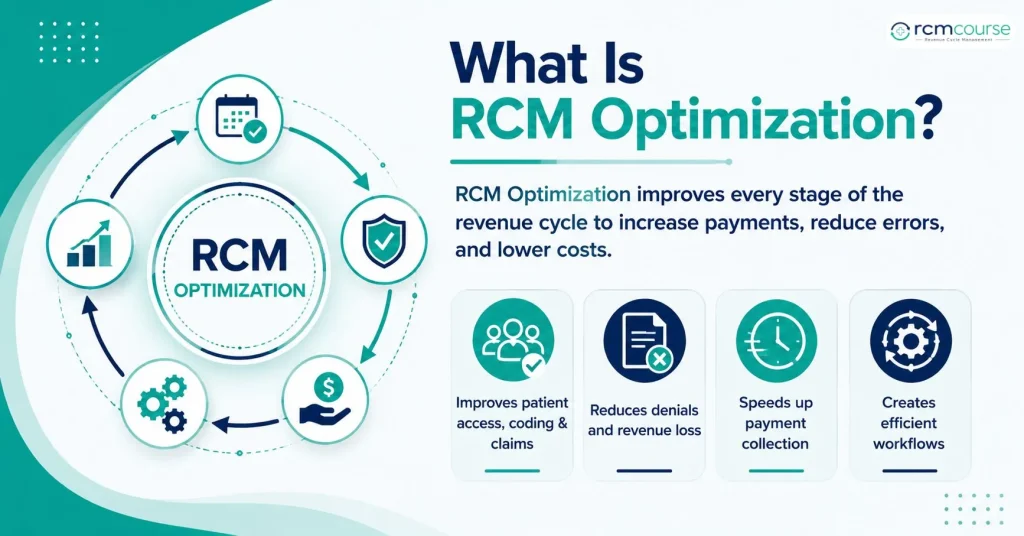
RCM Optimisation is the ongoing process of tightening every stage of the revenue cycle, patient access, coding, claims submission, denial handling, and collections, so more revenue is captured correctly the first time, faster, and at lower cost to collect. It’s not a one-time fix; it’s a discipline of measuring, catching leakage points, and closing them before they become write-offs.
Unlike basic billing, which just processes what’s in front of it, Optimisation treats the revenue cycle as one connected system. A gap in front-end verification doesn’t stay a front-end problem. It shows up three weeks later as a denial, then again as an aged AR bucket nobody wants to touch. Optimising means fixing the system, not just the symptom.
How Do You Optimise the Front End of the Revenue Cycle?

Front-end Optimisation means verifying eligibility, benefits, and patient data before the visit, because a claim built on bad information is denied before it’s ever coded. This single stage prevents the largest share of downstream denials, since eligibility and demographic errors are among the most common, and most preventable, denial causes.
In practice, this looks like:
- Real-time eligibility verification at scheduling and again at check-in, not just once a month.
- A Standardised intake checklist that captures insurance ID, group number, subscriber relationship, and demographics in the same format every time; inconsistent intake is one of the most common sources of rework.
- Prior Authorisation tracking built into scheduling, so a procedure never gets booked without the auth already confirmed or in motion.
- Patient financial Counselling at registration, so cost expectations are set before service, not after the bill arrives.
Practices that move eligibility checks upstream typically see fewer technical rejections within the first billing cycle, because the claim never leaves the building with bad data attached.
Why Does Coding Accuracy Determine Your Reimbursement?
Accurate coding and charge capture ensures every service actually performed gets billed at the correct code, modifier, and charge, because an undercoded or miscoded claim either gets denied or reimburses you for less than you earned. Coding errors and missing documentation remain leading drivers of denials across specialties, with rates commonly running 10 to 18% depending on complexity.
Three practices consistently reduce coding-related revenue loss:
- Charge capture audits run monthly, comparing rendered services against submitted charges to catch missed or duplicate charges.
- Documentation-to-code alignment checks, especially for time-based codes (like Behavioural health CPT codes) where minutes billed must exactly match chart documentation.
- AI-assisted claim scrubbing before submission, which flags code-modifier mismatches, bundling conflicts, and missing NCCI edits before the payer ever sees the claim. This is becoming a growing standard as payers deploy their own AI-driven claim review.
The goal is a clean claim rate above 95%, the percentage of claims accepted on first submission without correction. Every point below that benchmark represents claims that need manual rework, which costs real money: industry estimates put the cost to rework a single denied claim between $25 and $181.
How Do You Build a Denial Management Process That Actually Recovers Revenue?
Robust denial management means treating every denial as a data point, not just a task: Categorising why it happened, fixing the upstream cause, and appealing every recoverable dollar instead of writing it off. Roughly three in four denials on commercial plans stem from administrative or paperwork issues rather than genuine coverage disputes, which means most denials are winnable if someone actually works them.
An effective denial workflow has four parts:
- Categorise on receipt. Split denials into eligibility, Authorisation, coding, timely filing, and medical necessity buckets so patterns are visible immediately, not after a quarter of guessing.
- Root-cause the top three categories monthly and route the fix upstream (retrain front-desk staff, adjust a coding rule, tighten prior-auth scheduling) rather than just resubmitting and hoping.
- Appeal systematically, with templated, evidence-backed appeal letters for the most common denial reasons. Don’t let appeal writing depend on whoever has time that day.
- Track denial recovery rate as its own KPI, separate from the initial denial rate, since a high denial rate with strong recovery is a very different problem than a high denial rate with poor recovery.
Practices that build this loop instead of treating denials as one-off fires routinely bring denial rates down from the double digits toward the 5% benchmark that HFMA and MGMA data associate with well-run revenue cycles, without adding headcount, because the fixes happen upstream instead of in an ever-growing rework queue.
How Should You Streamline Patient Collections?
Streamlining patient collections means collecting the patient’s portion, Co-payments, deductibles, coinsurance, as early and as easily as possible, because patient responsibility is now the third-largest payer category behind Medicare and Medicaid, and it’s the hardest balance to collect once the patient has left the building.
The highest-leverage changes here:
- Collect at point of service using real-time benefit estimates, not after a statement mails weeks later.
- Offer multiple payment channels, including text-to-pay, card-on-file, and payment plans, since friction at payment is friction against collection.
- Send clear, jargon-free statements that explain what’s owed and why; confusing statements drive calls, disputes, and non-payment far more than the actual balance size.
- Set a firm but reasonable follow-up cadence for Ageing patient balances, rather than letting them drift silently into bad debt.
Patient collection rate doesn’t have one universal industry benchmark the way clean claim rate does, since it depends heavily on payer mix and deductible structure, but tracking it consistently, cohort over cohort, shows you whether your process is improving or leaking.
Which KPIs Actually Tell You the Revenue Cycle Is Healthy?
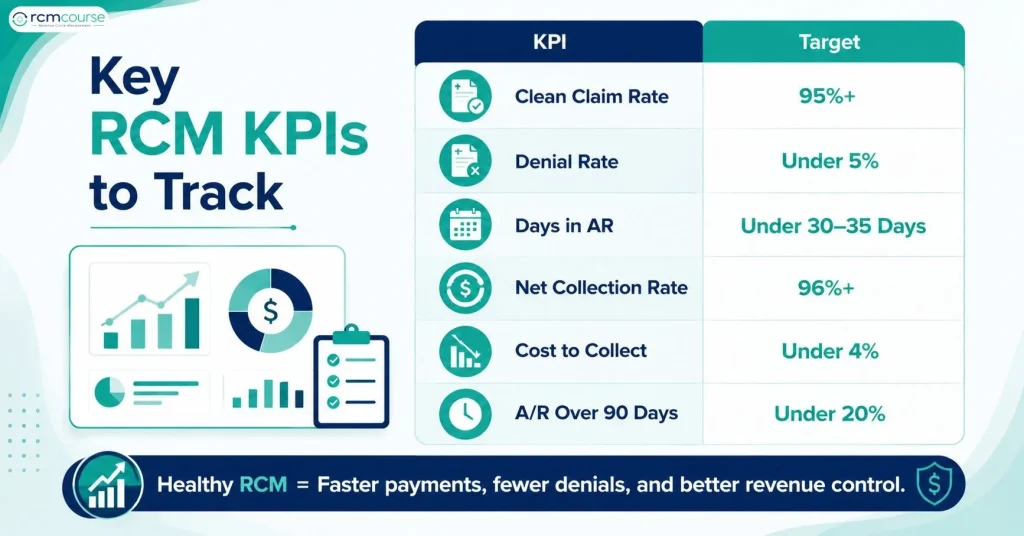
The core RCM KPIs to monitor are clean claim rate, denial rate, days in accounts receivable (AR), net collection rate, and cost to collect. Together they show whether revenue is moving through the cycle quickly, accurately, and completely. Track these five first before expanding to a fuller dashboard.
| KPI | What It Measures | 2026 Benchmark |
|---|---|---|
| Clean claim rate | % of claims accepted on first submission | 95%+ |
| Denial rate | % of claims denied by payers | Under 5% |
| Days in AR | Average days to collect after service | Under 30 to 35 days |
| Net collection rate | % of collectible revenue actually collected | 96%+ |
| Cost to collect | Cost of collections as % of net revenue | Under 4% |
| A/R over 90 days | % of receivables aged past 90 days | Under 20% |
A few practical notes on reading these together: a good average Days in AR number can hide a bad tail. A 35-day blended average can mask a portfolio where a third of claims are stuck past 100 days, so always pair Days in AR with the A/R-over-90-days figure. And net collection rate, not gross collection rate, is the number that reflects true performance, since gross collection rate is distorted by fee-schedule differences across payers.
Set up dashboards on three cadences: daily (rejections, point-of-service collections, eligibility failures, which need same-day action), weekly (denial trends, AR Ageing movement, charge lag), and monthly (the five core KPIs against benchmark, with any miss triggering a root-cause review that month, not next quarter).
How Do You Stay Compliant with Payer Guidelines Without Slowing Down Billing?
Staying compliant means building payer-specific rules, timely filing windows, prior-auth requirements, bundling edits, modifier rules, directly into your claim-scrubbing workflow, so compliance is checked automatically instead of relying on staff memory across dozens of payer contracts. Payer rules also change faster than most billing teams can manually track, and 2026 has brought tighter NCCI bundling edits and revised prior-Authorisation policies across several payer categories.
To keep compliance from becoming a bottleneck:
- Maintain a living payer rules matrix, one reference per payer covering timely filing, auth requirements, and documentation standards, reviewed at least quarterly.
- Build payer-specific edits into your clearinghouse or claim-scrubbing tool, not into a spreadsheet someone has to remember to check.
- Run periodic internal audits against your top payers’ current medical policies, since payer guidance updates without much warning.
- Keep documentation and coding teams looped into payer policy changes in real time, not through word-of-mouth after a denial spike already happened.
Compliance done well doesn’t slow billing down. It prevents the slowdowns caused by denials, appeals, and post-payment audits later.
Frequently Asked Questions
What Is RCM Optimisation?
RCM Optimisation is the continuous process of improving every stage of the revenue cycle, patient access, coding, claims, denials, and collections, to capture more revenue correctly on the first pass, at lower cost, and in less time. It treats the revenue cycle as one connected system rather than a series of separate departmental tasks.
What Are the Three Pillars of RCM?
The three pillars of RCM are front-end operations (patient access, eligibility, Authorisation), mid-cycle operations (coding, charge capture, claims submission), and back-end operations (denial management, payment posting, and collections). Strong RCM requires all three pillars working in sync. A weakness in one pillar shows up as a failure in the next.
How to Optimise RCM in Medical Billing for Long-Term Revenue Stability?
To optimise RCM in medical billing for long-term revenue stability, healthcare practices should strengthen every stage of the revenue cycle, from patient registration and insurance verification to coding, claims, denial management, and collections. A well-optimised RCM strategy reduces denials, prevents revenue leakage, accelerates reimbursements, and improves overall financial performance.
What is Revenue Cycle Management (RCM) in healthcare?
Revenue Cycle Management (RCM) in healthcare is the process of managing all financial activities involved in patient care, including registration, insurance verification, medical coding, claim submission, payment collection, and revenue tracking.
What Are the Key Metrics of RCM?
The key RCM metrics are clean claim rate (target 95%+), denial rate (target under 5%), days in accounts receivable (target under 30 to 35 days), net collection rate (target 96%+), and cost to collect (target under 4% of net revenue). These five give the clearest picture of revenue cycle health and should be reviewed monthly at minimum.
How Do You Optimise Revenue Cycle Management?
You Optimise RCM by tightening front-end verification, ensuring accurate coding and charge capture, building a proactive denial management workflow, streamlining patient collections, tracking core KPIs on a regular cadence, and keeping payer-guideline compliance built into your billing workflow rather than handled manually. Optimisation works best as one connected system, where a fix in one stage reduces the workload in the next.
What are the 13 steps in Revenue Cycle Management?
The 13 steps include scheduling, registration, insurance verification, patient care, coding, charge capture, claim submission, adjudication, payment posting, denials management, patient billing, AR follow-up and collections.
Conclusion
Long-term revenue stability doesn’t come from fixing one broken step in the billing process. It comes from treating the entire revenue cycle as one connected system. That starts with verifying eligibility and capturing complete, accurate patient data before the visit, since most preventable denials trace back to something that went wrong at the front desk.
From there, accurate coding and regular charge capture audits keep you from either losing revenue to undercoding or inviting denials through mismatched documentation, while a proactive denial management process, Categorising, root-causing, and appealing systematically, recovers the revenue that a reactive team would simply write off.
None of this works in isolation, though. Streamlined patient collections matter more each year as patient responsibility grows as a share of total revenue, and none of it can be sustained without discipline: tracking clean claim rate, denial rate, Days in AR, net collection rate, and cost to collect on a regular cadence, and treating any miss against benchmark as something to fix that month, not next quarter.
Built on top of all of it, payer-guideline compliance embedded directly into your workflow, rather than left to staff memory, keeps the whole system from sliding backward every time a payer updates its rules.
If your denial rate or Days in AR is off benchmark right now, the fastest next step isn’t a wholesale overhaul. It’s a 90-day denial audit to find your top three root causes, and building the fix around those first.

